





23 Aug Toilet Waterproofing Cost Singapore: 2026 Price Guide
Toilet waterproofing cost in Singapore splits three ways before anyone quotes: property type, method, and membrane system. HDB restricts tile hacking in new flats for the first three years, which removes one of those methods entirely for some owners. This blog walks you through 2026 ranges by property type and the cost drivers behind them, alongside waterproofing services in Singapore scope.
Proseal Contracts Pte Ltd is a BCA-registered waterproofing specialist and licensed building contractor founded in Singapore in 1999, working under workhead CR13, Waterproofing Installation.
How much does toilet waterproofing cost in Singapore in 2026?
Overlay work runs from around $600 for an HDB common bathroom to $4,500 for a large landed en-suite. Hacking, which includes re-tiling, runs from roughly $2,000 to $14,000 across the same span.
| Property type | Typical area | Overlay method | Hacking method (incl. re-tile) |
| HDB common bathroom | 25 to 35 sqft | $600 to $1,400 | $2,000 to $4,000 |
| HDB master bathroom | 35 to 50 sqft | $900 to $1,800 | $2,800 to $5,000 |
| Condo common bathroom | 30 to 50 sqft | $900 to $2,000 | $2,800 to $5,500 |
| Condo master bathroom | 50 to 90 sqft | $1,500 to $3,200 | $4,000 to $8,500 |
| Landed guest or common | 40 to 70 sqft | $1,200 to $2,600 | $3,500 to $7,000 |
| Landed master or en-suite | 70 to 130 sqft | $2,200 to $4,500 | $6,000 to $14,000 |
Prices indicative for the 2026 Singapore market, drawn from contractor-market observation and Proseal quote history. Assumes a cementitious or hybrid PU system with a 5 to 7 year warranty. Subject to site inspection, substrate condition, access and scope. Hacking figures include waterproofing, re-tiling and basic fixture reinstatement; plumbing works are quoted separately.
The ranges are wide because four variables move independently. Substrate condition decides how much preparation is needed. Access decides how long material and debris take to move. An existing leak decides whether diagnosis has to happen before scope can be set at all. And membrane specification decides both material cost and warranty length.
Treat a quote sitting 30% below the bottom of its range as a specification difference rather than a discount, and ask what changed. In practice the answer is preparation, thickness or the ponding test, in that order.
What are you actually paying for in a bathroom waterproofing quote?
Membrane material is usually 20% to 25% of the total. Everything else is preparation, labour and protection, which is exactly why cut-price quotes cut those and leave the visible membrane alone.
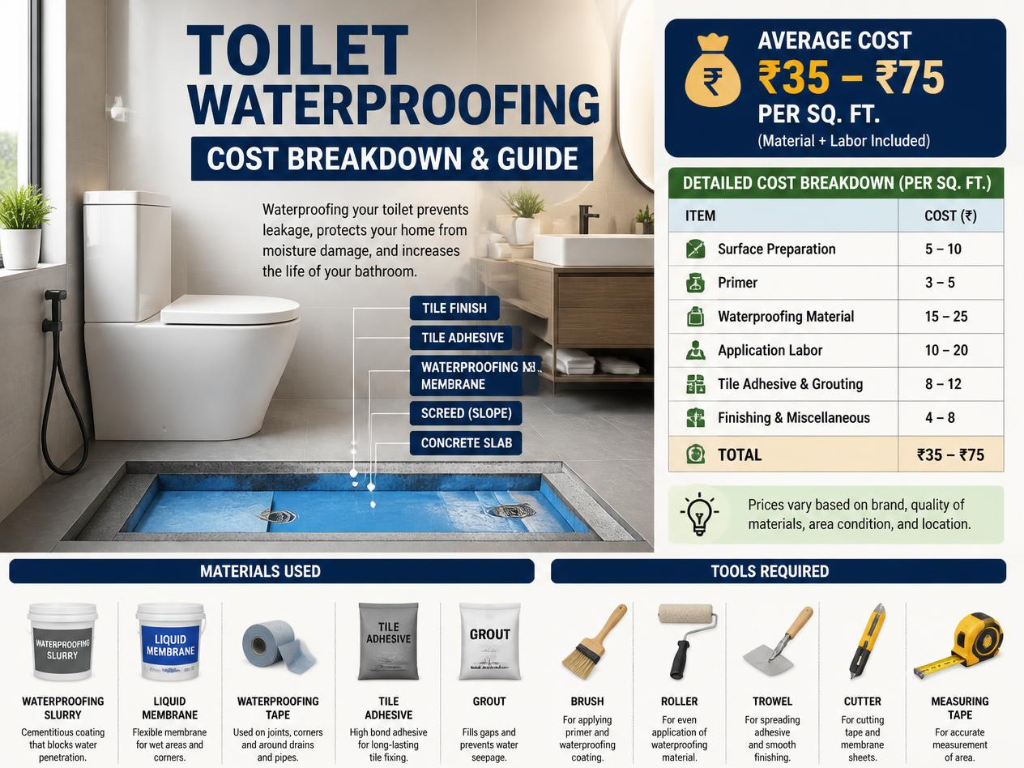
A properly itemised quotation shows surface preparation at roughly 10% to 20% of cost, covering acid etching, grinding or removal of existing coatings. Primer accounts for 3% to 7% where the system requires one. The waterproofing membrane itself, material and labour together, runs 30% to 45%, and brand and dry film thickness drive that line. The protection screed over the membrane adds 10% to 15%. Disposal and haulage account for 3% to 5%, and it is a real cost in an HDB block or a condo with lift restrictions.
Where hacking is involved, re-tiling and fixture reinstatement is the largest single line at 25% to 35%.
The ponding test costs almost nothing in materials and a day in programme, which is precisely why it goes missing. It is also the only step that proves the system works before tiles cover it, so a quotation that omits it is omitting the verification, not a nicety.
Read the percentages as a diagnostic. A quote where the membrane line is 60% of the total has either priced a premium system or, more often, priced no preparation at all.
Overlay or hacking: what is the actual cost difference and when does each apply?
Hacking costs roughly three times overlay for the same bathroom, and it buys a warranty that runs two to three times longer. Overlay applies a new membrane over sound existing tiles after preparation. Hacking removes the tiles, exposes the screed or slab, waterproofs from there, and re-tiles.
| Factor | Overlay | Hacking |
| Downtime | 2 to 4 days | 7 to 14 days |
| Cost, HDB toilet | $600 to $1,800 | $2,000 to $5,000 |
| Typical warranty | 2 to 5 years | 5 to 10 years |
| Suitable when | Tiles sound, no hollowness, no active leak | Active leak, hollow tiles, failed membrane, renovation in progress |
| Risk if chosen wrongly | Membrane will not bond to a degraded substrate and fails within 1 to 2 years | Unnecessary cost and two weeks of disruption |
Contractors decide between them with three checks: a percussion test across the existing tiles to find hollowness, a moisture meter reading, and a visual inspection of grout lines and skirting.
The rule worth holding is this. If water is already reaching the unit below, overlay is almost never right, because the water path sits under the tiles and a surface membrane cannot reach it. Understanding how membranes go down makes that limitation obvious: the system only protects what it can bond to.
What should an HDB owner budget, and what does HDB actually allow?
Budget $600 to $1,400 for an overlay on a common bathroom and $2,800 to $5,000 for a hacking job on a master bathroom. Before you budget for hacking at all, check the age of the block, because HDB may not permit it.
For a new flat, HDB’s renovation guidelines restrict removal of bathroom floor and wall tiles for the first three years from completion. The restriction exists to protect the waterproofing membrane HDB installed and warrants. Hacking inside that window voids that warranty, and unauthorised works expose the owner to a reinstatement order and a fine of up to $5,000. For those owners the hacking column above is not a budget option, and overlay is the compliant route.
Two more rules change how you shop. HDB specifies a minimum 150 mm upturn, meaning the membrane must run 150 mm up the wall from floor level, so a quotation silent on turn-up height cannot be assessed against the rule. And every contractor working in an HDB flat must be listed in HDB’s Directory of Renovation Contractors, with the contractor submitting any permit rather than the owner.
Two HDB-specific cost notes. Owners doing both bathrooms together commonly see 5% to 10% off the second unit, because setup and disposal are already mobilised. And flats built before 2000 often have thinner screed that needs building up before the membrane goes on, which adds $200 to $500.
The expensive mistake is choosing overlay when tiles are already lifting or sounding hollow. The money is spent, the bond fails, and the leak returns inside a year. The signs a wet area is failing are worth checking before you decide which method to price.
What does condo bathroom waterproofing cost, and what drives the difference?
Expect $900 to $2,000 for an overlay on a common bathroom and $4,000 to $8,500 for hacking a master bathroom. Condo pricing runs 5% to 15% above the HDB equivalent for the same scope, and access is the reason rather than the waterproofing itself.
Lift load-in restrictions, protective covering of common areas, deposit requirements and limited working hours all consume programme time that has to be priced. Larger master bathrooms of 50 to 90 square feet raise the per-unit figure while often lowering the per-square-foot rate, because fixed costs spread across more area.
Structure matters more in a condo than owners expect. Pre-cast and post-tensioned slabs change what can be drilled and anchored, and getting that wrong on a post-tensioned slab is a structural problem rather than a waterproofing one. Hacking works in a strata development also frequently need MCST approval, and a competent contractor coordinates that rather than leaving it with you.
Three detail points carry most of the failures: the floor trap, the shower area, and the wall-to-floor junction. A quotation that prices an area without naming those three has priced a surface, not a system. The case for treating this as specialist work rather than a renovation line item is set out in why bathroom waterproofing matters.
What does landed property bathroom waterproofing cost?
Landed pricing has the widest spread of the three: $1,200 to $2,600 for a guest bathroom overlay, and $6,000 to $14,000 for a master bathroom hacking job. Bathroom area ranging from 40 to over 150 square feet explains most of that.
Scope boundaries blur in landed homes. En-suite, dressing area and toilet often function as one connected wet zone and get treated as a single scope, which raises the headline figure while lowering the risk of an untreated junction between them.
Two structural variables are specific to landed property. Ground floor bathrooms sometimes need attention to moisture rising from the soil, which is a different problem from the one above the slab. And bathrooms on the second or third storey sit directly over living space, so the consequential cost of a failure is highest exactly where the warranty terms deserve most attention.
Detailing complexity is the quiet cost driver. Custom showers, freestanding tubs and walk-in wet zones multiply the number of junctions, upstands and terminations, and every one of those is a place the system can fail. Designer tile supplied through the contractor rather than by the client typically adds 10% to 25% to that line.
How is waterproofing cost per square foot calculated in Singapore?
Per square foot runs $15 to $35 for overlay and $80 to $150 for full hacking with standard tiles. The figure is genuinely useful above roughly 50 square feet and misleading below 35.
| Scope | Per sqft | What it includes |
| Overlay only | $15 to $35 | Surface prep, primer, two-coat membrane, ponding test |
| Hacking and waterproofing, no re-tile | $45 to $80 | Above plus tile removal and debris disposal |
| Full hacking, waterproofing and re-tile | $80 to $150 | Above plus tile supply, laying and grouting |
| Full hacking with premium tiles or complex detailing | $150 to $250 and up | Above with designer tile, mosaic or complex junctions |
Fixed costs are why small bathrooms break the model. Travel, setup, testing and disposal do not scale down with area, so a 25 square foot HDB common bath will not cost 25 times the per-square-foot rate. Most contractors apply a minimum charge in the region of $500 to $800, and that minimum is the honest version of the arithmetic.
A contractor quoting strict per-square-foot with no minimum and no site visit has worked backwards from a number you will find attractive. Something has to give to reach it, and it will be the preparation or the membrane thickness, because those are the two lines nobody can inspect once tiles are down.
Do membrane brand and system change the price?
Yes, and the spread between the cheapest and the most durable system is roughly 15% to 30% on the material line for four to five extra years of warranty. That is usually the best value trade in the whole quotation.
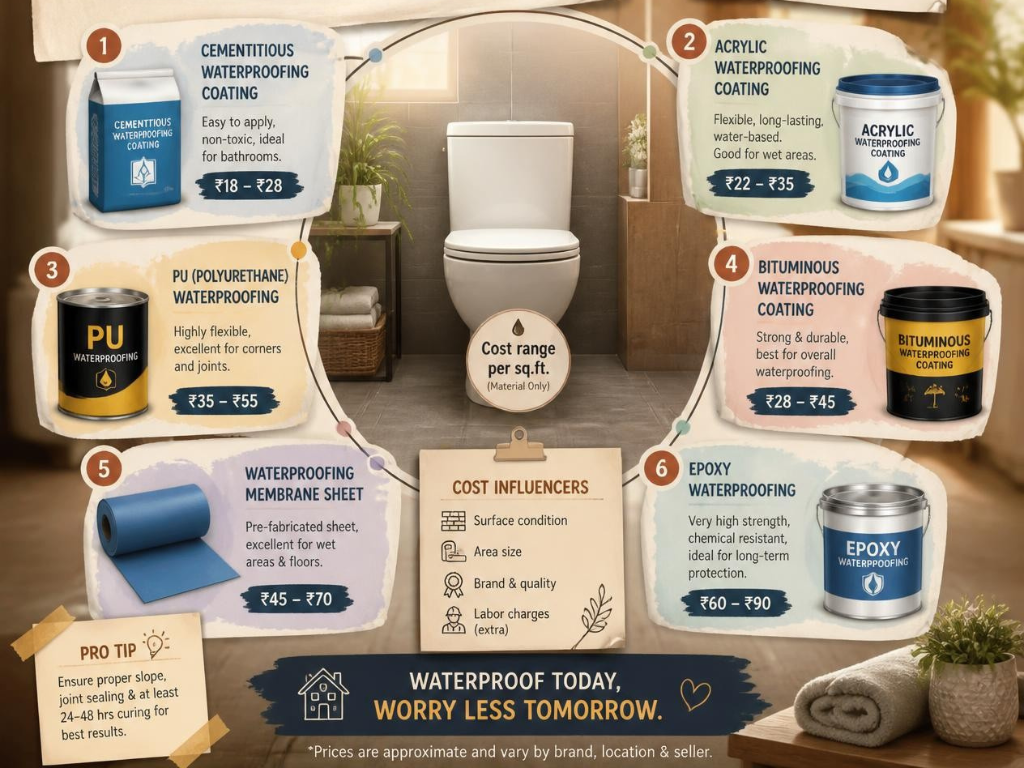
| System | Example products | Cost tier | Typical warranty | Best suited to |
| Cementitious, two-component | Davco K10 Plus, Mapei Mapelastic, Sika Sikalastic | Standard | 5 to 7 years | Most HDB and condo toilets |
| Polyurethane, liquid-applied | Sika PU, Mapei Aquaflex, Ardex WPM | Premium | 7 to 10 years | Master bathrooms, heavy wet zones, landed |
| Acrylic-based | Various | Budget | 3 to 5 years | Overlay on low-traffic areas |
| Hybrid, cementitious with acrylic fortification | Davco and Mapei combinations | Premium | 7 to 10 years | High-value bathrooms and long-stay properties |
SS 637:2018, the Singapore code of practice for waterproofing of reinforced concrete buildings which replaced CP 82:1999, provides the framework these systems are designed and installed against. A contractor who cannot name the standard their specification works to has not specified anything, and BCA’s contractor registry lists waterproofing installation under workhead CR13 if you want to check who you are dealing with.
Applicator certification is the condition most owners miss. Davco, Sika, Mapei and Ardex generally honour their extended warranties only where installation was carried out by a certified applicator. A contractor proposing a system they are not certified for has quoted you a warranty that will not answer when called, whatever the paperwork says. The differences between membrane types explained matter less than whether the firm applying it is approved for it.
What legitimately pushes the price up, and what should not?
Six things justify a higher number: an active leak requiring diagnosis before scope can be set, hollow or damaged tiles needing extra demolition, access constraints, a premium membrane or extended warranty, a wall turn-up above 300 mm, and multiple wet zones treated together.
Five things do not. “Site conditions” invoked without naming the condition. Scope creep after the quote is accepted. Cost adjustments after demolition reveals something the site inspection should have found. Tile supply marked up more than about 20% over retail. And separate charges for items that belong in any base quote, meaning disposal, primer and the ponding test.
The fourth of those is the one to watch, because it is the most common and the most defensible-sounding. A site inspection exists to find what is behind the tiles. A contractor who inspected and then discovers a surprise has either not inspected properly or has priced optimistically to win the job.
Worth noting: a legitimate variation comes with an explanation of why it could not have been foreseen. If that explanation is not offered, ask for it in writing before approving anything.
What does a short warranty actually cost over ten years?
A cheap overlay is a payment plan. Run the ten-year arithmetic on an HDB master bathroom and the cheapest first quote is rarely the cheapest outcome.
An $800 overlay carrying a 3-year warranty typically needs a second application around year 3 and a third around year 7, reaching roughly $2,500 over ten years. A $1,400 overlay with a 5-year warranty needs one repeat around year 6, landing near $2,900. A $3,800 hacking job with an 8-year warranty needs nothing inside the decade beyond minor touch-up.
Those figures exclude the cost that actually hurts. A single leak reaching the unit below runs $3,000 to $10,000 in ceiling and flooring repairs plus whatever is negotiated with the neighbour, and a failure in year 3 of a cheap overlay routinely triples the true cost of the original decision.
The comparison worth making is total cost of ownership across the period you intend to own the property, not the first quotation. An owner selling in two years and an owner staying fifteen should reach different answers from the same table, and both should reach them deliberately. Scoping toilet and balcony waterproofing around that horizon is the single decision with the largest financial consequence in this article.
Conclusion
Three decisions set the number and only one is genuinely negotiable. Property type is fixed, the method is decided by the substrate and sometimes by HDB, and the membrane system is where an owner chooses. Paying 15% to 30% more on that line for four extra warranty years is the best-value trade on this page.
Send your property type, bathroom size and whether there is an active leak through the contact form or call 8688 8600. Proseal inspects before quoting, states the system and thickness in writing, and issues the warranty in your name.
FAQs About Toilet Waterproofing Cost Singapore
How much does toilet waterproofing cost for an HDB flat in Singapore?
Overlay on a common bathroom runs $600 to $1,400 and hacking on a master bathroom runs $2,800 to $5,000 in 2026. Doing both bathrooms together commonly saves 5% to 10% on the second unit. Flats built before 2000 may need screed build-up, adding $200 to $500.
Can I waterproof my bathroom without hacking the tiles?
Yes, where the existing tiles are sound, not hollow and not leaking. Overlay applies a new membrane over prepared tiles and typically carries a 2 to 5 year warranty against 5 to 10 years for hacking. For new HDB flats inside the three-year restriction, overlay is the only compliant option.
How long does toilet waterproofing take in an HDB flat?
Overlay takes 2 to 4 days including curing and the ponding test. Hacking with re-tiling takes 7 to 14 days. The ponding test alone needs a full 24 hours before tiles go down, and a contractor compressing that step is compressing the only verification in the job.
Is PU membrane worth paying more for than cementitious?
Yes for master bathrooms, heavy wet zones and landed property. Liquid-applied PU systems such as Sika PU, Mapei Aquaflex and Ardex WPM typically carry 7 to 10 year warranties against 5 to 7 for standard cementitious, for roughly 15% to 30% more on the material line.
Do I need a BCA-registered contractor for bathroom waterproofing?
BCA registration is not legally required for private residential work, but CR13, Waterproofing Installation, is the workhead that signals a waterproofing specialist. For HDB flats there is a separate requirement: the contractor must be listed in HDB’s Directory of Renovation Contractors, and they submit any permit, not you.

Sorry, the comment form is closed at this time.