





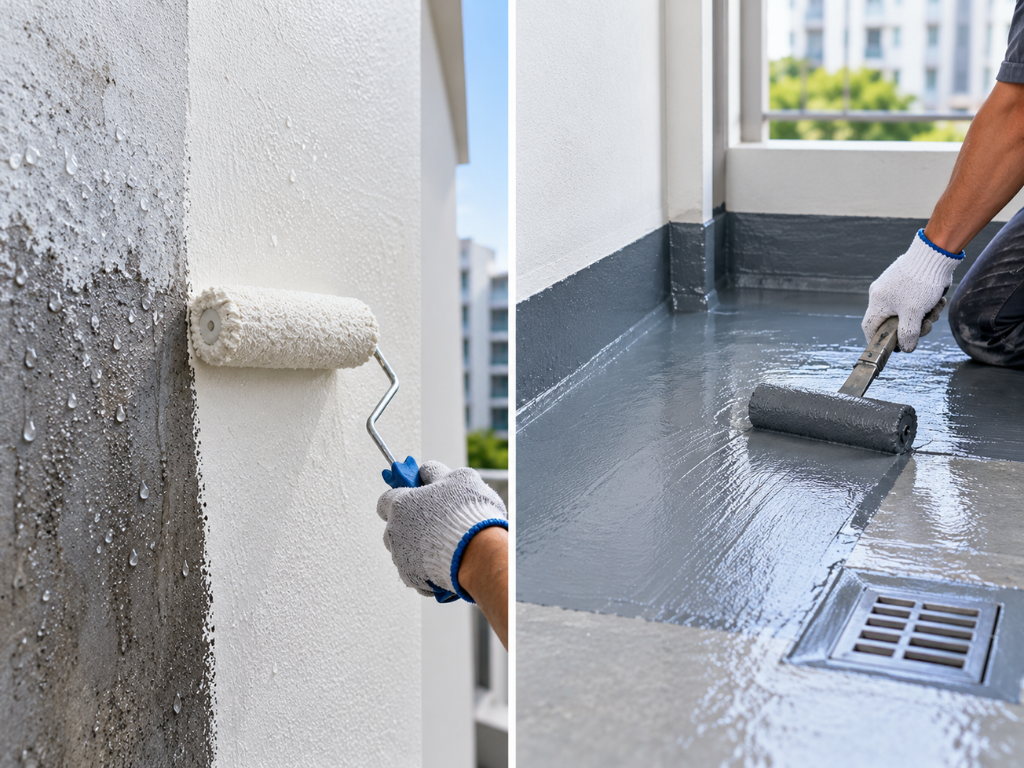
22 Oct Waterproof Paint vs Waterproofing Membrane in Singapore
Waterproof paint sheds rain off a sound vertical wall. It’s an elastic exterior coating about 0.1 to 0.2 mm thick. A waterproofing membrane is a continuous barrier 0.6 mm or thicker that holds back standing water, water pressure and crack movement, which is why flat roofs, bathrooms, planters and anything below ground need one. HDB handled an average of 77 complex seepage cases a month in 2025, so your first decision when specifying waterproofing for Singapore buildings is which layer the surface needs.
Waterproof paint vs waterproofing membrane: the numbers side by side
A liquid waterproofing membrane runs 4 to 11 times thicker than the film an elastic paint needs to cover hairline cracks, and it bridges cracks that paint can only sit over once someone has filled them. Three manufacturer data sheets show the gap, two of them Singapore editions.
| Property | Standard exterior paint (Nippon Weatherbond) | Elastic “waterproof” paint (Nippon WeatherBond Flex) | Liquid membrane (Sika Sikalastic-595) |
| Type | 100% acrylic emulsion | Acrylic polymer rubber-based elastic coating | Acrylic-PU hybrid membrane |
| Dry film | 40 microns per coat | 60 to 90 microns per coat | 0.6 to 1.5 mm for the system |
| Build | Sealer + 2 coats | Skimcoat, sealer + 2 coats | Primer + 2 to 3 coats |
| Cracks | Hairline cracks filled with putty first | Covers hairline cracks at 140 microns minimum | No cracking over a 2 mm crack (ASTM C836) |
| Elongation at break | Not stated | Not stated | Over 250% unreinforced (ASTM D412) |
| Stated scope | Internal and external masonry | Waterproofing on vertical walls | External and internal walls and roofs; not for permanent immersion |
Thickness decides most outcomes. Nippon Paint’s Singapore data sheet for Weatherbond, a 100% acrylic emulsion, calculates coverage on 40 microns of dry film and tells applicators to fill hairline cracks with putty before painting. Two coats leave about 80 microns on your wall.
Sika’s Singapore data sheet for Sikalastic-595, an acrylic-PU liquid membrane, builds 0.6 to 1.5 mm. That works out at 600 to 1,500 microns, with elongation above 250% and a tested crack-bridging result of 2 mm, cycled 10 times at 1 mm.
The stand, push, move test: which one your surface needs
Ask three questions about the surface. Does water stand on it? Does water push against it? Does the substrate move more than a hairline? Answer yes to any one of them and you need a membrane. Answer no to all three and elastic paint will do the job.
| Question | Yes looks like | Layer needed |
| Does water stand on it? | RC flat roofs under 7 degrees, balconies, planter bases, bathroom floors | Membrane, with falls to drains |
| Does water push against it? | Basements, water tanks, pools, planters, retaining walls | Membrane rated for water head |
| Does the substrate move? | Cracks wider than hairline, movement joints | Membrane with crack bridging, plus joint treatment |
| All three no | Sound rendered external wall, rain runs off | Elastic paint over a repaired, dry wall |
Most buildings need both layers. Put the membrane where water collects and the paint where water runs past. Proseal’s guide to how each waterproofing membrane works covers sheet and liquid systems in detail. SS 637:2018, Singapore’s code of practice for waterproofing reinforced concrete buildings, covers roofs, floors, walls, basements and precast elements, with and without hydrostatic pressure.
Is waterproof paint enough for exterior walls?
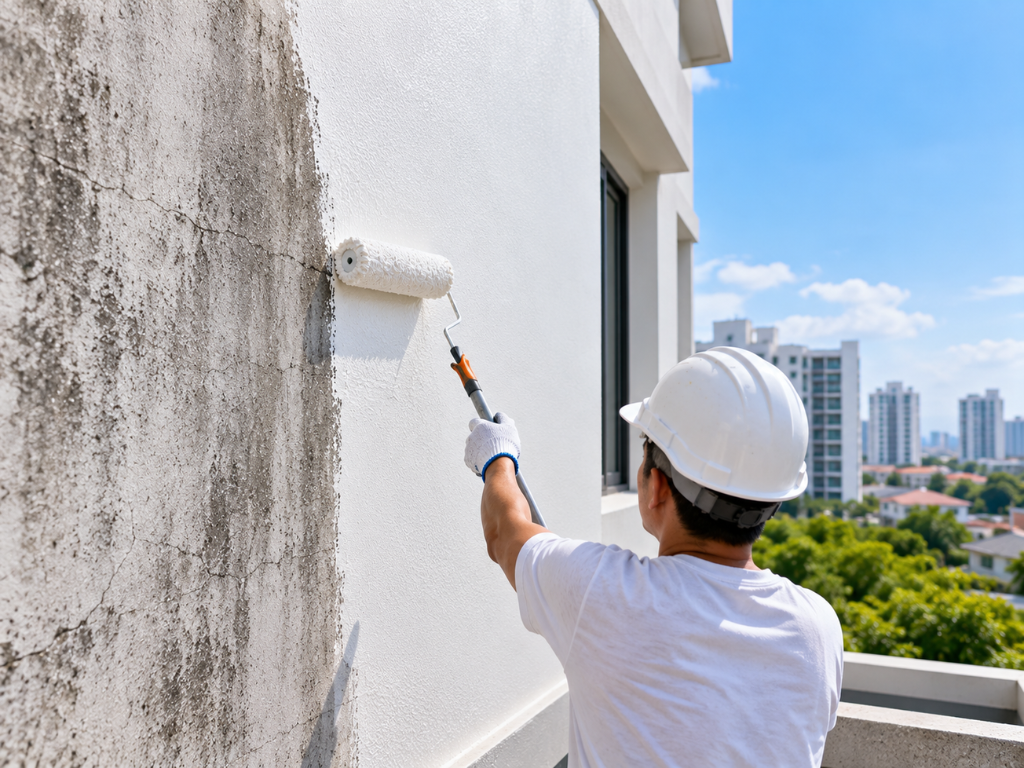
Waterproof paint is enough on a sound, vertical external wall with hairline cracks only, where rain runs off instead of sitting. Nippon’s own data sheet for WeatherBond Flex limits the waterproofing claim to vertical walls. The same sheet says all water seepage “must be checked and repaired” before painting, and caps masonry moisture at 16% on a Protimeter.
That makes elastic paint the last step of a repair. Proseal’s external wall leakage repair work follows that order: find the entry point, seal it with sealant replacement, PU crack injection or re-pointed render, then apply an elastomeric coating and matched paint.
A crack that moves beats the paint. A 140-micron elastic film covers a hairline, and it can’t span a 2 mm opening that widens and closes with the heat every day. Proseal’s notes on keeping walls free of moisture cover the render and sealant work that has to come first.
Breathability helps a wall. Nippon describes Weatherbond as a breathable film with high water vapour permeability, so damp inside the render escapes instead of blistering your paint.
When do you need a waterproofing membrane?
You need a membrane wherever water stands on the surface, pushes against it, or meets a crack that moves. Singapore’s roofs, wet areas and below-ground structures each fall into at least one of those cases.
Flat roofs and ponding water
RC flat roofs sloped below 7 degrees hold standing water after heavy rain, and no paint carries a rating for that. Proseal’s RC flat roof waterproofing uses one of two systems: a 5-coat flexible acrylic membrane in grey, or a torch-on bituminous membrane. Pick torch-on for roofs that pond constantly, because it tolerates standing water longer.
Even liquid membranes have a ponding limit. Sika states that Sikalastic-595 is “not suitable for permanent water immersion” and asks for falls that take water off the finished surface. On an old roof that ponds, correct the slope or move to a torch-on system.
Bathrooms, kitchens and balconies
HDB requires a waterproofing membrane, not paint, when you replace bathroom floor finishes. Its renovation rules for building works call for pre-packed waterproofing screed and a membrane turned up at least 150 mm against walls and kerbs. In kitchens and open balconies, you need the membrane within a 400 mm radius of sanitary stacks.
Basements, tanks, pools and planters
Anything holding water back under pressure needs a membrane rated for it. Sika’s data sheet for SikaTop-107 Seal PH, a cementitious waterproofing slurry used in tanks, wet rooms and basements, notes that structures holding more than 1 m of water head need a thicker coating or another solution. Proseal’s planter box specification puts a flexible cementitious or PU membrane inside the walls and base, with a separate root barrier.
How long paint and membranes last in Singapore
Elastic paint on exposed walls lasts about 5 to 8 years, while roof membranes run 10 to 15 years, based on Proseal’s published service figures. Compare quotes on years of protection before you compare price per square metre.
| System | Typical service life | Source |
| Exterior paint and sealant on exposed elevations | 5 to 8 years | Proseal external wall repairs |
| HDB BTO external paintwork warranty | 6 years | Ministry of National Development, 2022 |
| 3-coat acrylic roof tile coating | 7 to 10 years | Proseal roof tile works |
| Wet area membranes in HDB flats and condos | 5 to 10 years | Proseal wet area works |
| 5-coat acrylic membrane on RC flat roofs | 10 to 12 years | Proseal RC flat roof works |
| Torch-on bituminous membrane on RC flat roofs | 12 to 15 years, if seam laps stay intact | Proseal RC flat roof works |
Ponding shortens all of these. Proseal’s roof figures drop by 2 to 3 years on roofs with standing water or blocked outlets, so treat drainage as part of the membrane specification rather than a separate job.
Get the surface assessed before you choose a product. Proseal runs a non-obligation site evaluation of the affected area.
Match the layer to the surface
Paint and membranes do different jobs, so neither one wins outright. Water that runs down a sound wall needs 140 microns of elastic paint over a dry, repaired substrate. Water that stands, pushes or follows a moving crack needs 0.6 mm or more of membrane, with falls to drains and HDB’s 150 mm upturn in bathrooms. Paint a surface that needed a membrane and you’ll pay for the work twice.
Not sure which surface you’re dealing with? Book a site evaluation with Proseal and get the layer specified before the quote.
Frequently asked questions
Can I use waterproof paint on a flat roof?
Not on its own, if the roof holds water. Proseal’s RC flat roof figures show that roofs sloped below 7 degrees keep standing water after heavy rain. Those roofs need a membrane, either a 5-coat acrylic system lasting 10 to 12 years or torch-on bitumen lasting 12 to 15 years.
Can you paint over a waterproofing membrane?
Yes, on UV-stable liquid membranes the manufacturer approves for overcoating. Many owners skip the paint: Sika supplies Sikalastic-595 in white, grey and matched colours, and it resists UV on its own. Cementitious slurries such as SikaTop-107 Seal PH won’t take paint, because Sika requires screed or tile adhesive over them within 7 days.
Is waterproof paint the same as a waterproof coating?
The terms overlap, so judge by film thickness. A paint-grade coating such as Nippon’s WeatherBond Flex dries to 60 to 90 microns per coat. A membrane-grade liquid coating such as Sika’s Sikalastic-595 dries to 0.6 to 1.5 mm. If a quote says “waterproof coating”, ask for the dry film thickness.
Does waterproof paint stop water seeping through a wall from inside?
No. Elastic exterior paints work on the side the rain hits, and Nippon requires all seepage repaired before WeatherBond Flex goes on. Water pushing out from a planter, tank or basement needs a membrane on the wet side, and SikaTop-107 Seal PH flags structures above 1 m of water head for a thicker build.

Sorry, the comment form is closed at this time.