





01 Nov Water Seepage in Wall Singapore: 2026 Diagnostic Guide
Water seeping into a wall in Singapore comes from one of four sources, and the height of the damp patch points you to the right one. Since January 2022, BCA’s Periodic Facade Inspection regime has covered buildings taller than 13 metres and older than 20 years, and that shifts who answers for an external wall. Run the checks below and name the cause before you sign off on any concrete repair and waterproofing scope.
What are the four ways water gets into a Singapore wall?
Wind-driven rain, capillary rise, hydrostatic pressure and an internal water source. Your wall will have one of these, or two working together, and each one needs its own repair.
During a squall, wind drives rain almost sideways into the external face. Bert Blocken and Jan Carmeliet, whose review in the Journal of Wind Engineering and Industrial Aerodynamics is still the standard reference, describe wind-driven rain as “the most important moisture source affecting the performance of building facades”. The water gets in through cracked render, failed sealant around window frames, open construction joints and porous masonry.
Capillary rise pulls moisture up through porous material from a wet base. It needs water at the bottom of the wall and an unbroken absorbent path above it. Few walls above ground level in Singapore have both.
Hydrostatic pressure forces water through a wall when a body of water sits against the wet side. You find it in basement walls, retaining walls and planter boxes. Of the four, only this one drives water in under real pressure.
An internal source means a concealed pipe, a wet area behind the wall or an aircon condensate line. Damp from these ignores the weather, so you can rule them in or out faster than the other three. The same material behaviour explains why walls take on moisture in a tropical climate, whichever mechanism you’re dealing with.
What does the height of the damp patch tell you?
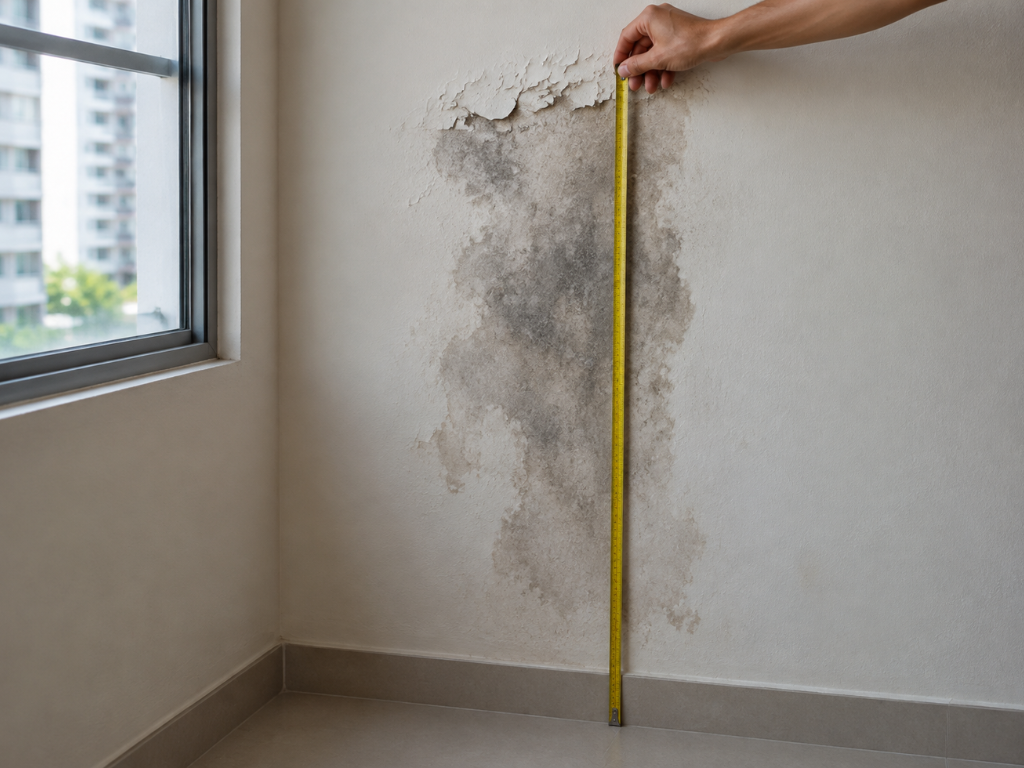
It tells you more than any other single check, and you can read it in seconds. Before you do anything else, measure from the floor to the top of the damp area.
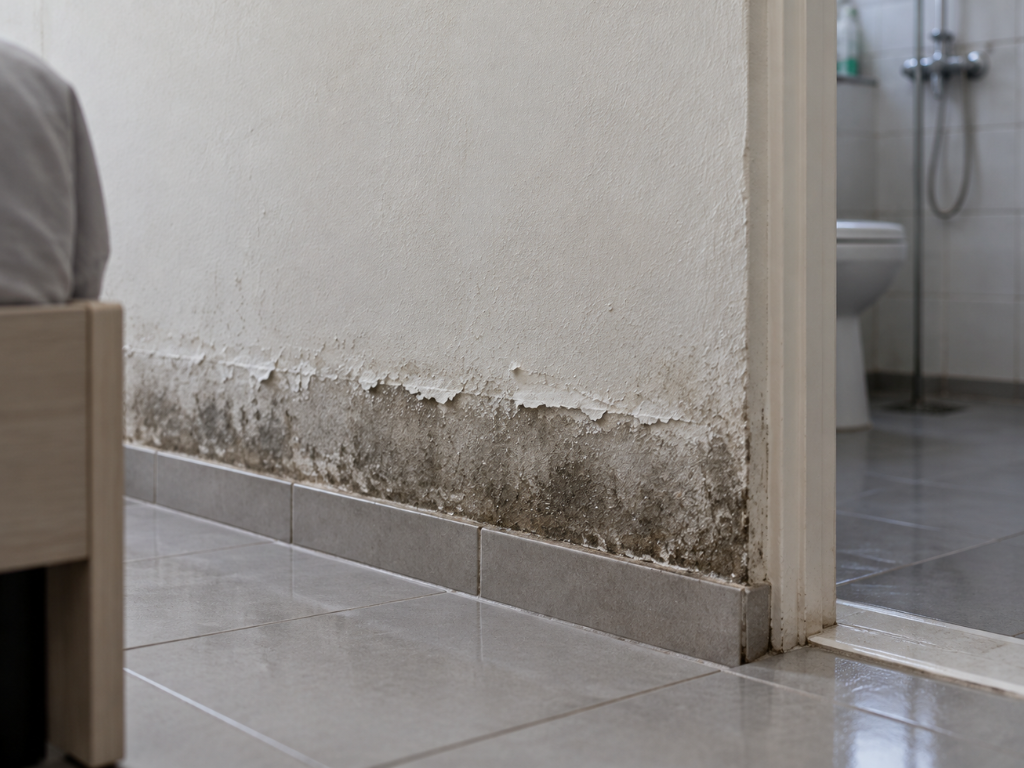
Damp in the lowest 0.5 to 1 metre with a clear upper edge, often lined with a white deposit, points to capillary rise. The tide-mark forms where evaporation from the wall face catches up with the water drawn up from below. That balance point holds at a steady height.
Damp that starts high and spreads downward, widest at the top, points to external ingress. Water got in somewhere above and ran down inside the wall build-up, so look for the entry point at or above the highest damp you can see.
A round or oval patch at any height, with no link to the floor or ceiling, points to an internal source. Pipes run at fixed heights inside walls, and water from a puncture spreads out evenly around it.
Even damp across a whole wall face below ground level points to hydrostatic pressure.
If one wall shows two patterns, you have two problems, and fixing one leaves the other leaking. Photograph the wall with a tape measure in frame and note the date. When the damp boundary climbs after rain and holds steady through dry weather, you’ve identified the mechanism without a single tool.
How do you tell external ingress from an internal pipe leak?
Check the damp against the rain, which costs you nothing. External ingress shows up or gets worse within hours of heavy rain, then dries back over the next few days. A pipe leak looks the same whatever the weather does.
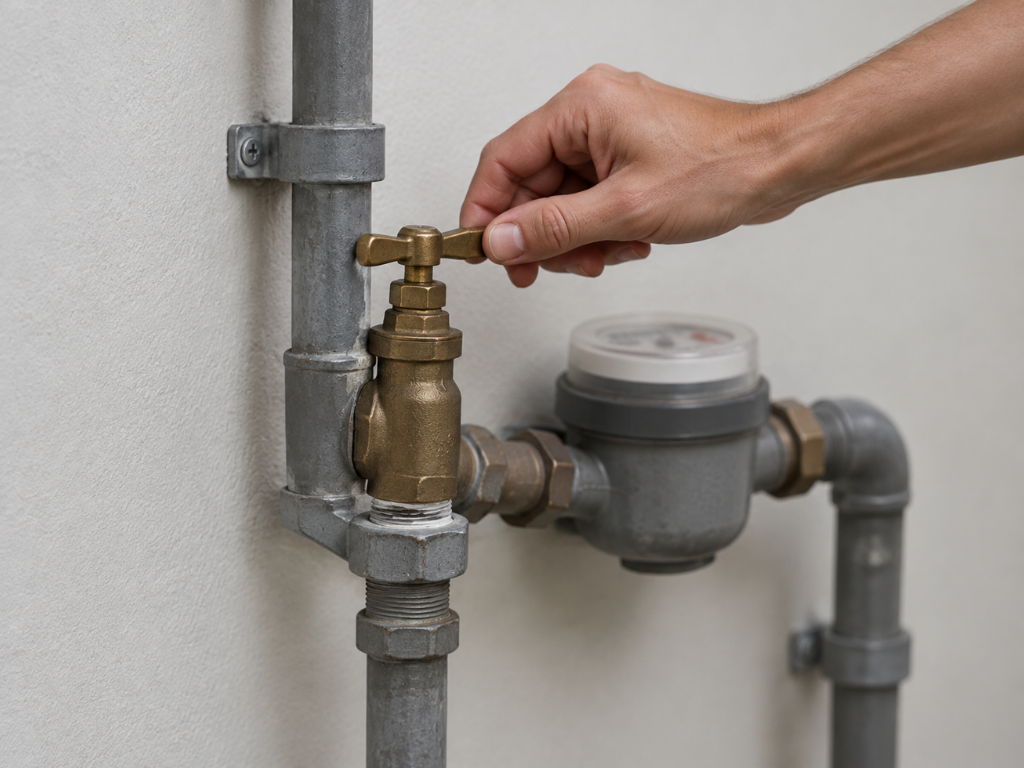
Confirm it with a supply isolation test. Shut your unit’s main stopcock for 24 hours in dry weather and mark the damp boundary before and after. If the patch keeps growing with the supply off, a pressurised pipe isn’t feeding it, so check drainage or rain next. If it stops growing, you have a concealed pipe leak.
The Meteorological Service Singapore recorded 2,984.9 mm of rain in 2025, 18% above the long-term average, so you won’t wait long for a test event. Log three dated downpours against the state of the wall and see whether the damp moves with them.
The direction your wall faces gives you a second clue. Sumatra squalls blow in from the west and southwest between April and November, while Northeast Monsoon surges hit the opposite elevations from December to March. A west-facing wall that gets worse mid-year and settles by January is following the squall calendar, and you can treat that as strong evidence of external ingress. External wall leak repair starts from that exposure map, not from where the stain happens to sit.
Is rising damp real in Singapore?
Yes, but contractors diagnose it far more often than it happens. Capillary rise needs water at the base of the wall and a continuous porous path upward. Above ground level in a reinforced concrete building, you have neither.
Take damp at the base of a wall on the twelfth floor of an HDB block. No ground water reaches that height, whatever a previous contractor told you. Water from a source higher up runs down inside the wall build-up, collects at the floor slab junction and wicks a short way back up. You’ll see the same tide-mark as rising damp, and the repair has to start at the source above.
In Singapore, you’ll find true capillary rise in ground floor walls touching soil and in older masonry built without a damp-proof course. Walls backing onto planter boxes or landscaped beds, where soil sits against the structure, can have it too.
Two questions sort the real thing from the lookalike. Does the wall touch the ground or hold back soil? Is there a wet area, window frame or service penetration above the damp that could be feeding it? A no to the first and a yes to the second means the water is travelling down.
Why is my HDB wall damp?
In most HDB flats, the damp comes from an adjacent wet area, a concealed pipe inside the wall, or rain getting in through the block facade. Which side of the wall the damp sits on tells you which one you have.
Damp on a wall you share with a bathroom, kitchen or your neighbour’s wet area points to failed waterproofing on the other side. The wall itself is intact. Water crosses it from a broken wet area membrane, and the floor-to-wall junction, where the upstand is weakest, usually gives out first.
Damp on an external wall of the block is a facade issue, so report it to the Town Council, which maintains the block’s common property. You’re responsible for the interior of your own flat, and the building’s outer skin sits outside that.
A concealed pipe leak gives you damp that ignores the weather, with no wet area next door to blame. Get the leak located before anyone opens the wall. Hacking into the wrong section costs money, and the only way to undo it is replastering.
Internal partition walls in most HDB flats carry services and don’t hold up the building. So when you spot a damp patch at a fixed height on an internal wall, ask for a pipe investigation before you ask for a waterproofing quote.
Who is responsible for a condo external wall?
The management corporation, and since January 2022 the MCST has a statutory inspection duty on top. External walls in a strata development are common property. As an owner, you report the defect to the MCST instead of hiring your own contractor.
BCA’s Periodic Facade Inspection regime came into force on 1 January 2022 under the Building Control Act. Buildings taller than 13 metres need a facade inspection every seven years once they pass 20 years old. The regime names building owners, Town Councils and management corporations as the responsible parties. They must appoint a Competent Person, meaning a Professional Engineer or Registered Architect holding a Certificate in Façade Inspection. That person carries out a full visual inspection plus a hands-on inspection of a representative section of each elevation. If they find deterioration, the owner has to fix it within the period BCA sets.
For you, as an owner in an ageing development, that turns a complaint into something the MCST can’t set aside. A damp external wall is evidence of facade deterioration, the very thing the regime was set up to catch, and the law gives the MCST a named duty to deal with it.
Whether the cause counts as a defect or deterioration still affects who pays in the end. The MCST’s duty to investigate starts before anyone settles that question.
What about a landed property wall?
You carry it alone. Landed houses are exempt from the Periodic Facade Inspection regime, and without an MCST or Town Council, nobody else will prompt an inspection.
Nothing forces you to inspect, and nothing holds you up either. If you want the work done next month, you can book it for next month.
Landed homes deal with hydrostatic pressure, which HDB flats and condos rarely see. Basements, semi-basements, retaining walls and planter boxes all hold water against the structure and push it in. A membrane on the dry face of a wall under that load gets pushed off instead of pressed on, which explains why negative-side treatment on basement walls so often fails within a season.
Ground contact adds a second landed-specific risk. Walls touching soil are the one place in Singapore where true capillary rise is common. Check whether the wall has a damp-proof course at all, and if it does, whether it has failed.
Boundary and party walls raise one more question. When you share a wall with a neighbour, the title deed decides who is responsible. Read yours before you bring up the leak with them.
What tools actually diagnose wall seepage?
A moisture meter finds the edges of the wet area and thermal imaging maps its shape. A small invasive opening then confirms what’s behind the surface.
A pinless capacitance meter reads about 20 mm to 30 mm below the surface without marking the finish, which suits plaster and render. Treat the readings as comparisons. You want a map of wet against dry across one material, and a plaster reading set against a concrete reading tells you nothing.
Thermal imaging picks up temperature differences, because wet material holds and releases heat differently from dry. It shows the size and shape of the wet area, and that shape tells you whether water arrives from above, from below or from a single point. The camera can’t see water, and it won’t find the entry point. Someone still has to read the thermal pattern against how the building is put together.
On external walls, access sets the limit. A facade defect on the fourteenth floor needs someone to reach it, and rope access facade work gets to one joint on one elevation in a day, where scaffolding takes a week.
The opening turns the map into a diagnosis. Cut a small test opening at the wettest point and you’ll see whether the water sits in the render, the blockwork or the concrete. What you find there decides the repair.
PU injection or cementitious membrane: which fix applies?
They fix different problems, so you can’t swap one for the other. PU injection stops active water moving through a single crack or joint. A cementitious membrane stops water soaking through a whole surface.
For injection, the applicator drills ports along the crack and pumps in polyurethane resin under pressure. The resin reacts with the water in the crack and expands to fill the gap. Because the resin needs water to react, it works on cracks that are actively weeping and does nothing for a dry hairline crack.
You apply a cementitious membrane across a surface to stop water passing through the material itself. It suits porous render, general permeability and wet area walls, and it needs a sound, prepared substrate to bond to.
Owners lose money when a contractor lays a membrane over a crack that’s still weeping. The membrane won’t bond to a wet surface. Where it does bond, it traps water under pressure behind it until it blisters or peels away. Inject the crack first, then apply the membrane.
Every fix in this guide comes back to matching the remedy to the mechanism. Get that right and you’re preventing wall moisture instead of paying to treat the same wall again and again.
Read the wall before you pay for a repair
You’re dealing with one of four mechanisms, and the wall shows you which before anyone brings in equipment. Damp height, timing and rain correlation narrow it down in about ten minutes, and the tools that follow only confirm it. Each mechanism needs a different repair. Pick the wrong mechanism and even a well-executed job leaves the wall damp, so you end up paying twice.
Send a dated photo with the damp height measured, your property type and your floor level through the contact form, or call 8688 8600. Proseal sends back a written diagnosis naming the mechanism before proposing any repair.
FAQs About Water Seepage In Wall Singapore
What is the white powder on my wall and is it serious?
It’s efflorescence, and yes, it matters. Water moving through the wall dissolves calcium and alkaline salts out of the cement and leaves them on the surface as it evaporates. That makes the powder chemical proof of moisture movement. Wipe it off. If it comes back within a week, water is still moving through.
Can I just repaint over a damp wall?
No. Paint on a damp substrate blisters or peels within months as moisture pushes outward, and anti-damp paint slows the symptom without touching the source. Fix the way water is getting in, let the wall dry to a stable moisture reading, then repaint.
Who pays for an external wall leak in a condo?
The management corporation, because external walls in a strata development are common property. Since January 2022, buildings over 13 metres and more than 20 years old also fall under BCA’s Periodic Facade Inspection regime, which gives the MCST a named inspection duty every seven years.
How long does a damp wall take to dry after the leak is fixed?
Plaster and render dry in weeks. Concrete and thick masonry take months, and a 100 mm wall section can stay wet for a full season after you stop the source. Take moisture readings before you redecorate, because the surface dries long before the material behind it.
Do I need a BCA-registered contractor for wall waterproofing?
Private residential work doesn’t legally require a registered contractor, but CR13, Waterproofing Installation, is the BCA workhead that identifies a waterproofing specialist. For facade work under the Periodic Facade Inspection regime, a Competent Person must carry out the inspection itself.

Sorry, the comment form is closed at this time.