





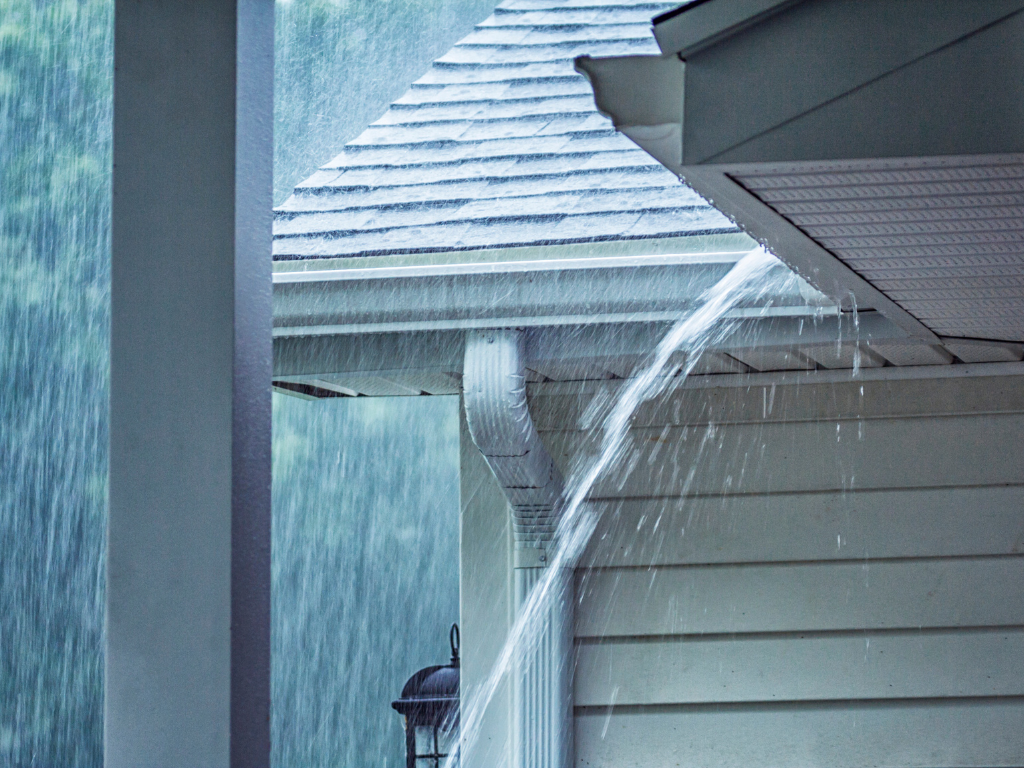
14 Aug Roof Leaks Only in Heavy Rain? The 3 Real Causes
If your roof only leaks in a downpour, you almost certainly do not have a hole in it. You have a detail that holds in ordinary rain and gives way under load. Singapore takes around 48 Sumatra squalls a year, each arriving with gusts of 40 to 80 km/h. Three mechanisms cause storm-only leaks, and separating them is most of the work in diagnosing and repairing roof leaks.
Proseal Contracts Pte Ltd has been repairing storm-triggered leaks in Singapore since 1999, BCA-registered under workhead CR13, Waterproofing Installation.
The three triggers
| Trigger | What exceeds what | Where it fails | Typical repair |
|---|---|---|---|
| Volume | Rainfall rate exceeds drainage capacity | Gutters, outlets, downpipes, roof falls | Clear, resize or add outlets |
| Pressure | Wind pressure exceeds the seal at a joint | Laps, terminations, fasteners, movement joints | Re-terminate and mechanically fix |
| Direction | Rain vector rotates onto surfaces never designed to shed water | Parapet faces, undersides, vertical junctions | Dress, flash or coat the wetted face |
Why does my roof only leak when it rains heavily?
Heavy rain changes three things at once: how much water arrives, how hard the wind pushes it, and which direction it travels. Light rain does none of that. It drains away before it builds a head, and it falls more or less straight down. A defect only needs to cross one of those three thresholds to start leaking.
Each trigger needs a different repair, which is why the distinction is worth making. Sealant does nothing for a volume failure, because that one is a drainage problem. Clearing gutters does nothing for a pressure failure, because that one sits at a termination. A direction failure wets a surface nobody detailed for water in the first place, so it needs a new detail, not a patch on the old one.
Most owners assume there is one hole. On a Singapore roof past 15 years old there are usually two of the three running at once, so a single patch buys one dry storm and fails on the next. If a leak has already survived two repairs, both were almost certainly aimed at the wrong trigger.

What is a Sumatra squall, and why does it break roofs that pass every other test?
A Sumatra squall is an organised line of thunderstorms that forms over Sumatra or the Strait of Malacca overnight and moves east across Singapore. The Meteorological Service Singapore describes the characteristic pattern as a sudden onset of gusty surface winds of 40 to 80 km/h with heavy rain lasting one to two hours. Maximum recorded gusts reach 93 km/h.
The combination is what does the damage. Wind on its own lifts and flexes components but brings no water with it. Rain on its own comes down close to vertical and gets shed by details doing exactly what they were built to do. A squall delivers both at full strength inside the same 90 minutes, which is the only time a lifted lap and a supply of water exist together.
Researchers at the Meteorological Service Singapore and the Australian Bureau of Meteorology went through 33 years of squall radar records and counted 2,024 squalls, 1,590 of which made landfall over Singapore. Nguyen and colleagues put the “duration of passage over Singapore typically between 90 and 150 min.” Annual counts swung from 10 events in 1997 to 83 in 2001, averaging 48 landfalls a year.
That works out to roughly one loading test a week. A detail that has survived a decade of afternoon showers has still only been tested against water falling straight down.

How does wind push rain uphill into a roof?
Wind creates a pressure difference across the roof surface. Positive pressure sits on the windward face, negative pressure sits in the separation zone behind ridges and parapets, and water gets driven through any opening that connects the two. Laps, seams and fastener holes that gravity alone would never fill all qualify.
Bert Blocken and Jan Carmeliet, in the Journal of Wind Engineering and Industrial Aerodynamics review that is still the standard reference here, call wind-driven rain “the most important moisture source affecting the performance of building facades.” Roof edges and junctions behave like facades the moment the rain vector tilts.
So overlap details stop working. A tile lap, a metal sheet side lap and a membrane termination all depend on gravity carrying water down and out. At a 60 km/h gust the rain vector can approach horizontal, and water at a lap face gets pushed along the joint instead of off it. Capillary action pulls it the rest of the way in. A 3 mm gap that has stayed dry for eight years fills in ninety seconds.
Flat roofs fail differently. Wind scours ponded water toward the parapets and drives it up the upstand face, past the height the membrane was terminated at. It is the most common storm-only failure we open up, and the flat roof weak points behind it usually come down to a termination dressed for still water.
Can strong wind lift flashing and let water under it?
Yes, and the lift does not have to be visible. Negative pressure at a roof edge acts on the underside of any component with an air path beneath it. A flashing fixed with adhesive alone, or fixed at 600 mm centres instead of 300 mm, will deflect a few millimetres under gust loading and reseat when the gust passes. A calm-day inspection finds nothing.
Roof edges and corners carry the highest suction anywhere on a building. A flashing in the middle of a roof can be in poor condition and never leak, while an apparently sound one at a corner leaks twice a year. We inspect by the pressure map, which means corners and edges come first even when the middle looks worse.
Tile roofs show it most clearly. A ridge or hip tile bedded in mortar that has carbonated and lost its bond will rock under gust load, open a gap of 2 mm to 5 mm at the bed joint, and take water in for the length of the squall. The tile looks correct from the ground and correct from the roof. Only testing finds it, which is why roof tile coating work starts with a fixing audit before anyone specifies a coating.
Is it the roof leaking, or the gutter overflowing?
Check the gutter first. Overflow accounts for a large share of leaks reported as roof failures, and ruling it out costs nothing. Gutters are sized to a design rainfall intensity, and SS 525:2024, the Singapore code of practice for drainage of roofs, covers gutters, gutter outlets, rainwater downpipes and siphonic systems.
What owners get wrong is which way the overflow goes. A gutter over capacity sheds water at its lowest available edge, and on plenty of Singapore installations that edge is at the back, against the fascia or the wall. Sometimes that is the original set-out. More often leaf litter and silt have dammed the front lip first. The overflow then runs down the inside of the fascia and into the structure, the stain turns up at a ceiling perimeter or the top of an internal wall, and everybody starts looking at the roof.
Three signs point at overflow instead of membrane failure. The leak tracks a gutter line, not an open roof area. It shows within minutes of the rain turning heavy, not after an hour of it. And it stops almost as soon as the rain eases, because a gutter empties in seconds while a saturated screed drains for hours.
Clearing outlets before each monsoon is the cheapest preventive job on any building. Clearing gutters before monsoon costs a fraction of one ceiling repair.
Why does the leak show up at dawn and stop by mid-morning?
Because that is when Sumatra squalls arrive. The 33-year MSS radar record puts squall landfall at its peak between 3am and 7am local time and at its lowest between 1pm and 7pm. A leak that appears at first light and dries out by mid-morning is squall-triggered, and the timing alone narrows the diagnosis.
It also separates two mechanisms cleanly. Afternoon convective storms in Singapore bring high rainfall intensity with fairly modest wind. Squalls bring both. So a leak that shows in the afternoon under a heavy thundery shower is almost always a volume failure, while one that shows only at dawn, or shows far worse at dawn than in an afternoon downpour of the same rainfall total, is pressure or direction.
Log the time. Three dated entries over two weeks will separate volume from wind loading without roof access or equipment, and that log is worth more to a contractor than a photograph of the stain.
Does wind direction decide which side of my building leaks?
Yes, and Singapore’s two seasons load opposite elevations. Sumatra squalls form over Sumatra and the Strait of Malacca and propagate eastward, so they arrive from the west and southwest. Records from 2013 to 2023 show 65% originating over Sumatra and 19% over the Strait of Malacca, propagating northeastward in 40.6% of cases and eastward in 36.6%.
Northeast Monsoon surges reverse the picture. PUB’s Code of Practice on Surface Water Drainage sets the Northeast Monsoon from late November to March and the Southwest Monsoon from late May to September, with inter-monsoon periods in April to early May and October to early November. Squalls cluster in the April to November window. Surges land between December and March and drive rain onto northeast-facing elevations.
That changes where we start. A leak reported between April and November sends us to the west and southwest parapets, flashings and facade junctions. A leak reported between December and March sends us to the northeast faces. Sequencing a survey by season instead of by convenience halves the time it takes to find the entry point on a large building.
Why do metal roofs leak in wind but stay dry in still rain?
A metal roof is an assembly of overlapping sheets held down by fasteners, and every lap and every fastener penetration is a gravity-dependent seal. Still rain runs over them. Wind-driven rain runs along them.
Side laps fail first. A profiled sheet side lap relies on the upper sheet sitting tight on the lower one, and any deflection under wind load opens a path for capillary action to exploit. End laps go the same way, and a shortened end lap installed to save material fails at a lower wind speed than a properly detailed one. Fastener washers come next: an EPDM washer that has hardened after 8 to 12 years no longer recovers its seal when the sheet flexes, so the fastener leaks under gust load and seals again in still conditions. Third are the gutter and valley junctions on industrial roofs, where water driven along a valley at an angle overshoots the outlet and finds the end stop, which is rarely detailed for anything but vertical water.
There is more to it than laps and fasteners, and the remediation depends on profile and age. Where the sheet itself is still sound, a metal roof waterproofing system applied over the existing profile closes laps and fastener heads together without a strip-out.
How do you test for a wind-driven rain leak without waiting for a storm?
Use directed spray. A standard water test floods a surface from above, which reproduces volume and nothing else. To reproduce wind-driven rain you spray at the joint from the outside and from below, at an angle, holding one location for at least five minutes before you move on.
Sequence matters more than equipment. Start at the lowest suspected joint and work up, because testing high first wets everything below it and destroys the result. Keep one person inside watching, in phone contact, and mark each location before you spray it. One technician spraying and then walking inside to check has no idea which of six locations produced the drip.
Directed spray has a limit worth stating. Hose pressure at a nozzle is not a pressure differential across a building envelope. It reliably finds direction failures and open capillary paths, and it under-detects pressure failures at laps that only open when the component itself deflects under gust load. For those, the timing log plus a targeted opening at the suspect lap beats anything you can run on a calm day.
How to narrow it down before you call anyone
Storm-only leaks are threshold failures. Volume, pressure and direction each load a different part of the building at a different time of year, and each needs its own repair, so a patch aimed at the wrong one buys a single dry storm. When the leak happens tells you more than what the stain looks like.
Log three dated leak events with the time of day and send them through the contact form, or call 8688 8600. A Proseal supervisor will tell you which of the three triggers you are dealing with and which elevation to survey first.
FAQs about roof leaks in heavy rain
How heavy does the rain need to be before a roof leak shows up?
There is no single threshold, because rainfall alone is not the trigger. A volume failure shows once the rate exceeds gutter or outlet capacity. A pressure failure shows once gusts reach roughly 40 km/h, the lower bound the Meteorological Service Singapore gives for Sumatra squall winds, whatever the rainfall total.
Can a roof pass a water test and still leak in a storm?
Yes, and it happens often. A ponding or flood test applies a static head from above, so it reproduces volume loading only. It cannot reproduce the 40 to 80 km/h pressure differential a Sumatra squall applies to a lap or a parapet termination. Directed spray at an angle catches what a flood test misses.
Which months are worst for roof leaks in Singapore?
Two windows. Sumatra squalls peak from April to November and load west and southwest elevations. Northeast Monsoon surges run from late November to March, per PUB’s Code of Practice on Surface Water Drainage, and load northeast elevations. Singapore’s annual rainfall has been rising by 92.5 mm per decade since 1980.
Does sealing the crack fix a wind-driven rain leak?
Rarely. Sealant closes a gap in still conditions and opens again once the component deflects under gust load, which is why the same repair holds for one storm and fails on the next. Pressure failures need mechanical fixing and a re-formed termination, specified against SS 637:2018 for reinforced concrete roofs.
Is a leak that only happens twice a year worth fixing?
Yes. Water getting in twice a year still saturates screed and insulation, and every cycle carries chlorides into the reinforcement. We open up storm-only leaks that have run for three or four years and find spalling that started long before any stain appeared. Every monsoon you leave it adds to the repair cost.

Sorry, the comment form is closed at this time.