





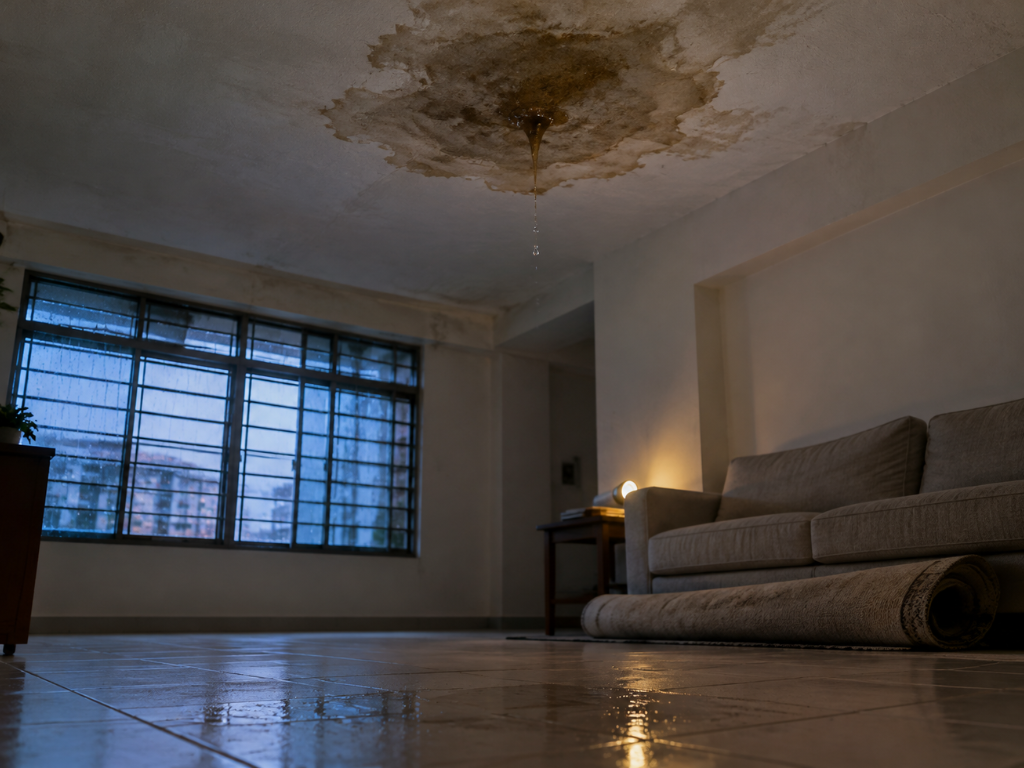
30 Oct Roof Leaking? What to Do in the First 24 Hours
Knowing what to do when a roof is leaking matters most in the first hour, before anyone touches a ceiling. The US Environmental Protection Agency puts the drying window at 24 to 48 hours before mould begins, and Singapore’s humidity sits at the fast end of that range. Four blocks of time, in order, starting with the electricity and ending with getting a roof leak fixed.
Proseal Contracts Pte Ltd has run emergency leak response across Singapore since 1999, BCA-registered under workhead CR13, Waterproofing Installation, on a 24-hour hotline.
The 24-hour sequence
| Block | The one job | What waits |
|---|---|---|
| 0 to 10 minutes | Isolate electricity to the affected area, move people out from under it | Everything else |
| 10 to 60 minutes | Contain and divert the water, protect what can be moved | Cleaning up |
| 1 to 6 hours | Photograph and log everything before touching the ceiling | Any hacking or drilling |
| 6 to 24 hours | Start drying, arrange inspection, notify whoever owns the pathway | Repair decisions |
Doing block two before block one is how people get hurt. Doing block four before block three is how claims fail.
What should you do in the first 10 minutes of a roof leak?
Get people out from under the wet area, then isolate the electricity to that part of the home. Nothing else in the first ten minutes matters as much, and both cost nothing.
Water tracking through a ceiling reaches light fittings, downlight housings and concealed wiring before it reaches the floor, so the drip you can see sits below the hazard you cannot. Move furniture and electronics out of the wet zone once the power is off, not before.
Where the ceiling is bulging or sagging, treat the room as closed. A sagging ceiling holds a volume of water nobody can estimate from below, and when it goes it goes all at once. Shut the door, keep children and pets away, and deal with it from outside the room.
Most Singapore roof leak calls land between 3am and 7am, because that is when Sumatra squalls make landfall. Half the households reading this will be doing these ten minutes in the dark and half asleep. Read the immediate leak response steps on a dry day, while it is still a page and not an emergency.
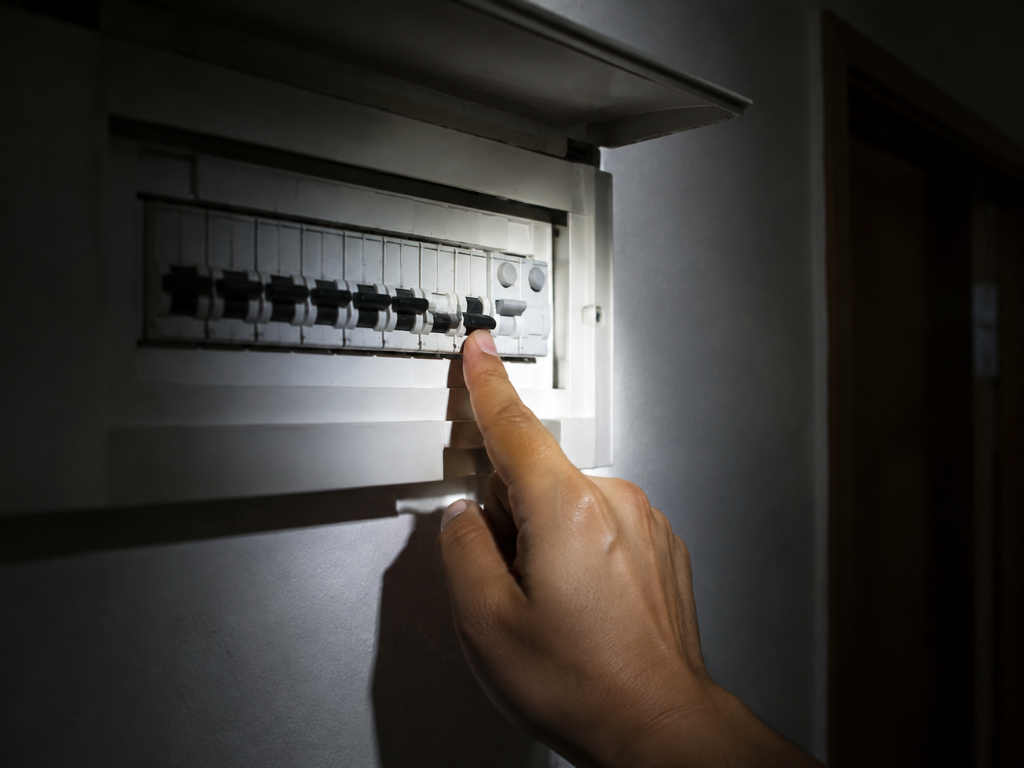
Do you need to switch off the electricity?
Yes, to the affected circuits, at the distribution board. Water and live wiring in the same ceiling void is the one hazard in a roof leak that kills, and it is the only step in this article that cannot wait for daylight.
Your RCCB or ELCB sits in the DB box, usually near the doorway and sometimes in the storeroom or household shelter. The Energy Market Authority requires every residential premises in Singapore to have one, with fines up to S$5,000 from 1 July 2025 for homes without. Tan Zhi Wei, Principal Engineer at EMA’s Inspectorate Department, put the requirement plainly: “It is essential that homeowners ensure an RCCB is installed in their premises.”
The gap is older housing. HDB flats built before 1985 did not come with an RCCB or ELCB unless one was fitted later, so a good part of the housing stock most likely to have an ageing roof also lacks the device that protects you while it leaks. If you are unsure, look for the switch with a “Test” button on it. No such switch in your DB box means a call to a Licensed Electrical Worker, and it is not something to put off.
Turn off the lighting circuit serving the wet room even if nothing has tripped. An RCCB that has not tripped means it has not yet detected leakage. It does not mean water has stayed away from the wiring.
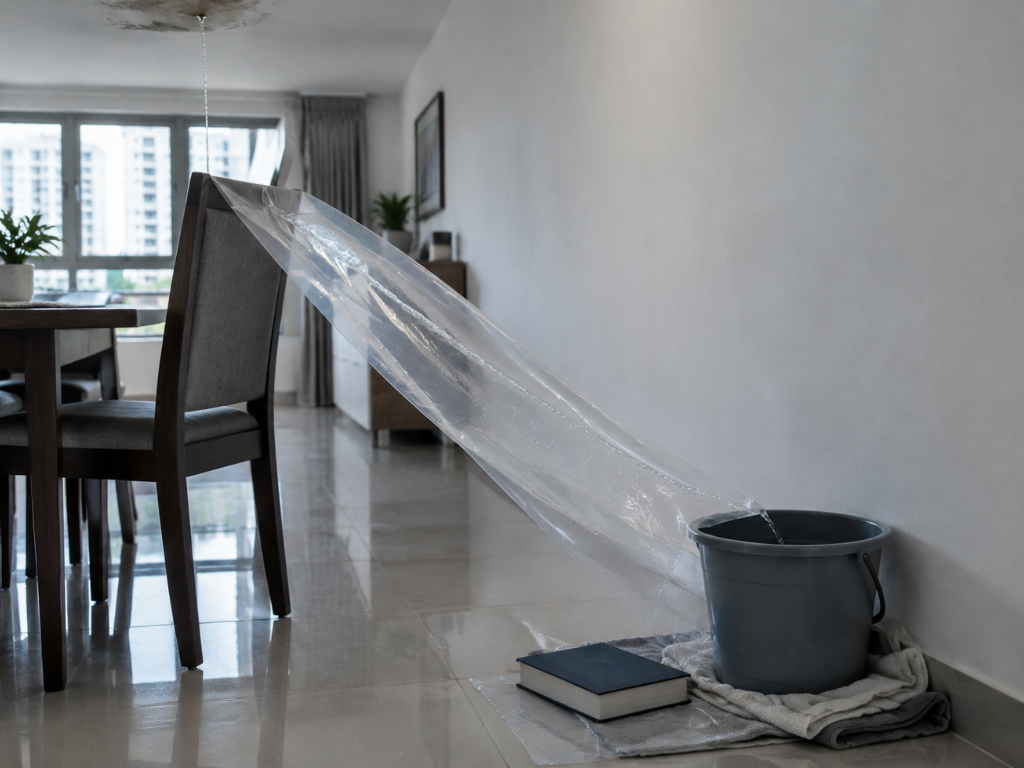
How do you contain the water without making the damage worse?
Divert it, do not collect it. A bucket under a drip catches water that has already soaked its way through the ceiling. A plastic sheet taped into a channel that runs to a bucket catches it before it spreads sideways.
Run the sheet from directly under the wettest point to a container at the edge of the room, with enough fall to keep the water moving. Weight the low end so it does not shift when the container fills. On a tiled floor, lay towels along the container line, because splash from a 2 metre drop wets a wider area than the drip itself.
Lift what can be lifted. Rugs, boxes and anything with a paper or fabric base soak up water fast and become the mould substrate later, so they matter more than the furniture that will dry out. Electronics come out first, once the power is off.
The mistake to avoid is aggressive cleaning during the event. Wiping and mopping the ceiling face pushes water into the finish and destroys the staining pattern that tells a contractor which way the water travelled. Contain it, then leave it alone until it is documented. The water leakage repair options are a job for the following day.
Should you hack or drill the ceiling to release trapped water?
No. You will find advice telling you to drill a hole in the centre of a ceiling stain to drain the standing water. It is wrong for most Singapore ceilings.
It holds for a plasterboard false ceiling, where the void above is accessible and the panel is sacrificial. It fails for a reinforced concrete soffit, which is what you are looking at in most HDB flats and strata units without a false ceiling. Drilling into an RC soffit that has been wet for an unknown period risks hitting reinforcement that is already corroding, and HDB’s own guidance on spalling concrete treats loose and flaking concrete as a hazard for someone competent to assess.
The second reason is evidential. A drilled ceiling cannot be assessed for the staining pattern, the extent of saturation or the direction of travel, and those are exactly what a contractor uses to find the entry point. Hacking before diagnosis turns a diagnosable leak into a guess.
Leave the ceiling intact, contain the water below it, and let whoever does the ceiling leak repair work decide where and whether to open it. A ceiling bulging under load is a reason to clear the room and call someone. It is not a reason to reach for a drill.
What should you photograph before anyone touches anything?
Six things, in this order: the wet ceiling with a timestamp, the stain boundary marked with tape, the wettest point, any dripping in progress on video, the affected contents, and the DB box showing which circuits are off.
Timestamps matter more than image quality. A dated photograph taken during rainfall, followed by a second taken 48 hours into dry weather, establishes rainfall dependency. That is the single most useful fact for whoever repairs it, and the first thing an insurer or a Town Council will ask about.
Mark the stain boundary with masking tape before you photograph it. A boundary that has advanced by the next rain event proves an active leak. Without the tape, two photographs of a brown patch prove nothing.
Log the times alongside. When the leak started, when the rain started, when it stopped. Four lines on a phone note carry more weight in a strata dispute or an insurance claim than a hundred photographs of the same ceiling, and at 4am there is little else to do.
How long do you have before mould starts?
24 to 48 hours, and in Singapore assume the shorter end. The US Environmental Protection Agency advises drying water-damaged areas and items within 24 to 48 hours to prevent mould growth, and recommends keeping indoor humidity below 60 percent.
That figure assumes moderate indoor conditions. Singapore does not supply them. Ambient relative humidity here runs high all year, and paper-faced plasterboard, timber battens and soft furnishings are all cellulose substrates that support growth. The published window was derived under milder conditions, so take 24 hours as your deadline and treat 48 as optimistic.
Drying is mechanical, not passive. Open the room to cross-ventilation, run fans across the wet surface instead of straight at it, and run a dehumidifier if you have one. Air conditioning helps by dropping humidity, but it does not move air across the ceiling face, so it supplements the drying without doing it.
What you cannot dry from below is a saturated screed above an RC slab. It holds water for days and re-wets the ceiling after you think it is dry. A ceiling that dries and then re-stains during dry weather has told you the substrate is holding water, and that changes the repair scope.
Is it safe to stay in the room?
Leave the room if the ceiling is sagging, bulging, cracking, or dropping flakes and rust-coloured debris. Those signs mean the failure has moved from the finish into the structure, and none of them are worth waiting out.
Rust stains and flaking concrete point to spalling, where water reaching the reinforcement inside the slab has started corrosion. Corroding steel expands against the concrete cover and pushes pieces of it away from the soffit, and those pieces come down without warning. The cover fails progressively while still looking stable, which is how owners end up walking under it for months.
A false ceiling behaves differently and fails faster. Plasterboard holding pooled water sags visibly, and once the fixings pull through, the panel and its water arrive together. A visibly sagging panel means the room stays closed until someone competent has drained it and dropped it deliberately.
Where debris has already fallen, the roof leak has become two jobs. Waterproofing stops the water and spalling concrete repair restores the slab, in that order, because new repair mortar over an active leak fails the same way the original cover did.
Can you put a tarpaulin on the roof yourself?
No. Do not go onto a wet roof during or after a storm, and do not send anyone else up there either.
Singapore roofs are wet, often steeply pitched or metal-clad, and frequently on buildings where the edge protection is a parapet you cannot safely lean over. Ministry of Manpower data puts Falls from Height among the top three causes of the 36 workplace fatalities recorded in 2025, and those were trained workers with harnesses and permits. A homeowner in slippers at 4am is a different risk category entirely.
Temporary sheeting is a legitimate holding measure, but it is a two-person job with anchorage, and on anything above a single-storey landed roof it needs rope access or a platform. Call someone who can do it under a permit.
One temporary measure is worth doing from the ground on a landed property. Clear the rainwater outlet or gutter if you can reach it safely with a pole from stable footing. A blocked outlet is a common cause of sudden overflow, and clearing it sometimes stops the leak within minutes. If it needs a ladder in the rain, it waits.
Who do you call, and in what order?
Tenure decides the order. For a top-floor HDB flat, the block roof is common property maintained by the Town Council, so they come first. In a strata development, the management corporation holds the common property duty. In a landed house, you call a contractor directly.
Call regardless of the hour if water is active, the ceiling is sagging, or electricity has been affected. An overnight call-out that contains a leak costs less than the ceiling replacement that follows a night of unchecked water. Proseal runs a 24-hour hotline on 8688 8600 for exactly this window, because the squall that caused the leak has usually passed by 7am and the damage has not.
Have four things ready before you call: the property type and floor, when the leak started, whether it is still active, and whether power has been isolated. Those four answers decide whether the responder brings containment materials, an electrician, or a platform.
Notify your insurer the same day even if you have not decided to claim, and keep the reference number. Where the leak turns out to be inter-floor and not roof-driven, the pathway changes again, and identifying ceiling leak sources correctly on day one saves weeks of misdirected correspondence.
What the first 24 hours actually buy you
The first 24 hours do not fix a roof. They decide how much of the ceiling survives, whether anyone gets hurt, and whether you have the evidence to make the next six months straightforward. Power off, contain, photograph, dry. The drill stays in the drawer.
If water is active now, call 8688 8600. Otherwise send your dated photographs, the time the leak started and your property type through the contact form, and a Proseal supervisor will tell you whether this needs a same-day visit or a dry-weather inspection.
FAQs about what to do when your roof is leaking
Will my home insurance cover a leaking roof?
Cover varies by policy, and the common split is that sudden water damage to contents and finishes is covered while the repair of the failed roof itself is not. Notify your insurer within 24 hours and quote your dated photographs. Read your own policy wording, because general guidance will not settle it.
Can I use a fan or dehumidifier to dry the ceiling?
Yes, and start within the first 24 hours. The US Environmental Protection Agency recommends keeping indoor humidity below 60 percent, ideally 30 to 50 percent. Aim fans across the wet surface, not straight at it, because moving air over the face dries faster than pressure against it.
What if the leak stops before anyone can come and look?
Photograph it anyway and keep the log. A roof leak that stops when the rain stops is the clearest possible evidence of rainfall dependency, which narrows the diagnosis considerably. Proseal builds the rainfall correlation from the dates you record, so a leak that has stopped is still a diagnosable leak.
Is it worth calling someone out at 3am or should I wait until morning?
Call if water is active, the ceiling is sagging, or power has been affected. Sumatra squalls make landfall over Singapore mostly between 3am and 7am, so the overnight window is when most roof leaks start and the one where containment does the most good.
How quickly can a contractor actually stop a leak?
Containment happens on the first visit. A permanent stop requires locating the entry point, which usually needs dry weather and roof access, so the realistic sequence is contain within hours, diagnose within days, repair after that. Any contractor promising a permanent fix during active rain is promising the wrong thing.

Sorry, the comment form is closed at this time.