





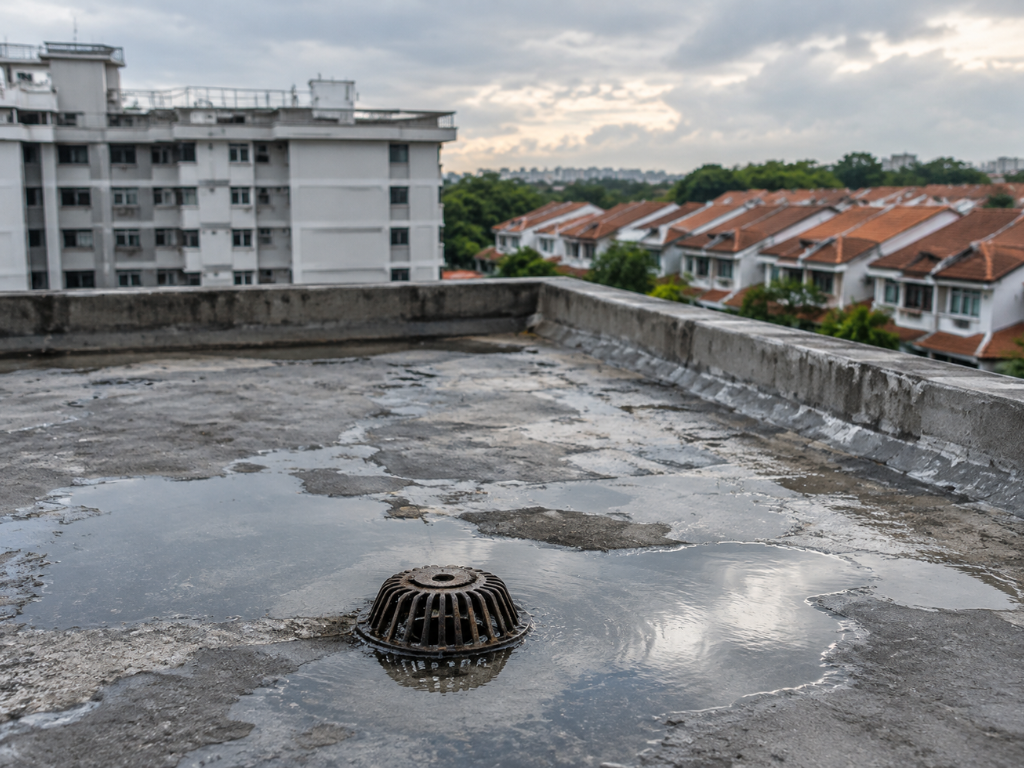
31 Oct Roof Leak Responsibility: Who Pays in Singapore?
Roof leak responsibility in Singapore turns on one question: who owns the roof. BCA’s Strata Management Guides, last updated 26 January 2026, now refer to the governing statute as the Building (Strata Management) Act, renamed from the Building Maintenance and Strata Management Act. Three tenures give three answers, and each one changes who you write to before repairing a leaking roof.
Proseal Contracts Pte Ltd has carried out roof leakage repairs for MCSTs, Town Councils and private owners across Singapore since 1999, BCA-registered under workhead CR13, Waterproofing Installation.
Responsibility at a glance
| Tenure | Who holds the duty | Funded from |
|---|---|---|
| Condo or strata, top-floor unit | Management corporation (MCST) | Sinking fund |
| HDB flat, top floor | Town Council | Town Council funds |
| Landed property | Owner, in full | Owner |
| Strata, leak between two lots | The lot found responsible | That owner |
Who is responsible for a roof leak in Singapore?
The party responsible for the roof is responsible for the leak. In a condominium or strata development that is the management corporation, because the roof is common property. In an HDB block it is the Town Council. In a landed house it is the owner, with no exception and no shared pathway.
The confusion here comes almost entirely from a category error. Most published guidance on Singapore water leakage deals with inter-floor leakage between two units, where the law provides a specific presumption about the lot above. A roof leak into a top-floor unit is a different animal. Nothing sits above the top-floor lot except common property, so there is no upper lot to presume against.
Getting the category right on day one decides who you write to, which fund pays, and how long it takes. A top-floor owner who spends three weeks negotiating with a neighbour has misidentified the problem. The same owner writing to the council with the correct statutory basis usually gets a site visit inside a fortnight.
Property type changes the cost picture as much as it changes the law, and seepage by property type sets out how the same defect behaves differently across HDB, condo and landed stock.
Is the roof common property in a condo?
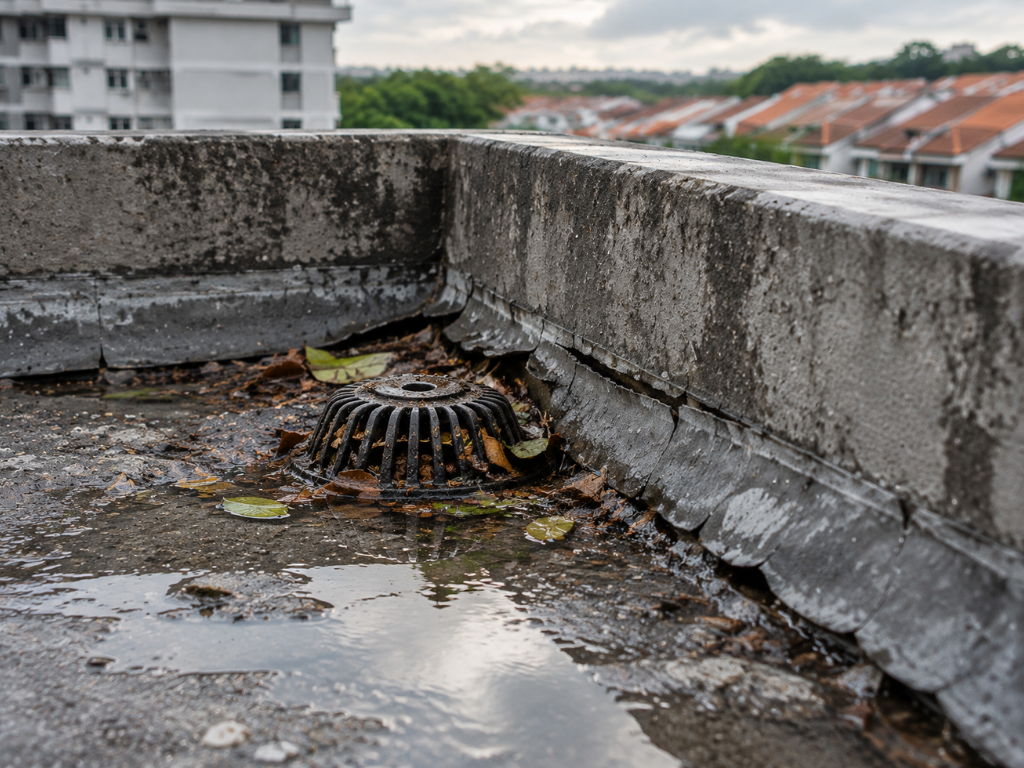
Yes. Common property under the Act is the part of the land and building not comprised in any lot, used or capable of being used by the occupiers of two or more lots. A roof slab, its waterproofing membrane, parapets and rainwater outlets all sit outside the boundaries of any single lot and serve the whole building.
Being physically above your unit does not make something part of it. The High Court settled the reasoning in Management Corporation Strata Title Plan No 367 v Lee Siew Yuen [2014] 4 SLR 445, where beams above the ceiling of a unit in a 41-year-old development were held to be common property. The Court held that “comprised” in the statutory definition means included in, not merely situated within, and that the beams formed part of a supporting infrastructure holding the building together.
That reasoning transfers directly to a roof. A roof slab over a top-floor lot is not comprised in the lot just because it sits on top of it.
One exception catches people out. Private roof terraces and balconies frequently are within the lot, and the boundary is set by the strata title plan, not by what looks obvious from inside the unit. Pull the plan before you argue the point, because a leak from a private roof terrace into the unit below is a different conversation with a different payer.
Does the inter-floor leakage presumption apply to a roof leak?
No, and this is the most common error in published guidance on the subject. The presumption in section 101(8) applies where there is an alleged defect in a lot, or in common property, situated immediately above another lot, and it shifts the burden to whoever controls the space above.
For a top-floor unit there is no lot above. Water is arriving from the roof, which is common property, so the burden sits with the management corporation and not with a neighbour. Invoking the presumption against an upstairs owner who does not exist wastes the one thing a leaking roof does not give you, which is time.
The presumption still matters in one roof-adjacent scenario. Where a unit sits below a private roof terrace belonging to another lot, that terrace is part of the upper lot, the situation is genuinely inter-floor, and the presumption operates normally.
Working out which of the two you have is a technical question before it is a legal one. Separating a membrane that has reached the end of its life from a defect somebody caused runs along the same lines as telling defect versus wear and tear apart in any seepage claim.
What must an MCST actually do about a leaking roof?
Control, manage and administer the common property, and keep it in a state of good and serviceable repair, renewing or replacing it where reasonably necessary. That duty is statutory, not discretionary, and it does not depend on how many owners are affected.
Teo Keang Sood, Professor at the National University of Singapore Faculty of Law, writing in the Singapore Journal of Legal Studies, describes the management corporation as being “under a statutory duty to maintain and upkeep the common property”. He notes that the duty continues after the developer’s defects liability period expires, which is the period most top-floor owners are told they have missed.
The Act goes further in one respect that rarely gets cited. Where a part of a building comprised in a lot contains a structural defect affecting the support or shelter provided for another lot, the management corporation must carry out the rectification work. Shelter is what a roof does. The duty reaches the roof by two routes, not one.
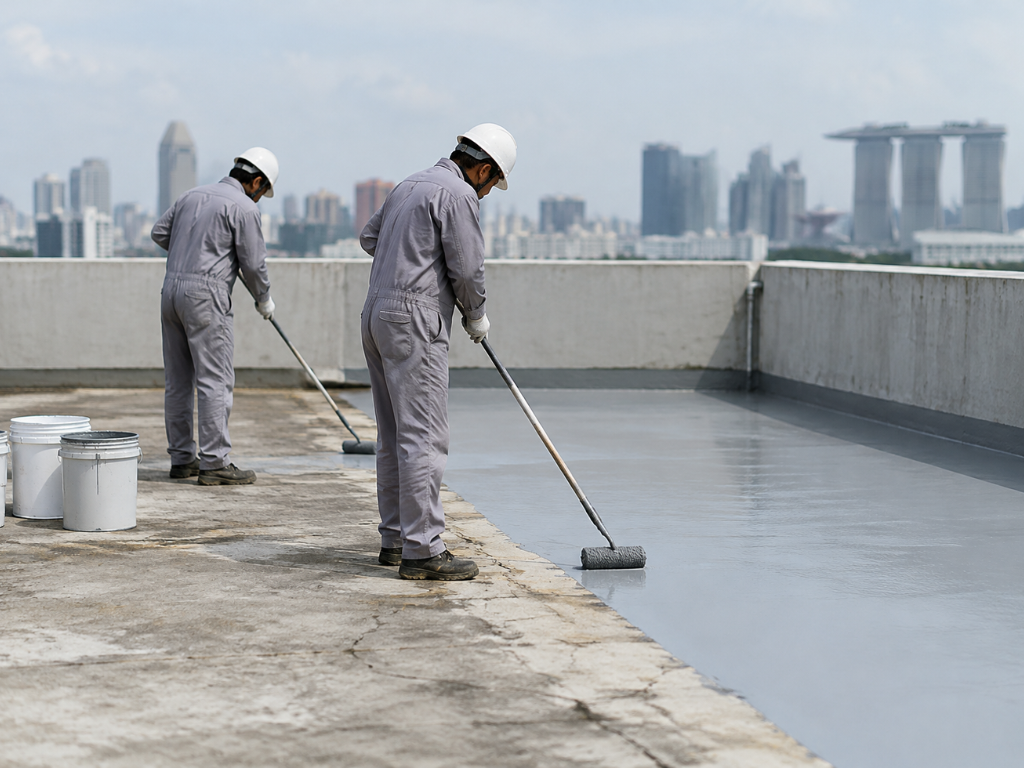
MCSTs that treat this as a procurement exercise instead of a dispute resolve it fastest. Proseal works to that model on water leakage repair services for councils, and the completed strata projects record is usually what a council wants to see before a motion goes to a general meeting.
Which fund pays, the management fund or the sinking fund?
The sinking fund. Roof waterproofing renewal is non-recurrent capital expenditure, which is exactly what the sinking fund exists for, and the two funds must be held separately.
The distinction is not bookkeeping preference. Recurrent operating costs such as cleaning, security and routine maintenance come from the management fund. Major repair or replacement of common property, including roof waterproofing and repainting, comes from the sinking fund. Moving money between them to cover a shortfall is an offence under the Act.
That one rule explains most of the delay top-floor owners experience. The law is clear, the council agrees, and the roof still waits, because the sinking fund balance will not carry a full membrane replacement and a special levy needs a resolution at a general meeting. Where the sinking fund is insufficient, the Act allows the management corporation to levy contributions on owners.
Know that before you write your first letter. A council that cannot fund a replacement can usually fund a diagnosis and a localised repair immediately, which stops the water while the capital works motion goes through the AGM cycle.
Who pays in an HDB flat with a top-floor roof leak?
The Town Council. The roof of an HDB block is common property maintained by the Town Council, so a leak entering a top-floor flat through the block roof is theirs to repair, and not a cost to share with a neighbour.
This is where the HDB and strata routes diverge sharply. HDB’s guidance on ceiling leaks treats the floor slab between two flats as a shared responsibility between the upper and lower owners, with the Goodwill Repair Assistance scheme covering 50 percent of the cost and the two owners splitting the balance. That framework applies to inter-floor leakage. It does not apply to a roof, because a roof is not a party structure between two flats.
Second-floor flats leaking down to a void deck are a third case again, with costs shared between the Town Council and the flat owner.
Top-floor owners routinely get routed into the neighbour-dispute process by default and spend weeks there. Say in the first message that the flat is on the top floor and that the suspected source is the block roof, and the file goes to the right desk.
What about a landed property?
The owner pays, in full. No shared pathway, no statutory presumption to fall back on, no management corporation, no Town Council, and no neighbour with a slab in common.
That sole liability cuts both ways. The owner carries the whole cost, and also carries the whole decision: no AGM cycle, no sinking fund balance, no council resolution. A landed owner who wants the roof done in March can have it done in March.
The one qualification worth checking is a party wall or a shared gutter on a terrace or semi-detached property, where a roof drainage element may serve two properties. Those are contractual and title questions, not strata ones, and the deed decides them.
Insurance is the other variable. Landed owners more often hold building cover than strata owners, whose building is usually insured by the management corporation under a single policy, so the claim route differs even where the physical repair is identical.
What if the MCST refuses or delays the repair?
Escalate in three steps: a written request citing the statutory duty, then mediation, then an application to the Strata Titles Boards. The Strata Titles Boards can make binding orders, including orders requiring works to be carried out.
Put the first request in writing to the council, not just to the managing agent. The managing agent executes decisions. The council holds the duty. A request that reaches only the agent’s inbox often stops there. A request minuted at a council meeting does not.
Include three things: the evidence of water ingress with dates, a request that the matter be tabled, and a reference to the maintenance duty under the Act. BCA publishes a set of Strata Management Guides covering dispute resolution and water seepage specifically, and quoting them in correspondence tends to shorten the exchange considerably.
Where the dispute is between neighbours and not with the council, the Community Mediation Centre and the Community Disputes Resolution Tribunals are the route. Which forum applies follows from where the water is coming from, and the building leakage action guide covers the diagnostic order that decision depends on.
What has changed in the law since October 2025?
The Act was renamed. With effect from 1 October 2025, the Building Maintenance and Strata Management Act became the Building (Strata Management) Act, and BCA now abbreviates it B(SM)A across its published guidance.
The rename matters for anyone reading older material. Almost every article, template letter and managing agent circular in circulation still says BMSMA, and much of the online guidance predates the change entirely. The substance of the maintenance duty is unaffected, so a correspondence file citing the old name is not void. But a council that cannot name the current Act is a council working from stale material on everything else too.
Singapore Statutes Online also records further amendments commencing in 2026. Anyone relying on a specific section number for a live dispute should check the current version of the Act itself, because section numbering has moved across revised editions before.
For a top-floor owner it comes to this: the duty you are relying on has not weakened, and the name on your letter should be current.
Why the law is the easy part
Roof leak liability in Singapore is settled law dressed up as a dispute. The roof is common property, the duty sits with the management corporation or the Town Council, and the landed owner carries it alone. What delays repairs is a sinking fund balance and a meeting calendar, which makes it a procurement problem and not a legal one.
Send your tenure, floor level and the leak dates through the contact form, or call 8688 8600. Proseal produces the scope and inspection report councils need before a motion goes to a general meeting.
FAQs about roof leak responsibility in Singapore
What is limited common property, and does a roof count?
Limited common property is common property designated for the exclusive use of some lots instead of all of them, such as a corridor serving one stack. A main roof serving the whole building is ordinary common property. The strata title plan, not the Act, records which designation applies to any given area.
Can the MCST charge the top-floor owner for roof repairs?
No, not for the roof itself. Roof waterproofing is common property maintained from the sinking fund, which every owner contributes to by share value. A top-floor owner pays their share of that fund like everyone else, and pays separately only for damage inside their own lot, such as ceiling finishes.
Does the managing agent decide, or the council?
The council decides. The managing agent is engaged to execute decisions and administer the estate, and holds no statutory maintenance duty under the Building (Strata Management) Act. Address requests to the council and ask for the matter to be minuted, because a decision that is not minuted has not been made.
Does the developer still pay if the building is new?
Only within the defects liability period under the sale and purchase agreement, which runs 12 months from the relevant trigger date. After that the management corporation’s duty continues regardless, which Professor Teo Keang Sood identifies as one of the inequities in the current framework.
Can I claim on my own insurance instead of waiting for the MCST?
Contents and internal finishes are often claimable under a personal policy while the building itself sits under the management corporation’s policy. Notify both, keep the dated photographs, and pursue the two in parallel, not one after the other, because the MCST route runs on an AGM calendar and the insurance route does not.

Sorry, the comment form is closed at this time.