





27 Oct PFI Remedial Works: Right Order After a Facade Inspection
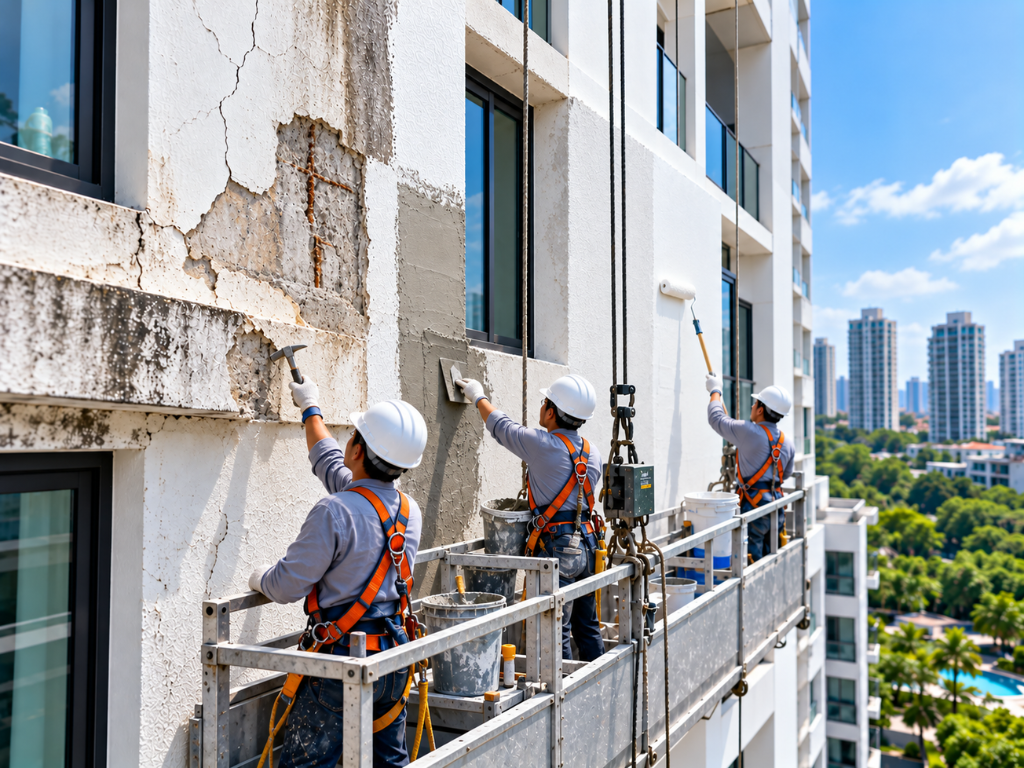
PFI remedial works are the facade repairs you have to carry out after a Periodic Facade Inspection rates your facade “Require Repair” or “Unsafe”. Make the unsafe items safe first. Then carry out the Competent Person’s repairs across the whole facade under a Professional Engineer’s supervision, photograph them, and close the job with a Completion of Remedial Works Report inside the Commissioner of Building Control’s deadline. Repaint last, because BCA’s PFI Guidelines never name paint as a remedial method and a coat of it hides the repairs your report has to evidence. Since 1 July 2025, you have 6 hours to report a fallen exterior feature that causes injury or damage, which raises the stakes on facade waterproofing and remedial works.
What the PFI classifications mean for your remedial works
A PFI report puts your facade in one of three classes, and the class decides how fast you act. BCA’s PFI Guidelines, Version 1.3 (September 2026), define them in section 10.1.
| Classification | BCA definition (section 10.1) | What the owner does next |
| Safe | “will not require any repair and is unlikely to become unsafe or require repair” | Nothing until the next cycle |
| Require Repair | “the condition of façade is deteriorating but does not pose any imminent danger” | Precautionary measures as recommended, then repairs within the stated timeframe |
| Unsafe | “dangerous and requires immediate attention and repair” | Immediate measures, Commissioner notified, then repairs |
The regime covers buildings taller than 13 m once they pass 20 years old, inspected every 7 years since 1 January 2022, under the Building Control (Periodic Inspection of Buildings and Building Facades) Regulations 2021. Landed houses and temporary buildings are exempt. BCA estimated about 30,000 buildings in the first seven-year cycle.
For both “Require Repair” and “Unsafe” facades, section 10.4 requires the report to recommend immediate precautionary measures. A “Require Repair” finding starts your clock all the same.
Unsafe defects come first: the 6-hour rule
Make unsafe elements safe before you plan, tender or paint anything. Section 10.2 of the BCA PFI Guidelines states: “Any building façade elements found to be loose or dangling shall be removed immediately.” Whether you also cordon off the area or put up protective hoarding is decided case by case.
The Competent Person must “immediately report the unsafe conditions to the Commissioner of Building Control and building owner” under section 4.1.4. You act straight away rather than waiting for the report to be filed.
Falling elements now carry a hard deadline. The Building Control (Reportable Matters) Regulations 2025 took effect on 1 July 2025. If a fallen exterior feature kills or injures someone, or damages other property, you report it to the Commissioner within 6 hours of becoming aware of it.
BCA’s PFI page gives the Safety Incident Hotline as 9789 7847 or 9781 6720, with the written report due within 24 hours through the online Fallen Exterior Features form. BCA’s circular of 13 December 2024 names who has to report: the building owner, the person responsible, the facade contractor or consultant, the person retrofitting, and the Competent Person.
The right order: remedial works first, repainting last
Repair in the order the risk runs, then paint. BCA’s guidelines never name paint or repainting as a remedial method, and the only coating they mention is “loss of protective coating” on galvanised steel brackets.
| Stage | Work | Who signs off | Why it sits here |
| 1. Make safe | Remove loose or dangling elements; cordon off; hoard | CP recommends; owner acts | Section 10.2 requires immediate removal |
| 2. Approvals | Structural plan approval and permit to commence structural works, where applicable | PE (civil or structural) | Section 12.2: obtain before repairs start |
| 3. Structural and concrete repairs | Spalling concrete, cracked concrete, corroded brackets | Supervising PE or CP | Strength comes before weatherproofing |
| 4. Render, tile and joint repairs | Bulging or cracked plaster, loose tiles, failed sealant | Supervising PE or CP | These are listed PFI defects in section 9.2 |
| 5. Leak sealing | Water entry points through cracks and joints | Contractor, checked by supervisor | Water left inside restarts corrosion |
| 6. Photograph and certify | Photos of completed repairs; certification | Owner submits; PE or CP certifies | Section 12.3; evidence must exist before paint covers it |
| 7. Repaint (optional, not a PFI item) | Primer and topcoats over cured, dry repairs | Owner’s own specification | Uses the same access; hides nothing still needed |
Watch out for a contractor who quotes “repair and repaint” as one line. If the painter covers a repair before the supervisor has inspected and photographed it, you lose the evidence your Completion of Remedial Works Report needs. Photograph every repaired location before the first coat goes on.
Proseal handles the repairs in stages 3 to 5 as a BCA-registered contractor working to the CP’s recommendations. That covers spalling and crack repair, PU injection for leaking cracks and external wall leak sealing. Repainting sits in Proseal’s general works and repainting scope, priced as its own stage.
Repair the whole facade, not just the 10% inspected
Your repair proposal covers the entire facade, even though the close-range inspection doesn’t. Section 6.4.1.1 requires close-range inspection of “at least 10% of the surface area of each elevation.” Section 11.4.7(a) then requires the repair proposal to cover the “entire façade, not just for the inspected façade areas.”
That difference affects your budget. The CP works from a sample, so the quantities for the uninspected areas are estimates. Price the remedial contract on rates per defect type, and the scope can grow as the crew finds defects in the uninspected areas without you going back out to tender.
Your repair crew is already on the facade, so it can tap and sound the uninspected 90% as it works. Proseal’s rope access remedial teams reach each defect point without re-rigging, and the technicians hold IRATA certification and the MOM-mandated Work-at-Height course. Section 6.4.3.3 asks the CP to pick different areas for close-range inspection in the next cycle, 7 years on.
Who supervises, signs and submits
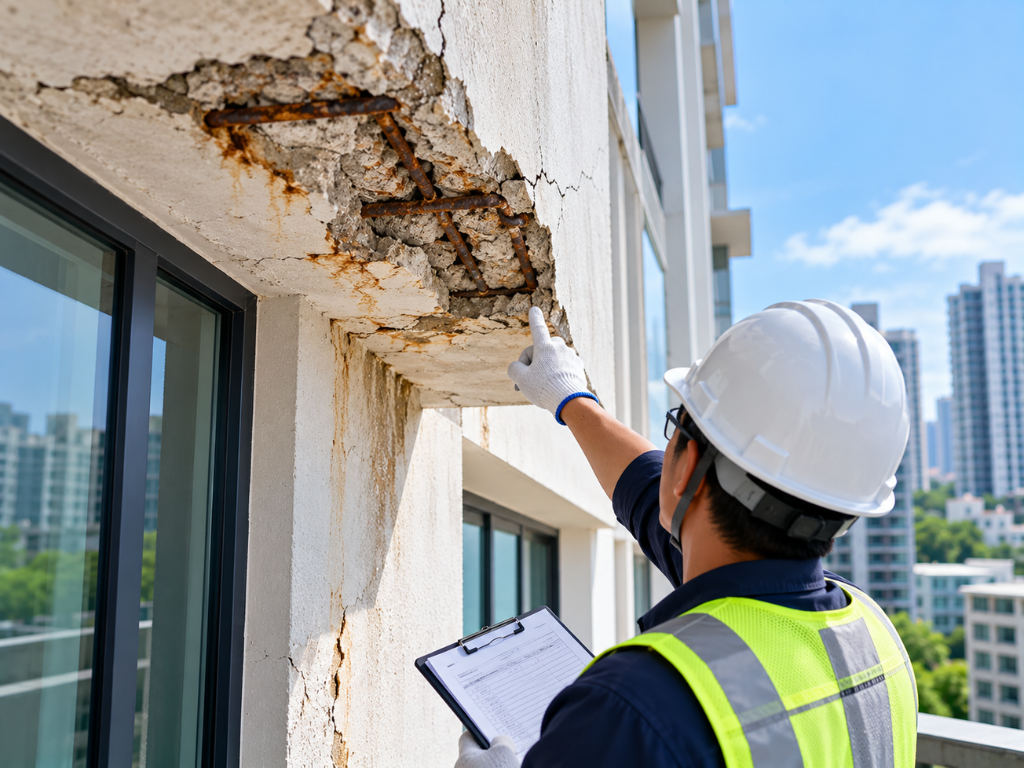
The Competent Person diagnoses, a Professional Engineer supervises the repairs, and you submit the paperwork. Section 3.2 defines the CP as a Professional Engineer in the civil or structural discipline, or a Registered Architect. Both the CP and the Facade Inspector must hold the Certificate in Façade Inspection under section 3.4.
The Facade Inspector is a registered Resident Engineer or Resident Technical Officer, or another person BCA recognises. The FI works under the CP’s “direction and supervision”, and the CP “remain[s] ultimately responsible”.
Who supervises the repairs depends on who your CP is. Under section 12.2, if the CP is a Professional Engineer, the guidelines recommend appointing the same person to supervise. If the CP is an architect, you have to appoint a Professional Engineer to supervise the repair works.
Close-out runs on BCA’s own forms. BCA’s PFI page lists three: the PFI_F1 Appointment Form, the PFI Report Template and the PFI Completion of Remedial Works Report Template. Section 12.3 requires photos of the completed repairs and a certification that they followed the CP’s recommendations under PE or CP supervision. In a condo, the MCST council makes those decisions, as Proseal’s guide to who owns the external wall explains.
Deadlines and penalties for PFI remedial works
You have to finish the recommended works within the period the Commissioner of Building Control specifies. Section 28(7) of the Building Control Act states that the owner “must carry out, or cause to be carried out” those measures or works within that period. The repair proposal itself has to state a “timeframe to complete the repairs”.
Missing it is an offence. Under section 28(9), an owner who fails without reasonable excuse to carry out the works faces a fine of up to $20,000, imprisonment of up to 12 months, or both. A continuing offence adds up to $500 for each day, rising to $2,000 for each day after conviction.
Plan around the timeframe in the proposal. Agree it with your CP before the report is filed, so the remedial contract, the access method and the weather window all fit inside it.
Repair first, evidence second, paint third
Treat a PFI report as a repair order with a deadline, and paint isn’t on it. Make unsafe items safe within hours, repair the whole facade to your CP’s proposal, photograph every repair and file the completion report, and you’ve done what section 28 asks of you. Repainting after that costs you less, because the access is already up and nobody needs to see under the paint again.
Holding a PFI report with “Require Repair” items? Send Proseal your CP’s repair schedule for a remedial-works quote with repainting priced as a separate stage.
Frequently asked questions
Does a PFI require repainting the building?
Not as a standard item. BCA’s PFI Guidelines, Version 1.3 (September 2026), don’t list paint or repainting as a remedial method. The inspection targets cracked or bulging plaster, spalling concrete, loose tiles, damaged sealant and corroded brackets. Follow your CP’s report if it recommends a protective coating. Otherwise, repainting is your own choice.
What is the PFI Completion of Remedial Works Report?
It’s BCA’s template for closing out the repairs a PFI report recommended. Under section 12.3 of the PFI Guidelines, you submit photos of the completed repairs and a certification that they followed the Competent Person’s recommendations under the supervision of a Professional Engineer or the CP. You’ll find the template on BCA’s PFI page.
Who can carry out PFI remedial works?
You appoint the contractor, but the works have to follow the Competent Person’s recommendations, with a Professional Engineer or the CP supervising. Under section 12.2, structural repairs need plan approval and a permit to commence structural works, where applicable. Proseal carries out remedial works as a BCA-registered contractor founded in 1999.
Do landed houses need a Periodic Facade Inspection?
No. BCA’s October 2021 announcement exempted landed houses and temporary buildings. The regime applies to other buildings taller than 13 m once they pass 20 years old, with inspections every 7 years from 1 January 2022. BCA estimated about 30,000 buildings would need inspection in the first cycle.

Sorry, the comment form is closed at this time.