





21 Oct Painting After Waterproofing: How Long to Wait in Singapore
You can paint over waterproofing once two clocks have run out: the membrane’s cure time on its technical data sheet, and the time your wall needs to dry below the primer’s moisture limit, which is 18% or lower on a Protimeter for Nippon Paint’s 500 Sealer. Check that the paint system suits the membrane’s chemistry as well, because the wrong pairing peels. HDB handled an average of 77 complex seepage cases a month in 2025, so the repaint that follows waterproofing and leak repair is routine work in Singapore homes.
How long after waterproofing can I paint?
Wait for whichever clock runs longer: the membrane’s cure time, or the time your wall needs to dry below the primer’s moisture limit. You’ll find the cure time on the membrane’s TDS and the moisture limit on the primer’s TDS. Two manufacturers wrote those documents and they rarely agree, so read both before you book the painter.
| What was applied | What the data sheet says | Practical wait before paint |
| Acrylic-PU hybrid wall membrane (Sika Sikalastic-595) | 1 to 2 hours between its own coats at 30°C; ready for use after about 24 hours; silent on overpainting | 24 hours minimum, plus written paint-compatibility confirmation from Sika |
| Aromatic PU membrane (Sika Sikalastic-618, UK data sheet) | Finishes with its own top coat; coats ideally within 48 hours; after 4 days, clean and apply Sika Reactivation Primer | Use the system’s own top coat; any later coat goes on reactivation primer |
| Cementitious slurry (SikaTop-107 Seal PH) | Not for long-term UV exposure; cover with screed or tile adhesive within 7 days; keep off rain for 24 hours | Not a paint base on exposed surfaces; tile or screed within 7 days |
| Bitumen coating (Bond It Bitumen Paint) | Dries in about 24 hours; may bleed through paint applied over it | Only after a blocking primer the paint maker recommends |
| New cement plaster or render patch (Nippon 500 Sealer) | Cure 28 days or reach 18% moisture or lower on a Protimeter, whichever comes first | Sealer once the meter reads 18% or lower, or on day 28 |
Your render patch usually sets the date, and the membrane finishes long before it. Sika rates Sikalastic-595 ready for use after about 24 hours. The Nippon Paint 500 Sealer data sheet asks for new plaster to cure for 28 days or read 18% or lower on a Protimeter before the sealer goes on. So if a leak repair patched your render, the repaint waits days or weeks after the membrane itself is done.
Can you paint over a waterproofing membrane?
You can paint over a UV-stable liquid membrane once the manufacturer confirms the paint is compatible. You can’t treat a cementitious slurry built to sit under tiles as a paint base, and you can’t paint over bitumen without a blocking primer. Check the membrane type named on your applicator’s quotation to see which case you’re in. Proseal’s guide to how each membrane system works covers the differences.
PU and acrylic-PU membranes
Sikalastic-595 resists UV, mould and fungus. Sika reports no cracking, chalking, blistering or peeling after 2,000 hours of QUV artificial weathering. On a membrane like this, paint adds colour and nothing else. The data sheet names the top coat as another layer of Sikalastic-595 at 0.5 L/m² or more, and it says nothing at all about paint.
A silent data sheet doesn’t mean yes. Ask the membrane supplier to confirm in writing before anyone brushes acrylic emulsion on top, or order the membrane in the colour you want and skip the paint.
Single-component aromatic PU systems follow a stricter rule. Sika’s UK data sheet for Sikalastic-618 builds the system with its own top coat and asks for each coat within 48 hours. After 4 days, the applicator has to clean the surface and prime it with Sika Reactivation Primer before the next coat goes on. Paint on an aged membrane faces the same adhesion problem, so the membrane maker’s primer comes first.
Cementitious membranes
Sika doesn’t design SikaTop-107 Seal PH, a two-component polymer-modified cementitious slurry, for long-term UV exposure. Sika requires screed or cementitious tile adhesive over it within 7 days, and protection from rain for at least 24 hours. Paint an exposed slurry on a balcony upstand or planter wall and you leave the waterproofing layer to weather under a thin decorative film. Check whether the TDS allows exposed use before anyone opens a paint tin.
Bituminous membranes
Bitumen stains paint from underneath. Bond It’s data sheet for its bitumen paint warns that it “may bleed through any paints subsequently applied over it”. The same sheet asks for a primer recommended by the paint manufacturer before overpainting. If you see a brown or black shadow coming through new emulsion, this is what happened.
Is waterproof paint the same as a waterproofing membrane?
No. Waterproof or elastomeric paint is a wall coating that sheds rain off render. A membrane is a waterproofing system of the kind SS 637:2018, Singapore’s code of practice for waterproofing reinforced concrete buildings, covers for roofs, floors, walls and basements. On external walls you need both. Proseal’s external wall repairs seal the entry point, apply an elastomeric waterproof coating over the affected area, then finish with matched paint.
Which primer goes over a waterproofing membrane?
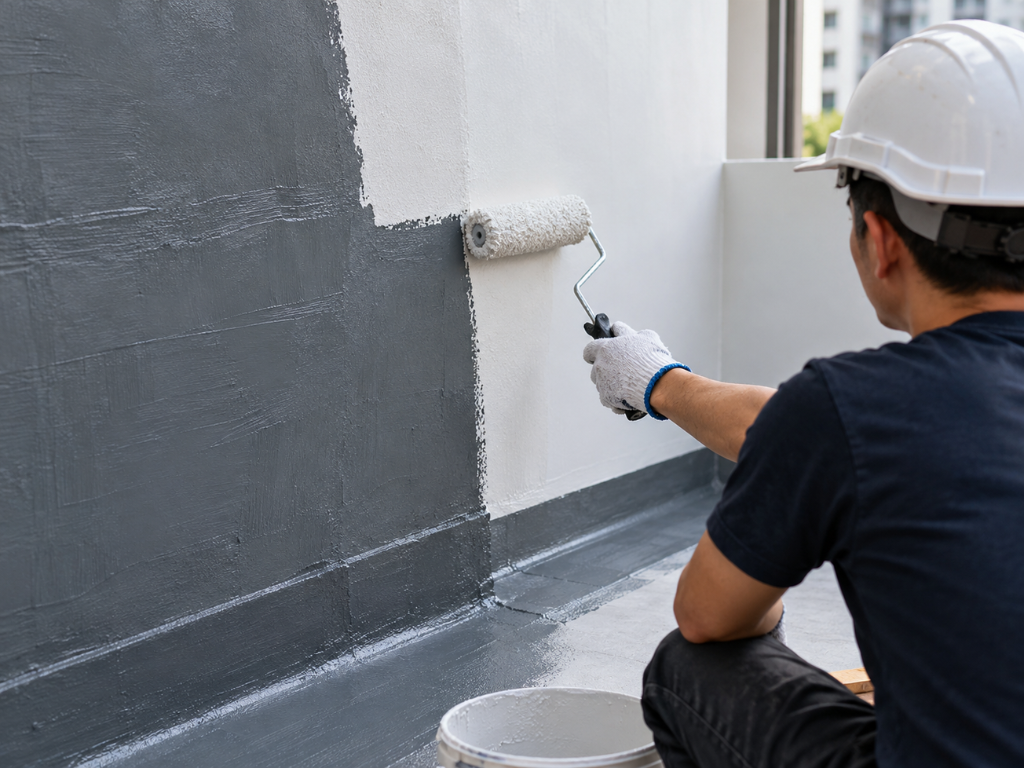
Use the primer the membrane manufacturer names for overcoating. On cement render, plaster or patched concrete that will take emulsion paint, use an alkali-resistant sealer. You’re dealing with two different products for two different surfaces.
Manufacturers make alkali-resistant sealers for porous, alkaline masonry. Jotun’s Jotashield Primer, a water-based acrylic, seals the substrate against alkalis and moisture to keep efflorescence and discolouration down. It’s dry to overcoat in 2 hours at 23°C and 1 hour at 40°C, measured at 50% relative humidity. Nippon Paint’s 500 Sealer, a solvent-based acrylic made for high penetration, takes an overcoat after 2 hours.
Neither works on a membrane. A cured PU membrane isn’t porous, so a penetrating masonry sealer has nothing to soak into. It sits on top as a weak layer between the membrane and your paint. On a membrane surface, the membrane maker’s primer or reactivation primer is the base.
Both paint makers specify the same build on masonry: 1 coat of primer or sealer, then 2 coats of topcoat. Jotun pairs Jotashield Primer with its Jotashield or Super Jotashield topcoats.
How Singapore humidity and rain change the painting day
Singapore mornings regularly break the humidity limits printed on waterproofing data sheets. The Meteorological Service Singapore climate records show relative humidity above 90% just before sunrise on dry days, falling to around 60% by the afternoon. The mean annual figure sits around 82%. Sika caps Sikalastic-595 application at 85% relative humidity.
Dew point matters as much as rain. Jotun and Sika both require the surface to sit at least 3°C above the dew point, so moisture doesn’t condense under the fresh film. A shaded wall still cool from overnight rain is the one most likely to fail that check, however dry it looks.
The season sharpens the problem right now. MSS describes October to November as the wetter of Singapore’s two inter-monsoon periods, with afternoon and early-evening thunderstorms that turn severe at times. Mean annual rainfall for 1991 to 2020 was 2,113.3 mm.
Work with a narrower window this season. Start exterior coats after the morning humidity drops, finish before the afternoon storms build, and re-measure moisture on any wall that caught rain since the last coat. Proseal’s explainer on why building walls absorb moisture covers how render takes on water in the first place.
Why paint fails after waterproofing
Paint over waterproofing fails because of moisture and chemistry, and rarely because of the paint. Each failure leaves a symptom you can trace back to its cause.
| Symptom | Cause | Fix |
| Blisters within weeks | Paint sealed over a damp substrate | Strip, dry the wall to 18% or lower, re-prime |
| White powder or patchy colour | Alkali and efflorescence from fresh render, no alkali-resistant sealer | Brush off salts, apply alkali-resistant sealer, repaint |
| Brown or black stain through paint | Bitumen bleed | Blocking primer the paint maker approves |
| Paint peeling off in sheets | Incompatible or unprimed membrane surface, or a missed recoat window | Membrane maker’s primer or reactivation primer, then compatible topcoat |
| Fine blisters after a cool morning | Condensation, surface below dew point plus 3°C | Paint later in the day on a warmed surface |
| Stain returns after the next storm | Leak source never fixed | Diagnose and repair the entry point before any paint |
The last row costs the most. No primer holds over an active leak, and a fresh coat only covers up the evidence the next contractor needs.
Plenty of Singapore homes are in this position. HDB handled 615 complex seepage cases from January to August 2025, an average of 77 a month against 72 a month in 2024, according to the Ministry of National Development. Tracing the seepage source first tells you whether you have a building defect or wear and tear, and whether repainting fixes anything at all.
Repainting after a leak repair in HDB flats, condos and landed homes
Whoever is responsible for the wall arranges the repaint. The Town Council handles HDB block facades, the MCST handles condo external walls, and you handle your own landed home or the inside of your unit.
New BTO developments carry a 6-year warranty on external paintwork covering peeling, discolouration and algae growth, handed to the Town Council at completion, according to the Ministry of National Development’s 2022 parliamentary answer. After the warranty runs out, Town Councils maintain block paintwork. In condos, external walls are common property under the Building (Strata Management) Act, formerly the BMSMA, so the MCST approves and funds the work.
Hire one contractor for both trades and you close the warranty gap. When a painter and a waterproofer come from different firms, a returning stain turns into an argument over whose layer failed. Proseal handles external wall leakage repair and the repaint under one scope through its repainting and general building works, using rope access on high-rise facades instead of scaffolding.
The repaint sequence after a leak repair
- Confirm the source is fixed. The wall has to stay dry through at least one heavy rain before you schedule paint.
- Let patched render cure. Wait 28 days, or until a moisture meter reads 18% or lower.
- Seal the masonry. One coat of alkali-resistant sealer on render, and the membrane maker’s primer on any membrane surface.
- Check the conditions. Relative humidity under 85%, with the surface at least 3°C above dew point.
- Apply two topcoats. Follow the overcoat interval on the primer’s TDS, usually 2 hours at Singapore temperatures.
Let the wall set your painting date
Your wall decides when you paint, and the membrane rarely does. A liquid membrane is ready in about a day, while a patched render holds the job until it reads 18% or lower. Singapore’s 82% average humidity and October storms narrow your window further. Match the primer to the surface rather than the paint brand, and keep paint off any stain that comes back after rain.
Planning a repaint after waterproofing or a leak repair? Book a repaint inspection with Proseal and get the repair and the paint quoted as one job.
Frequently asked questions
Can I paint the same day as waterproofing?
No. Even a fast liquid membrane like Sika’s Sikalastic-595 needs about 24 hours before it’s ready for use, and that figure assumes 50% humidity rather than a Singapore morning above 90%. Any new render patch also has to cure 28 days or reach 18% moisture on a Protimeter, per Nippon Paint’s 500 Sealer data sheet.
How do I know the wall is dry enough to paint?
Measure it with a moisture meter. A Protimeter reading of 18% or lower meets Nippon Paint’s limit for new plaster before its 500 Sealer goes on. Take the reading after the morning humidity drops, and again after any rain, because a wall that passed on Monday can fail after a Tuesday thunderstorm.
Can I paint exterior walls during the inter-monsoon season in Singapore?
Yes, within a narrower daily window. The Meteorological Service Singapore expects afternoon and early-evening thunderstorms in October and November, the wetter of the two inter-monsoon periods. Paint between the late-morning humidity drop and the afternoon storms, and keep the surface at least 3°C above dew point, as Jotun’s Jotashield Primer data sheet requires.
How long does exterior paint last on Singapore walls?
Plan on repainting exposed elevations every 5 to 8 years. Proseal’s external wall repair work puts tropical UV breakdown of sealant and paint within that range. For comparison, new HDB BTO blocks carry a 6-year warranty on external paintwork against peeling, discolouration and algae, per the Ministry of National Development in 2022.

Sorry, the comment form is closed at this time.