





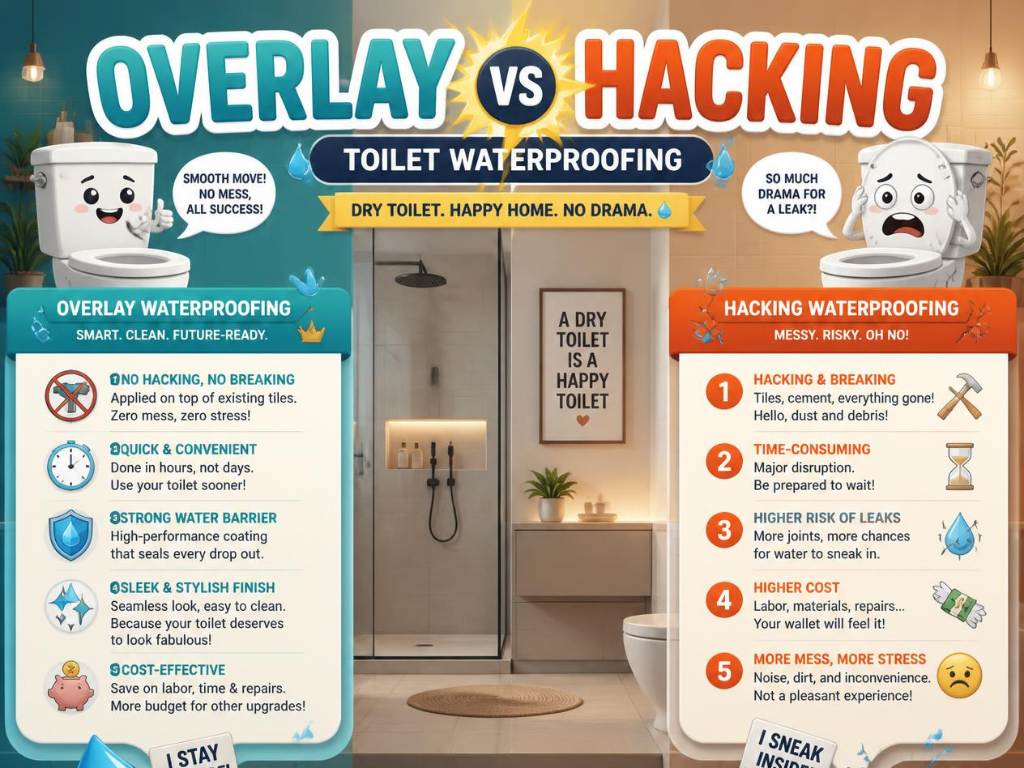
26 Aug Overlay vs Hacking Toilet Waterproofing: How to Choose
The overlay vs hacking toilet waterproofing decision is made by the substrate, not by preference. HDB restricts tile hacking in new flats for the first three years, which settles it for some owners before any inspection happens. This blog walks you through the diagnostic that decides it, both processes end to end, and where each one goes wrong, alongside leak repair and waterproofing work.
Proseal Contracts Pte Ltd is a BCA-registered waterproofing specialist and licensed building contractor founded in Singapore in 1999, working under workhead CR13, Waterproofing Installation.
Overlay or hacking: what is the short answer?
Overlay applies a new membrane over existing tiles after surface preparation, and works when the tiles are fully bonded, the substrate is dry and there is no active leak. Hacking removes tiles and compromised screed to reach the slab, and is required when any of those three conditions fails.
Three findings send a bathroom to hacking on their own. More than 15% hollowness measured across the floor by percussion test. Substrate moisture above 5% to 6% on a meter. Any water stain or damp patch in the unit below.
| Condition | Method |
| Tiles fully bonded, substrate dry, no leak history | Overlay is a candidate |
| Over 15% hollowness on percussion test | Hacking |
| Substrate moisture above 5% to 6% | Hacking |
| Stain or damp in the unit below | Hacking, without exception |
| Water pools and drains slowly after showering | Hacking, falls need correction |
| Bathroom over 15 to 20 years old on original membrane | Hacking strongly indicated |
Overlay costs roughly a third of hacking and carries roughly half the warranty. That ratio makes it attractive on paper, and it is the reason it gets recommended for bathrooms that cannot support it.
The table above is a screening tool, not a diagnosis. Two of the six rows need equipment to answer properly, and the moisture reading in particular cannot be eyeballed. Treat a clear result as permission to consider overlay rather than as a decision already made.
How do contractors actually diagnose which method you need?
A competent diagnostic takes 20 to 30 minutes and produces findings, not an opinion. A contractor who reaches a quote in under five minutes has guessed.
The sequence runs six checks. Visual inspection first, looking for cracked or lifted tiles, staining on the ceiling below, and damp at the skirting. Then the percussion test, tapping systematically across the floor with a solid instrument, because a hollow ring means the tile has lost adhesion to what is under it. Then a moisture meter reading of the substrate. Then grout line condition, where crumbling or missing grout indicates water has been tracking under the tiles for a long time. Then the floor trap and falls, because compromised drainage requires hacking regardless of how sound the tiles are. Finally, in an HDB flat or a condo, the unit below.
That last check is the one owners skip and it overrides everything above it. A stain on the neighbour’s ceiling means water has already crossed the slab, and spotting a ceiling leak early is what tells you the water path sits under the tiles rather than on them.
Ask for the findings in writing. Percussion results as a percentage, moisture as a figure, not “seems fine”. A specialist has the numbers because they took them.
What actually happens during overlay waterproofing?
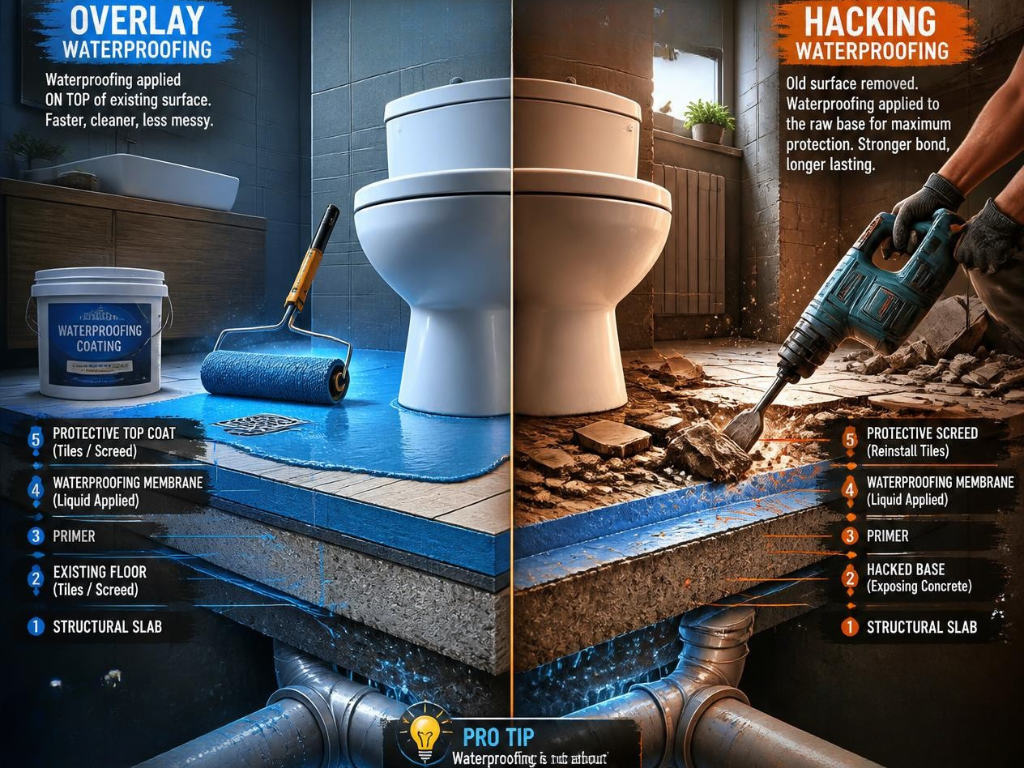
Overlay runs 2 to 4 days and never touches the slab. The membrane bonds to the tile glaze, which is why surface preparation decides whether it works.
Day one covers deep cleaning of tiles and grout lines and removal of old sealant and silicone at the wall-to-floor junction, followed by mechanical preparation, light grinding or acid etching, to create a bond profile on the glaze. Day two is primer, matched to the selected system rather than generic. Days two to three carry the membrane itself, typically two coats of cementitious or one to two coats of liquid PU at 1.0 mm to 1.5 mm dry film thickness. A thin protection layer follows where specified, and the job closes with a ponding test held a minimum of 24 hours before sign-off.
Three things overlay does not do, and no contractor should imply otherwise. It does not fix hollow tiles, which stay hollow under the new membrane. It does not correct drainage falls. And it does not reach water already sitting in the substrate.
Typical warranty runs 2 to 5 years depending on the system. The sequence itself is the same one used at slab level, and the membrane installation steps matter more here than in hacking, because the bond surface is less forgiving.
What does hacking and redoing bathroom waterproofing involve?
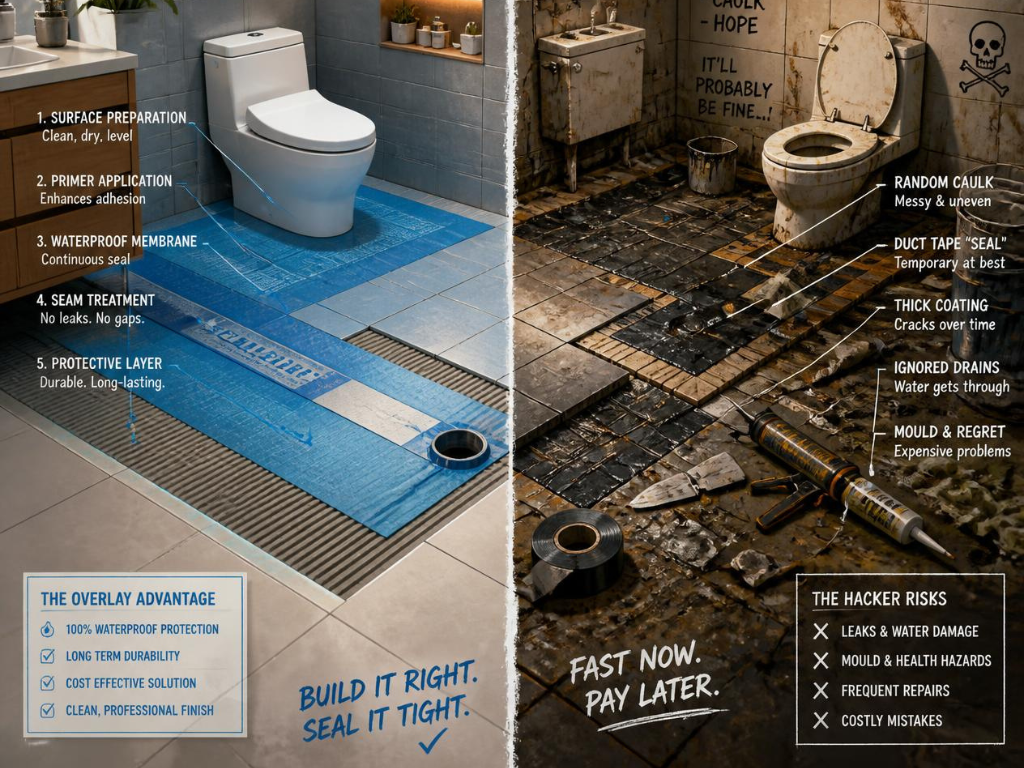
Hacking runs 7 to 14 days and reaches the slab, which is what lets it fix everything overlay cannot. Fixtures come out first, with site protection and dust containment, then tiles and compromised screed are removed and disposed of.
Substrate remediation follows, covering crack sealing, slab patching and drainage rectification. Then priming, then the membrane at 1.5 mm to 2.0 mm dry film thickness with wall turn-up carried to 300 mm where the design allows. A protection screed goes on next, laid to correct falls toward the floor trap, and that step matters more to long-term performance than the membrane brand does. The ponding test runs 24 hours, and 48 is common on master bathrooms. Re-tiling, grouting, silicone sealing and fixture reinstatement close the job.
Three things only hacking achieves. Full substrate remediation at slab level. A true wall-to-floor junction, because the turn-up starts below the tile line rather than over it. And a membrane in direct contact with concrete, which is the strongest bond available in the assembly.
Typical warranty runs 5 to 10 years depending on the system and the applicator’s certification. Where multiple wet zones connect, the wet area scope of works should treat them as one scope rather than three separate jobs.
How do overlay and hacking compare side by side?
Hacking costs roughly three times overlay and buys roughly double the warranty, full substrate access, and the ability to correct falls. Overlay buys speed and low disruption on a bathroom that does not need those things fixed.
| Factor | Overlay | Hacking |
| Duration | 2 to 4 days | 7 to 14 days |
| Relative cost | Baseline | Roughly 3x |
| Membrane dry film thickness | 1.0 to 1.5 mm | 1.5 to 2.0 mm |
| Wall turn-up | Limited, sits over existing tiles | Up to 300 mm from slab level |
| Substrate remediation | Not possible | Yes |
| Falls correction | Not possible | Yes |
| Typical warranty | 2 to 5 years | 5 to 10 years |
| Dust and debris | Minimal | Significant, containment required |
| Viable with existing leak | No | Yes |
Two rows carry more weight than the rest. Falls correction decides whether water reaches the floor trap at all, and no membrane compensates for a floor that ponds. Wall turn-up decides whether the wall-to-floor junction is protected below the tile line or merely above it, and that junction is where most wet area failures begin.
The trade-off only reads as a trade-off when the bathroom is a genuine overlay candidate. Where it is not, overlay is the most expensive decision available, because the money is spent, the failure still arrives, and the hacking job that follows also has to pay for the damage in between.
When does overlay fail, and why?
Overlay fails when it is bonded to something that is already failing. The membrane inherits the strength of whatever sits beneath it, which on a compromised floor is old tile adhesive that has lost its grip.
There is published evidence for this. Garrido and colleagues, writing in Construction and Building Materials in 2018, found that peel failure at joints between new and aged bituminous membranes occurred predominantly on the aged side rather than at the new material. Zhang and colleagues, writing in Polymers in January 2026, measured how far that degrades with age: cracking temperature shifted from −35 °C to −28 °C for one system after 28 days of accelerated ageing, and from −28 °C to −18 °C for another. Their conclusion for practitioners is that “material selection should be tailored to the aging condition of existing membranes.”
Four failure patterns recur. Hollow tiles ignored, where a floor above 20% hollowness continues loosening under the new membrane and cracks it within 12 to 18 months. An active leak masked, where water keeps tracking its existing path under the tiles and returns within 6 to 12 months, now trapped under two layers. Wrong falls left uncorrected, where water pools after every shower until the grout erodes and the silicone breaks. And old adhesive that has lost bond, where the overlay separates along with the layer it was stuck to.
Every one of those four would have been caught by a percussion test and a moisture reading. The overlay recommendation was either inexperience or a commercial preference.
When is hacking oversold?
Hacking gets recommended for bathrooms that do not need it, and the incentive is visible in the quotation. A hacking job is three to five times larger with more line items, which means more places for margin to sit.
Four situations where overlay would have worked. A bathroom under ten years old with all tiles sound and no leak history, needing a waterproofing refresh rather than a rebuild. Pre-emptive work before a property sale where the substrate is intact. Surface efflorescence or cosmetic staining misread as substrate failure. And scope creep, where waterproofing gets absorbed into a full bathroom renovation that was never driven by a waterproofing problem.
Protect yourself with three requests and one question. Ask for the percussion test result as a percentage. Ask for the moisture reading as a figure. Get a second opinion where hacking is recommended without specific findings cited.
Then ask this: if I choose overlay, what specific conditions in my bathroom would cause it to fail within five years? A specialist answers with the findings they took. An overseller answers with generalities about water always finding a way.
What if HDB will not let you hack?
For a new HDB flat, hacking is not an option regardless of what the diagnostic finds. HDB restricts removal of bathroom floor and wall tiles for the first three years from completion, to protect the waterproofing membrane it installed and warrants.
That changes the correct action rather than the correct method. An owner inside the restriction window with an active leak is not looking at a repair decision, they are looking at a warranty claim against HDB’s own membrane. Hacking anyway voids that warranty, and unauthorised works carry a reinstatement order and a fine of up to $5,000. Overlay remains permitted, because it adds a layer rather than removing one.
Two further HDB rules apply once the window has passed. Any contractor working in an HDB flat must be listed in HDB’s Directory of Renovation Contractors, and they submit the permit rather than you. And the membrane must carry a minimum 150 mm upturn at the wall, which is checkable against any quotation.
Where a leak appears in a flat that is three to five years old, establishing whether the cause is defect or normal wear decides who pays before it decides which method applies. Worth resolving that before commissioning anyone.
Which method is cheaper over ten years?
The right method at the start is always cheaper. The wrong one compounds, and the gap is roughly threefold rather than marginal.
An overlay chosen correctly on a sound substrate runs its initial cost, a minor junction touch-up around year six, and an optional second application around year nine. Across ten years that lands near double the original figure and stays the cheapest route available.
An overlay chosen incorrectly on a compromised substrate follows a different path. The leak returns around year two. Ceiling repair in the unit below, whatever is negotiated with the neighbour, the hacking job that was always going to be needed, and reinstatement of the finishes damaged in between. That sequence commonly reaches seven to eight times the original overlay figure.
Hacking chosen correctly runs its initial cost and very little else inside the decade. Compared against the failed-overlay path, choosing it at year zero saves the majority of the total.
The comparison that matters is total cost across the years you intend to hold the property, which is why scoping kitchen and toilet systems against that horizon beats optimising the first quotation.
How can you check this yourself before calling anyone?
Run five checks in order and stop at the first yes. Each one on its own sends the job to hacking.
Is there an active leak, a water mark on the ceiling below, or a damp patch anywhere? Tap ten spots across the floor with a metal spoon; do more than two sound hollow? Is the bathroom over 15 years old on its original waterproofing? Does water pool after showering and drain slowly toward the floor trap? Has anyone in the unit below mentioned staining?
Clear all five and overlay is a legitimate candidate, subject to a moisture reading you cannot take yourself. That last step is why this is a screening exercise rather than a diagnosis: substrate moisture above 5% to 6% disqualifies an overlay and is invisible without a meter.
Worth noting: if any of the five returned a yes and a contractor still proposes overlay, ask them to explain the finding rather than the method. A firm that has done the diagnostic can reconcile the two. A firm that has not will change the subject.
Conclusion
Substrate condition picks the method and everything else is commentary. Overlay is the cheaper answer to a sound bathroom and the most expensive answer to a compromised one, because a membrane is only ever as strong as the layer it bonds to. The percussion test and the moisture reading take twenty minutes and settle a decision worth thousands.
Send your property type, the bathroom’s age and whether anyone below has reported a stain through the contact form or call 8688 8600. Proseal provides written diagnostic findings with the method recommendation, not just a price.
FAQs About Overlay Vs Hacking Toilet Waterproofing
Can I just overlay my bathroom waterproofing without hacking in Singapore?
Yes, where tiles are fully bonded, the substrate is dry and there is no leak history. Overlay carries a 2 to 5 year warranty against 5 to 10 for hacking. For new HDB flats inside the three-year restriction on tile removal, overlay is the only permitted option.
Can overlay waterproofing fix an active leak from my HDB bathroom?
No. An active leak means water is already tracking under the tiles, and a surface membrane cannot reach a path beneath it. The water continues along the same route and the leak returns within 6 to 12 months, now sealed under two layers instead of one.
Does overlay waterproofing last as long as hacking?
No. Overlay typically warrants 2 to 5 years and hacking 5 to 10, because a membrane bonded to tile glaze cannot match one bonded directly to concrete. Zhang and colleagues, in Polymers in January 2026, showed bond performance degrading measurably with the age of the surface underneath.
What if a contractor recommends overlay but my neighbour has a ceiling stain?
Decline it. A stain in the unit below means water has crossed the slab, which puts the failure beneath the tiles where an overlay cannot reach. Ask the contractor to explain that finding against their recommendation, and treat a vague answer as your decision.
Do I need a BCA-registered contractor for overlay or hacking waterproofing?
Registration is not legally required for private residential work, but CR13, Waterproofing Installation, is the BCA workhead that identifies a waterproofing specialist. For HDB flats there is a separate requirement: the contractor must be listed in HDB’s Directory of Renovation Contractors and submits any permit on your behalf.

Sorry, the comment form is closed at this time.