





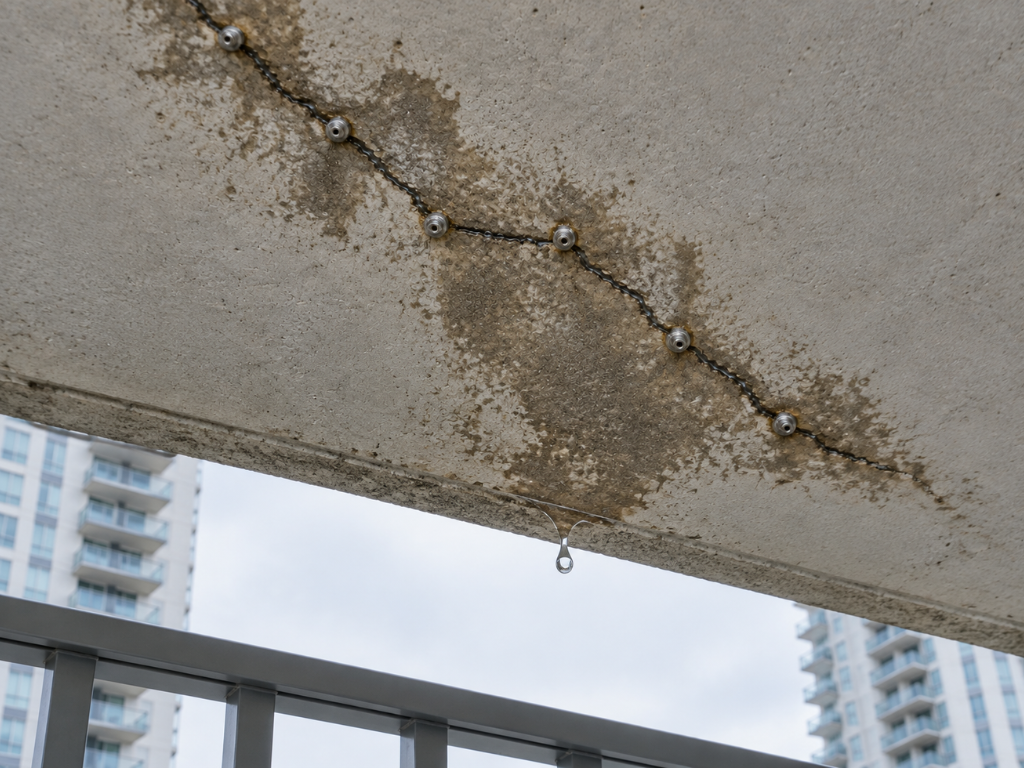
08 Nov MCST Water Seepage Repair: Condo Approval Process
Most MCST water seepage repairs in condos stall over procurement, and liability is rarely the sticking point. BCA’s Periodic Facade Inspection regime has covered buildings over 13 metres and more than 20 years old since January 2022, so a lot of external seepage work falls inside an inspection cycle your council already runs. Sort out approval, funding and contractor checks before you scope any external wall and leak works.
Who is responsible for water seepage in a condominium?
The management corporation, when the water comes from common property. That includes external walls, roofs, structural slabs and the building’s shared services, and the law makes it a duty the MCST can’t opt out of.
Professor Teo Keang Sood of the National University of Singapore Faculty of Law, writing in the Singapore Journal of Legal Studies, describes the management corporation as “under a statutory duty to maintain and upkeep the common property”. He also notes that the duty carries on after the developer’s defects liability period ends. Councils in ageing developments sometimes assume they’ve missed their chance to act, and that point tells them otherwise.
Two situations shift the responsibility. If the seepage starts inside a lot, from a failed wet area membrane or a concealed pipe, that owner pays. If the source is a private roof terrace or balcony belonging to an upper lot, you’re dealing with an inter-lot matter, and common property rules don’t apply.
Settle the technical question first, then the legal one. Whether the failure counts as a defect or ageing decides whether the council can pursue a developer claim alongside its maintenance duty. Get the inspection finding in writing on the day, so nobody has to piece it together at the meeting.
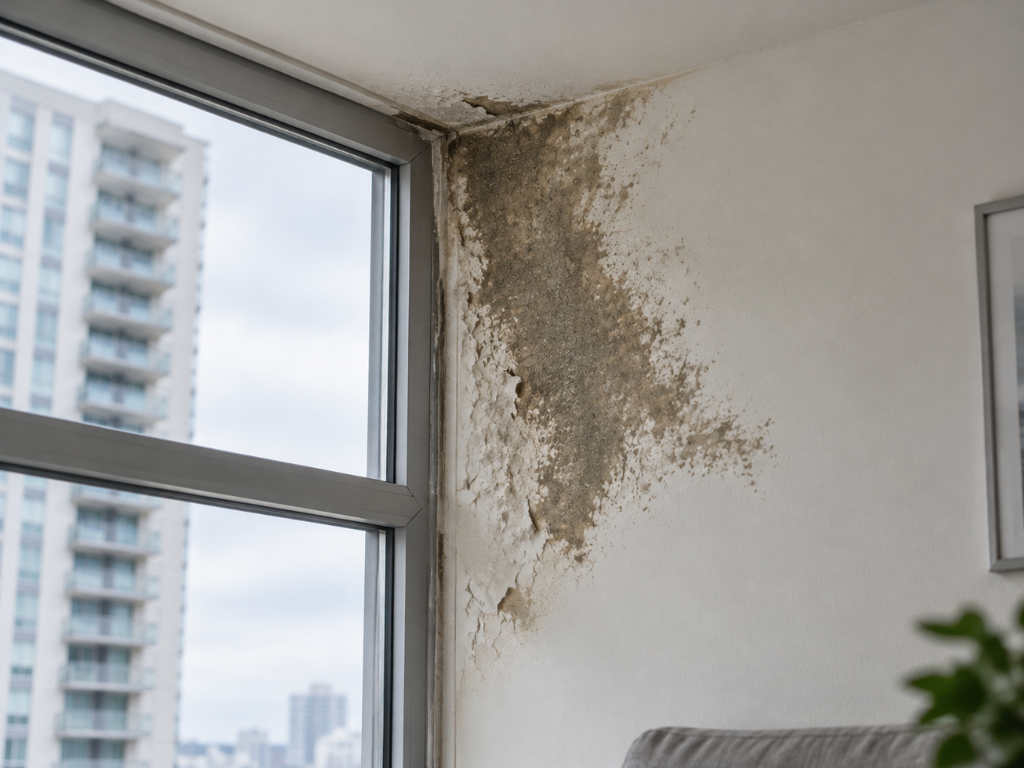
Is the external wall common property under the Act?
Yes. External walls sit outside the boundary of any lot and serve the whole building, so they count as common property under the Building (Strata Management) Act. The Act was renamed from the Building Maintenance and Strata Management Act on 1 October 2025.
If you’re a subsidiary proprietor with a damp external wall, you report a common property defect to the MCST. You don’t commission the repair yourself. Owners who hire a contractor directly and then ask for reimbursement usually find the council won’t pay for unauthorised works on common property, especially when it never had the chance to approve the scope.
The inside face of the wall trips people up. The MCST handles the water coming through the external wall. Once the source is fixed, the damaged plaster and paint inside your unit is generally yours to repair. You end up with one defect, two trades and two payers.
BCA publishes Strata Management Guides that cover common property maintenance and water seepage in particular. Quote them in your correspondence and most internal arguments end sooner. Scope the facade leak remediation carefully at this stage so contractors don’t price the two trades as one job.
Does the repair need AGM approval, or can the council just act?
The council can act within its delegated authority for maintenance. Once the spend goes past that authority, or the work needs a special levy, the council has to pass a general meeting resolution.
Your by-laws and the council’s own resolutions set that threshold. No single national figure applies, so start by reading your own limit instead of guessing. Routine maintenance and urgent works to prevent further damage usually fall inside it. Replacing a whole facade coating system usually doesn’t.
Urgent works follow separate rules, and councils don’t use them enough. The council can carry out works reasonably needed to stop immediate further damage before a meeting and ratify them afterwards. Leave a live leak for three months while someone drafts a motion, and the council pays for that extra damage too.
A sequence that works: commission the diagnosis under delegated authority, use the written findings to scope the remedial works, then bring a funded motion to the meeting. If your council takes an unscoped motion to an AGM, members spend a whole cycle debating a figure nobody can back up.
Which fund pays, and what happens if it is short?
The sinking fund. It pays for capital and non-recurrent works, including facade coating renewal and structural waterproofing. The management fund covers recurring running costs such as cleaning and routine maintenance.
The Act requires the MCST to keep the two funds separate, and the council can’t move money between them to cover a shortfall. That rule stalls most seepage repairs. The law is clear, the council agrees the work is needed, and the fund balance won’t stretch to a facade contract.
If the sinking fund falls short, the Act lets the management corporation collect extra contributions from subsidiary proprietors through a special levy. That needs a general meeting resolution, and getting owners to agree usually takes longer than the technical work.
Councils often overlook staging. A contractor can usually diagnose the problem and carry out localised remedial work now, under delegated authority, to stop the water. Meanwhile the capital motion for full facade treatment goes through the meeting cycle. The damage stops spreading, and the meeting votes on a costed scope instead of an estimate. The same thinking applies when you plan commercial building waterproofing as budgeted spend instead of emergency repairs.
What should an MCST require from a contractor before appointing them?
Six documents, and you can check all six before comparing any quotes: registration, the specification, insurance, access competency, the safety record and the warranty terms.
BCA lists waterproofing installation under workhead CR13, graded L1 to L6. Registration shows financial standing, declared technical staff and a record of completed jobs in that trade. Ask for the workhead code and grade, because anyone can call themselves a “specialist” and no one regulates the word.
The specification should name the product, the dry film thickness in millimetres and the surface preparation method. A quote that only says “waterproofing works to external wall” gives you nothing to compare against other quotes and nothing to inspect when the job is done.
Most councils ask the wrong question about access competency, and the next section explains why. You need two insurance policies, not one. The warranty should state the workmanship term separately from the manufacturer’s material term, because workmanship is what fails.
Collect all six before you go to tender and you’ll get quotes you can compare. Ask for them afterwards and you’ll end up negotiating.
Is IRATA certification required for rope access facade work?
No. IRATA runs the recognised international scheme, and taking part is voluntary. What Singapore makes mandatory is the Work-at-Height Course that the Ministry of Manpower requires under the Workplace Safety and Health (Work at Heights) Regulations 2013.
That gap has a real consequence most councils miss. A contractor can hold valid IRATA certification and still send up a technician who hasn’t done the mandatory Singapore course. If your council only asked about IRATA, you’d never know. Ask for both: each assigned technician’s IRATA level and certificate expiry, plus proof of the MOM Work-at-Height Course.
IRATA publishes the International Code of Practice and grades technicians from Level 1 to Level 3. A Level 3 technician takes charge of rope access safety on a project. SPRAT runs a similar scheme in North America. Those are the two recognised bodies, so if you see an unfamiliar acronym on a certificate, check it with the issuing body before you accept it.
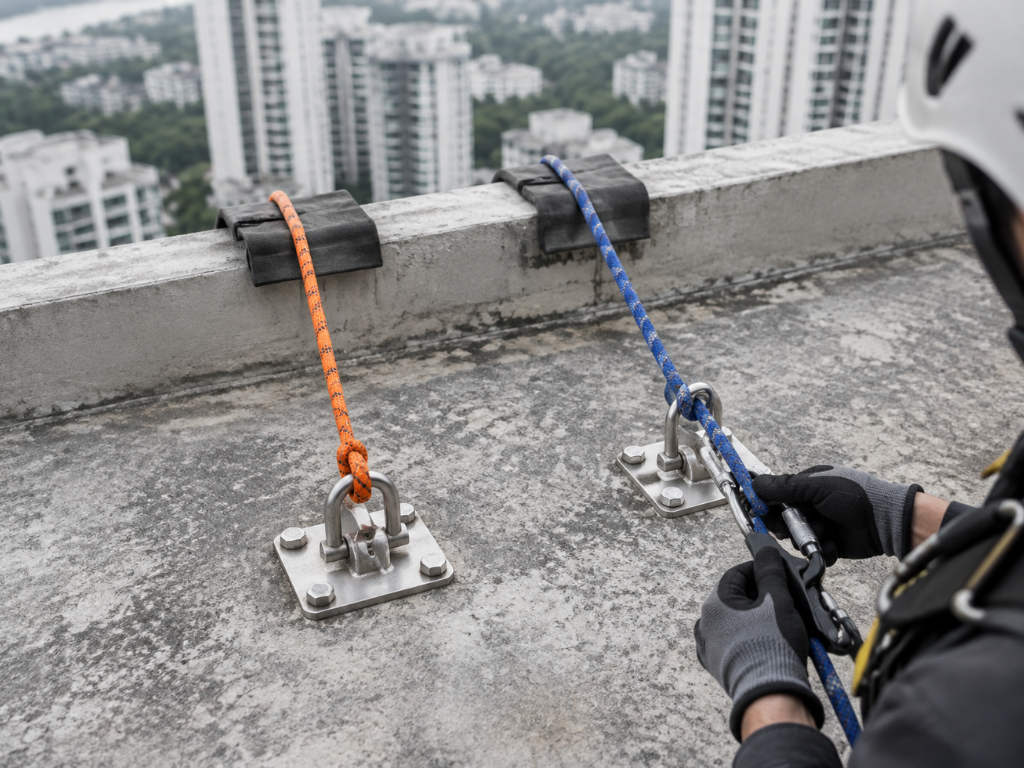
The method has clear rules. Technicians use two independently anchored ropes, one for working and one as a safety backup, with dual-attachment harnesses and progress capture devices. A contractor that runs rope access method work in house, without subcontracting, also keeps the competency records with the firm your council actually hired.
Who issues the permit to work for work at height?
The occupier. In a strata development, that means the management corporation or the managing agent acting on its behalf. The contractor fills in its part and signs, but the council issues the permit.
Councils often assume the contractor handles it. Then work goes ahead at height without the statutory document in place, and the liability falls on the party that should have issued it, not the firm on the ropes.
The injury figures show why this deserves attention. MOM’s WSH Report 2025 records that small-scale construction works accounted for over 60% of fatal and major injuries in the construction sector, with small-scale meaning addition and alteration works and renovations. Facade seepage remediation falls within that definition, which puts the highest-risk category of Singapore construction work on your building.
Ask the contractor for the risk assessment and safe work procedure in advance, so the council can issue the permit properly and nobody rushes a signature on the morning of the job. If a firm leaves the permit for the council to sort out on the day, expect the rest of its site management to run the same way.
What insurance should the MCST require?
Two policies, and councils most often forget the one that matters more. Public liability covers damage to property and harm to third parties. Work injury compensation covers a worker hurt on your building.
Get copies of both certificates. Check that the policy dates are current on the day work starts, not just on the day of tender. Confirm that the named insurer is the actual underwriter and not a broker’s letterhead.
Look closely at the coverage limit on a facade job. Water from a facade repair can reach the units below. A public liability limit that covers a small incident in the car park might fall short when six apartments get wet.
Check the MCST’s own policies as well. Ask your insurer whether contractor works on common property fall within the corporation’s cover. If a gap opens between the contractor’s policy and the corporation’s, the corporation pays for it.
How does the managing agent fit into the process?
The council decides, and the managing agent carries out the decision. The agent runs the estate, collects quotes and coordinates contractors, but holds no statutory maintenance duty under the Act.
That tells you where to send a request. A defect report that only lands in the agent’s inbox can sit there with nobody at fault, because the agent can’t commit the corporation beyond its mandate. When the report goes on a council meeting agenda, the council has to consider it and the minutes record the decision.
A good agent speeds things up a lot by scoping the work properly before asking for quotes. When three contractors each price a different scope, the council wastes a meeting comparing figures that never lined up and sends the agent back to start again.
As a subsidiary proprietor, send a written report to the agent and ask for a copy to go to the council. Include dated photos and a record of how the damp tracks the rain. Follow the standard building leakage procedure from day one and you’ll build the evidence the council needs before it can approve anything.
Stage the work so the meeting calendar doesn’t hold up the repair
In a strata seepage case, few people dispute liability. The management corporation holds the duty, external walls are common property, and councils accept both. The repair stalls over the sinking fund balance, the meeting calendar and contractor documents nobody collected before tender. Stage the work, with diagnosis now and the capital motion next, and you prevent most of the damage that builds up in between.
Send your development’s age, the affected elevation and any facade inspection findings through the contact form, or call 8688 8600. Proseal provides the measured scope and written findings your council needs before a motion goes to a general meeting.
FAQs About MCST Water Seepage Repair Condo
How long does an MCST water seepage repair usually take to approve?
Diagnosis can start within weeks under delegated authority. Capital works that need a special levy wait for the next general meeting, which can push the full programme several months out. Councils that stage the work, fixing the leak now and tendering the facade contract separately, stop the damage from growing during that wait.
Can an owner repair common property and claim the cost back from the MCST?
No, not for unauthorised works. External walls are common property, and the management corporation decides the scope and the contractor. Report the defect in writing to the managing agent and ask for a copy to go to the council. Councils generally won’t reimburse unapproved works, however reasonable the cost.
Does the Periodic Facade Inspection regime apply to our development?
Yes, if the building is taller than 13 metres and more than 20 years old. BCA’s regime, in force since 1 January 2022, requires a Competent Person to inspect every seven years. That means a Professional Engineer or Registered Architect with a Certificate in Façade Inspection, and owners must rectify defects within a period BCA sets.
Should we appoint the cheapest quotation?
Only if the scope, specification and warranty match. You can’t compare quotes that name different membrane systems, thicknesses or access methods, whatever the totals say. Require BCA workhead CR13 registration, a named product with its dry film thickness, and a workmanship warranty term stated separately from the material warranty.
Is the managing agent liable if the repair fails?
No. The management corporation holds the statutory maintenance duty, and the managing agent carries out council decisions within its mandate. You pursue defective work against the contractor under the warranty, which is why the workmanship term and the contractor’s BCA registration both matter when you appoint.

Sorry, the comment form is closed at this time.