





03 Nov HDB Water Seepage Neighbour Disputes: 2026 Process
If your HDB flat has water seeping in from a neighbour’s unit, you now have an escalation route that owners didn’t have before September. From 1 September 2026, HDB can issue a Mediation Direction that requires an uncooperative neighbour to attend mediation, following a pilot in Tampines that started in April 2025. Settle who is responsible, whether GRA applies and how to escalate before you scope any waterproofing and leakage services work.
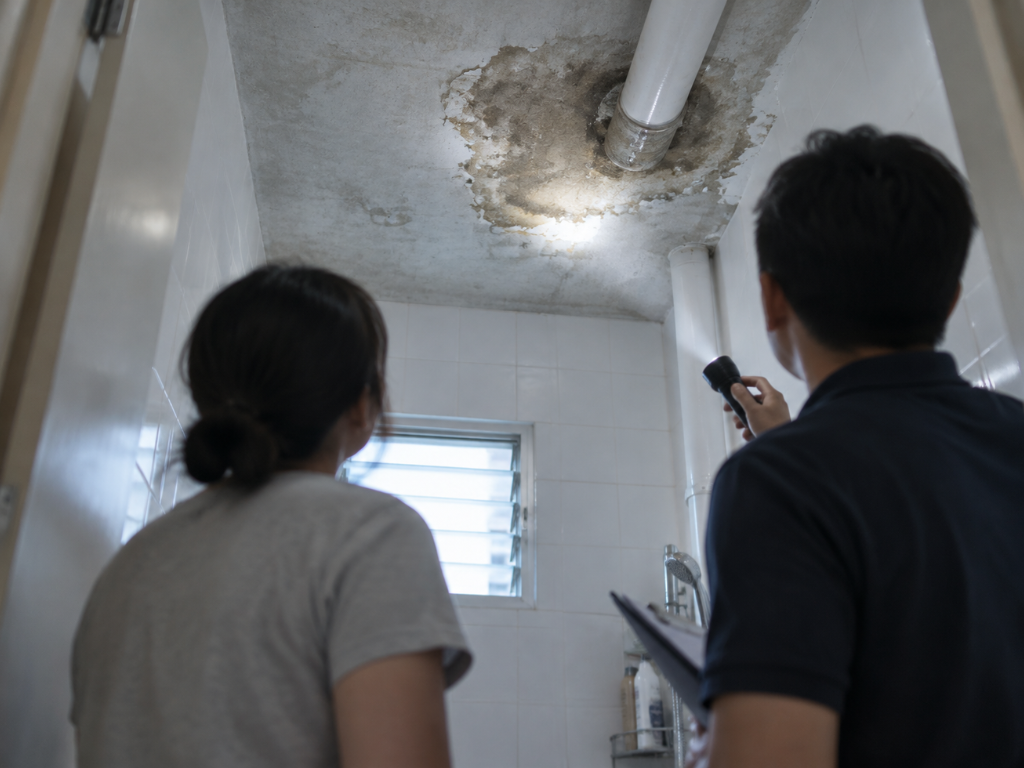
Who is responsible for water seepage between HDB units?
Both owners. The floor slab between two flats is a party structure, and the terms of lease make the upper and lower flat owners jointly responsible for maintaining and repairing it.
Many lower-floor owners don’t expect that. You see a stained ceiling and assume the neighbour above caused it and should pay. When a slab wears out with age, nobody caused it, and the two of you share the repair cost.
Three situations change that default. If renovation works or negligence in the upper flat caused the leak, the upper owner pays the full cost. If the source sits inside one flat instead of the slab, such as a concealed pipe, that flat’s owner pays. On the top floor, water coming through the block roof goes to the Town Council, because the roof is common property and your neighbour has no part in it.
Work out which case applies before anything else. The answer tells you whether you’re splitting a bill, sending one, or writing to the Town Council. HDB helps with the joint inspection that pins down the source.
What does the Goodwill Repair Assistance scheme actually pay?
HDB co-pays 50% of the repair cost, and the upper and lower flat owners split the other 50% equally, so each of you pays 25%. Secondary sources such as SingaporeLegalAdvice.com put a cap of $300 per repair location on each owner’s share. HDB’s own published statements don’t quote that figure.
Two conditions decide whether you qualify. GRA covers leaks in the floor slab caused by wear and tear. You also can’t apply directly: the Grassroots Adviser of your estate has to refer you. That step catches out owners who have already spent weeks negotiating with the flat above.
HDB calls GRA a goodwill scheme, set up to break deadlocks between neighbours and cut the disruption for both households. Keep that purpose in mind. HDB designed the subsidy so that agreeing costs you less than carrying on the argument.
Rental flats work differently, and HDB bears the repair cost there. HDB publishes the scheme terms in its ceiling leaks guidance. Check the current figures with your HDB branch before you budget, since published caps change.

When does GRA not apply?
When wear and tear didn’t cause the leak. That one condition rules out more cases than any other, and owners tend to find out about it late.
Renovation works in the upper flat are the clearest exclusion. If works carried out above caused the leak in the lower flat, the upper owner has to fix it and pay the full repair cost. Nobody pays a 25% share.
Leaks from anything other than the slab fall outside the scheme too. A concealed supply pipe inside the upper flat, an aircon condensate line or a failed connection is that owner’s own maintenance responsibility, and the shared party structure rules don’t come into it.
Everything turns on the cause, so the joint inspection counts for more than the negotiation afterwards. Whether the failure comes back as a wear and tear test result or as damage from works sets the cost split before anyone talks money. Ask for the finding in writing at the inspection, while the details are fresh.
What changed on 1 September 2026?
The Mediation Direction framework and the Community Relations Unit went nationwide. HDB and the People’s Association can now issue Mediation Directions in public housing estates, and the PA can issue them in private estates as well.
A Mediation Direction orders disputing neighbours to attend mediation at the Community Mediation Centre. MinLaw states that these orders are backed by law and must be complied with. Under the old voluntary system, your neighbour could stay away without consequence.
The rollout followed a pilot in Tampines town HDB estates from 7 April 2025, and it rests on the Community Disputes Resolution (Amendment) Act passed in 2024. MCCY, MinLaw and MND jointly run the underlying Community Disputes Management Framework.
If you’re reading older advice, check the date. Guides on HDB neighbour leak disputes written before September 2026 describe a process your neighbour could opt out of. In public housing estates, they can’t opt out any more, so that older advice undersells what you can do when a case stalls.
What do you do if your upstairs neighbour will not cooperate?
Report it to HDB and ask for a joint inspection, then use the Mediation Direction framework to get your neighbour to the table. In a public housing estate, your neighbour can no longer ignore the process.
The Community Mediation Centre’s figures show why this matters. Fewer than 30% of disputes registered with the centre went on to mediation, because one party refused to take part. Around 80% of the cases that did reach mediation settled. Mediation worked well once it happened, and the hard part was getting both neighbours to turn up.
Keep your request to HDB factual and documented. Give the flat number, the affected area, the dates the staining appeared or spread, and note that you’ve tried to contact the flat above. A written record from the first week will help you more than any argument you make three months in.
Start on the practical steps for building leakage at the same time instead of waiting on the process. You control containment and documentation, whoever ends up paying.
What can the Community Relations Unit actually do?
For a seepage dispute, very little, and you should know that before you count on it. Parliament scoped the CRU’s investigative and enforcement powers to severe neighbour disputes involving noise and hoarding. Water seepage falls outside that scope.
Within its scope, CRU officers can take statements and enter a home to gather evidence, either with consent or with approval from the director-general of community relations. They can also issue Mediation Directions, advisories, warnings and abatement orders. Senior Minister of State for Law Murali Pillai said officers would be empowered to “investigate, collect evidence, and if need be, intervene quickly”.
In a seepage dispute, you work with the Mediation Direction and with HDB’s own powers to investigate and repair. CRU enforcement doesn’t come into it. If you only skimmed the news on the 2024 amendments, you’d expect far more.
Raise this early with anyone advising you. A contractor or neighbour who tells you “the CRU will come and deal with it” is pointing you to a unit that doesn’t handle leak disputes.
When does a water seepage dispute reach the CDRT?
Last, after you’ve tried the other routes. The Community Disputes Resolution Tribunals, set up under the Community Disputes Resolution Act 2015, hear stubborn neighbour disputes once community mediation and other options have run out.
The CDRT hears claims about unreasonable interference with the enjoyment or use of your home. Water coming through from the flat above month after month fits that description, but the tribunal is there as a last resort, and you shouldn’t start with it.
One feature deserves more attention. If mediation succeeds and both of you agree, you can register the settlement agreement as a CDRT order. Should your neighbour break the agreement later, you get quicker and simpler legal recourse. You turn a verbal understanding into an enforceable order without sitting through a hearing.
The 2024 Amendment Act also lets the tribunal consider evidence CRU officers gathered and make new orders, including interim orders, so cases that do reach it move faster.
What happens if nobody cooperates at all?
HDB escalates, as it has for years. If a flat owner stays uncooperative after mediation and grassroots involvement, HDB can take legal action. Amendments to the Housing and Development Act in 2015 strengthened its powers to enter flats and carry out repairs.
Expect the process to take months. The investigation, the repair and getting both owners on board each add time, and a contested case drags on far longer than a cooperative one.
For you as the lower-floor owner, waiting costs more than it seems. Six more months of water crossing the slab keeps wetting your ceiling finish. Once it reaches the reinforcement, corrosion starts, and your waterproofing job becomes a concrete repair as well.
So run your own containment and documentation on your own timetable while the process moves at its pace. Nothing in the dispute stops you protecting your ceiling in the meantime.
What evidence should you gather from day one?
Dated photographs with a marked boundary, a log of when the staining appeared or spread, and every written message with the flat above or with HDB. You’ll rely on these at every stage that follows.
Mark the edge of the stain with tape and photograph it with the date visible. Repeat after each heavy rain and once during a dry spell. A boundary that keeps advancing proves an active leak, which one photo can’t do. It also separates a slab leak from external ingress, since ingress follows the weather.
Log the timing too: when the staining appeared, when it spread, and whether it lines up with anything upstairs such as showering or laundry. If the damp tracks your neighbour’s water use and ignores the rain, the source is the flat above and the facade is off the hook.
Keep every message, including the ones your neighbour ignored. Under the Mediation Direction framework, proof that you tried to make contact strengthens your case for a Direction. The steps for tracing a ceiling leak to its source run alongside all of this, so start them without waiting for the dispute to end.
How is the slab actually repaired?
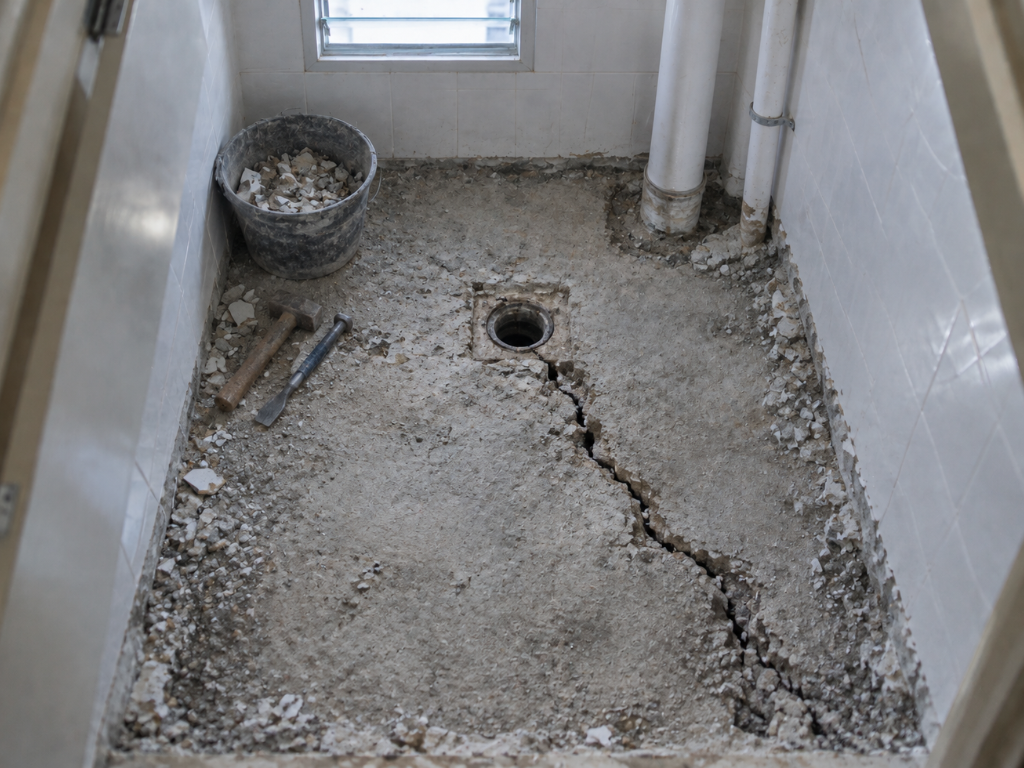
A contractor can take one of two routes, and the choice matters because only one needs access to the flat above. Hacking and re-waterproofing the upper flat’s floor fixes the whole floor. Injection grouting from below works when you can’t get into the flat upstairs.
For the conventional repair, the contractor removes the upper flat’s floor finishes, exposes the slab and applies a new membrane with a wall upstand. They then lay protection screed to falls and re-tile. It deals with the cause properly, but your neighbour has to agree, and they lose the use of their bathroom for one to two weeks.
When the leak follows a single crack or a construction joint, grout injection without hacking fills the gap from below with polyurethane resin. The resin reacts with the water in the crack and seals the path. The contractor works from the lower flat, so access stops being a problem, though injection treats a crack and won’t fix a membrane that has failed across the whole floor.
Your ceiling needs its own repair whichever route fixes the source. Wait for the slab to dry before you repair the ceiling, or the damage comes straight back. If spalling has started, the concrete repair has to come before any repainting.
Fix responsibility first, then the leak
The cause decides who pays, and the joint inspection settles the cause. Since 1 September 2026, a neighbour who refuses to engage can’t stall the process indefinitely, and that refusal used to be the main reason these cases dragged on for a year. Start documenting in week one, because every later stage relies on the record you keep.
Send dated photos, your floor level and the dates the staining spread through the contact form, or call 8688 8600. Proseal gives you written findings on the source, which is the document the cost split depends on.
FAQs About HDB Water Seepage Neighbour
Who pays if I am on the top floor and water comes through the ceiling?
The Town Council. It maintains the block roof as common property, so a top-floor leak through the roof isn’t an inter-floor matter and the GRA split between neighbours doesn’t apply. Mention your floor level in your first message so your case reaches the right team.
Is the upstairs owner always liable for a leak in my ceiling?
No. When wear and tear of the slab causes the leak, both owners share the cost, and HDB co-pays 50% under the Goodwill Repair Assistance scheme. The upstairs owner pays the full cost only if renovation works or negligence in their flat caused the leak, or if the water comes from their own pipes.
Can HDB force my neighbour to let inspectors in?
HDB can escalate, and 2015 amendments to the Housing and Development Act strengthened its powers to enter flats and carry out repairs. From 1 September 2026, HDB can also issue a Mediation Direction ordering your neighbour to attend mediation. The law backs that order, and your neighbour must comply.
How long does an HDB inter-floor leak dispute take to resolve?
Months, and longer if one party won’t cooperate. The investigation, agreeing on cost sharing and the repair itself each add time. You control containment and documentation from day one, so start both before anyone settles the dispute.
Does the Community Relations Unit handle water leaks between flats?
No. The CRU’s investigative and enforcement powers cover severe neighbour disputes involving noise and hoarding. For water seepage, you go through HDB’s investigation, the Mediation Direction framework that went nationwide on 1 September 2026, and the CDRT as a last resort.

Sorry, the comment form is closed at this time.