





23 Oct Elastomeric Paint in Singapore: Which Cracks It Can Bridge
Elastomeric paint is a high-build acrylic exterior coating that stretches with your wall. It covers static hairline cracks under about 0.3 mm, but only once the film reaches its rated thickness: 140 microns for Nippon’s WeatherBond Flex, about 340 microns for Sika’s full-durability spec. Cracks that keep moving, carry water or point to structural distress need sealant, PU injection or an engineer before any coating goes on. BCA’s facade inspection regime puts about 30,000 buildings through checks every seven years, so external wall waterproofing and repair starts with reading the cracks.
Elastomeric paint vs acrylic paint: what changes on the wall
Elastomeric paint carries a thicker, more elastic film than standard acrylic emulsion, so it covers hairline cracks that ordinary paint needs filled first. Nippon Paint’s Singapore data sheet for Weatherbond, a 100% acrylic emulsion, calculates coverage on 40 microns per coat and tells applicators to fill hairline cracks with putty. Its elastic sibling, WeatherBond Flex, goes on at 60 to 90 microns per coat and covers hairline cracks once the film reaches 140 microns.
| Property | Acrylic emulsion (Nippon Weatherbond) | Elastomeric paint (Nippon WeatherBond Flex) | Elastomeric protective coating (Sikagard-550 W Elastic) |
| Dry film | 40 microns per coat | 60 to 90 microns per coat | About 340 microns for full durability |
| Build | Sealer + 2 coats | Skimcoat, sealer + 2 coats, extra coat for severe hairline cracking | Primer + 2 to 3 coats |
| Crack performance | Hairline cracks filled with putty first | Covers hairline cracks at 140 microns minimum | EN 1062-7 Class A1 static (2 coats), Class B2 cyclic (3 coats) |
| Elongation at break | Not stated | Not stated | About 120%, measured on unweathered film |
| Water vapour | Breathable, high permeability | Not stated | Equivalent air layer 0.35 m at 230 microns |
You give up some vapour flow for that thickness. Nippon describes Weatherbond as a breathable film with high water vapour permeability. Sika’s Singapore data sheet for Sikagard-550 W Elastic rates it vapour permeable, with resistance equal to 0.35 m of still air at 230 microns. That’s a thicker barrier than a thin emulsion, so an elastomeric system needs a drier wall underneath it.
Which cracks elastomeric paint bridges, and which it can’t
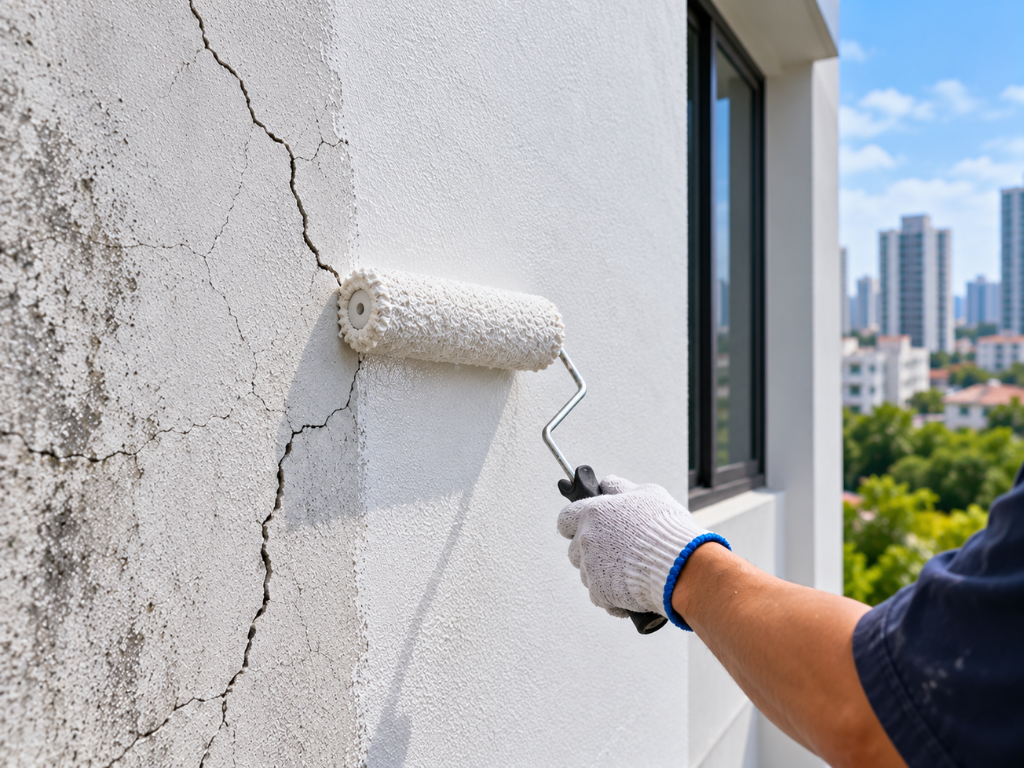
Elastomeric paint bridges static cracks up to the width its film was tested on, which on a real facade means hairline cracks under about 0.3 mm. Moving joints, leaking cracks and structural cracks each need their own repair before any coating goes on.
| Crack type | How to recognise it | Elastomeric paint alone? | Treatment before coating |
| Hairline crazing and shrinkage cracks | Under about 0.3 mm, random pattern, dry | Yes, at rated film thickness | Clean, prime, build to full DFT |
| Fine static cracks | 0.3 mm to about 1.5 mm, not growing, dry | Only high-build coatings tested to that width | Rake out and fill with flexible filler |
| Moving joints | At window frames, aircon pipe entries, panel and expansion joints | No | Sealant replacement or joint treatment |
| Leaking cracks | Stain inside after rain, dries in 24 to 48 hours | No | PU injection at the source |
| Structural cracks | Diagonal or stepped, widening, rust stains, spalling | No | Structural engineer assessment first |
Cracks under 0.3 mm are normal in reinforced concrete. Eurocode 2, adopted in Singapore as SS EN 1992-1-1, recommends 0.3 mm as the maximum design crack width for most exposed concrete. Manufacturers formulate elastomeric paints to cover render crazing and shrinkage cracks in that band.
Lab figures give you the ceiling, not the working limit. Sika’s Australian data sheet records a 1.5 mm crack width at break for Sikagard-550 W Elastic at 310 microns of dry film, measured by pulling the film once until it failed. A crack that opens and closes every day puts the coating through a harder test, and Sika measured the product’s 120% elongation on film “not exposed to weathering”.
Proseal’s external wall repairs trace Singapore facade leaks to four main causes: wind-driven rain through hairline cracks in cement render, failed silicone at window perimeters and aircon piping, expansion joint failure between facade panels, and degraded paint on exposed elevations. Elastomeric paint handles the render cracks and the tired paint. For the silicone and the joints, you need a sealant gun before anyone opens a paint tin.
Can elastomeric paint bridge cracks through Singapore’s heat and UV?
Yes on static hairline cracks, as long as the film reaches full thickness. Daily heat cycling and UV still wear the stretch out of it over 5 to 8 years. Meteorological Service Singapore data puts the daily range at a night-time minimum of about 23 to 25°C and a daytime maximum of about 31 to 33°C, so your facade expands and contracts once a day, all year round.
The cyclic crack test puts a coating through that same movement. Under EN 1062-7, Sikagard-550 W reaches static Class A1 with 2 coats and needs 3 coats for cyclic Class B2. Sika sets about 340 microns as the minimum dry film for full durability, covering CO2 diffusion, adhesion after thermal cycling and crack bridging. On sun-facing elevations, specify the third coat and check that the applicator put it on.
Colour matters too. Sika warns that dark shades, especially black, dark red and blue, fade quicker and need a refresher coat sooner. Proseal’s external wall repairs put tropical UV breakdown of sealant and paint at 5 to 8 years, faster than in temperate climates.
Crack repair before coating: the order that holds
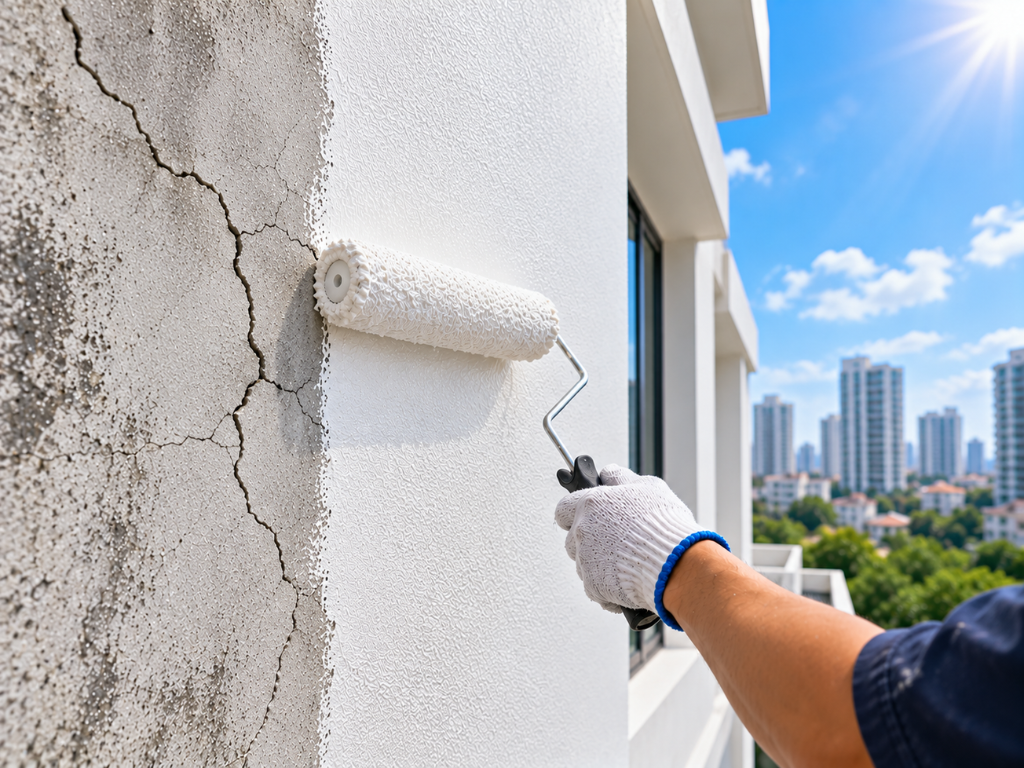
Repair each crack by type before the first coat, so the elastomeric film only has to cover hairlines. If a quote lists coats and says nothing about crack repair, the contractor has left out the hard part.
- Map and measure. Record every crack’s width and location. Flag anything wider than 0.3 mm, rust-stained, diagonal or growing.
- Find the leaks. Proseal’s external wall leak repair process locates the entry point by stain mapping or water-spray testing before sealing it.
- Treat by type. Replace the sealant at windows and aircon entries. Use PU crack injection on cracks that carry water, since the resin expands 5 to 30 times on contact with water and cures flexible. Fill static cracks wider than hairline with a flexible filler.
- Dry the wall. WeatherBond Flex requires masonry below 16% on a Protimeter. Sika requires new concrete to be at least 28 days old.
- Prime. Use the system’s own primer: Weatherbond Sealer or WeatherBond Flex Sealer under WeatherBond Flex, Sikagard-552 W Aquaprimer under Sikagard-550 W.
- Build and check the film. WeatherBond Flex calls for 113 to 200 microns wet per coat, and Sika advises regular wet film checks during application. Apply below 80% relative humidity, with the surface at least 3°C above dew point.
Proseal’s guide to repairing cracked and spalling walls covers patching and epoxy injection for damage that runs deeper than the render.
Breathability: why elastomeric paint blisters on a wet wall
Elastomeric paint blisters when it seals moisture into the wall, because the thicker film releases water vapour more slowly than a thin acrylic emulsion does. Nippon’s WeatherBond Flex sheet says all water seepage must be checked and repaired before painting. Sika’s Singapore sheet warns that an undried primer causes bubbles and blisters, especially in warmer weather.
Blistering on a fresh elastomeric coat comes down to one of two things: the wall read wet when the applicator coated it, or nobody fixed the leak. Peeling paint is one of the clearest signs of damp behind a wall, and Proseal’s explainer on why building walls hold moisture covers where that damp comes from.
Elastomeric paint in Singapore: who decides and when
Whoever owns the facade decides: Town Councils for HDB blocks, the MCST for condo common property, and you for a landed home. BCA’s inspection regimes are what put cracks on the agenda.
Since 1 January 2022, BCA’s Periodic Facade Inspection regime has required buildings taller than 13 m to have their facades inspected every seven years once they pass 20 years old. A Competent Person carries out the inspection, meaning a Professional Engineer or Registered Architect with a Certificate in Facade Inspection. About 30,000 buildings fall into the first cycle.
Structural cracks belong in a different report. BCA’s Periodic Structural Inspection runs every 10 years for residential buildings and every 5 years for non-residential ones, and a Structural Engineer carries it out.
For the repaint itself, HDB’s new BTO blocks carry a 6-year external paintwork warranty held by the Town Council, per the Ministry of National Development in 2022. On condo and high-rise facades, Proseal works by rope access instead of scaffolding. Its breakdown of wall seepage by property type sets out who pays in each case.
Read the cracks before you specify the coat
Elastomeric paint earns its price on static hairline cracks, and only at the film thickness its data sheet names: 140 microns for WeatherBond Flex, about 340 microns for full durability on Sikagard-550 W. Anything wider, wetter or moving needs sealant, PU injection or an engineer first. Judge a facade quote on two lines: the crack repair it lists, and the dry film thickness it commits to.
Planning a facade repaint or responding to an inspection report? Book a non-obligation external wall evaluation and get each crack assigned its repair before anyone specifies the coating.
Frequently asked questions
How long does elastomeric paint last in Singapore?
Expect 5 to 8 years on exposed elevations, the range Proseal’s external wall repairs record for tropical UV breakdown of sealant and paint. Light colours last longer, and Sika warns that dark shades fade quicker. Sikagard-550 W maintenance coats go on without priming, as long as you clean the existing coat thoroughly first.
Is elastomeric paint waterproof?
Only on vertical walls. Nippon limits WeatherBond Flex’s waterproofing claim to vertical walls, and Sika classes Sikagard-550 W under EN 1504-2 for protection against ingress and moisture control. Neither carries a rating for flat roofs or ponding water, which need a waterproofing membrane.
How thick should elastomeric paint be?
Thick enough to hit the data sheet’s rated dry film thickness, usually across 2 to 3 coats. WeatherBond Flex needs 140 microns to cover hairline cracks. Sikagard-550 W needs about 160 microns for its CO2 protection and about 340 microns for full durability, which includes crack bridging and adhesion after thermal cycling.
Can you apply elastomeric paint over existing paint?
Yes, if the old paint passes an adhesion test. Sika’s Singapore data sheet sets an average of at least 0.8 N/mm², with no single reading below 0.5 N/mm². Nippon’s WeatherBond Flex sheet tells the applicator to remove unstable old film with a chisel, scraper or grinder before the new system goes on.

Sorry, the comment form is closed at this time.