





26 Oct Condo Repainting: 6 Repairs the MCST Should Do First
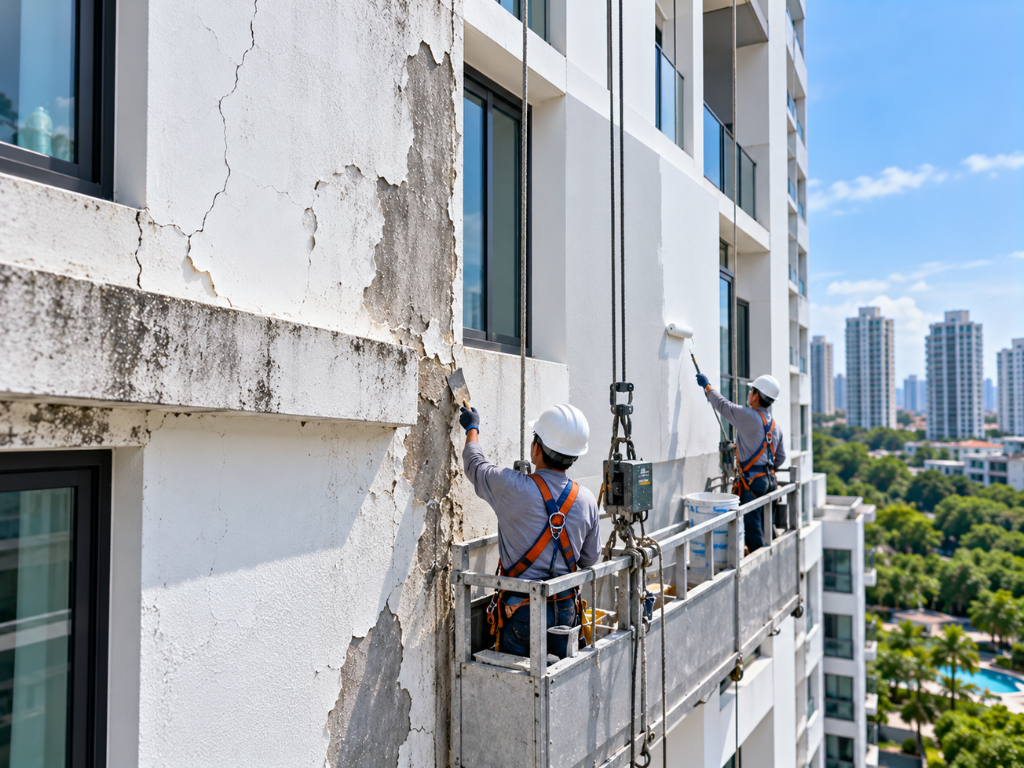
A condo repaint lasts only as long as the facade under it. Your MCST pays for the repaint from the sinking fund, and the coat holds only if you clear six defect types first: loose elements, spalling concrete, hollow or cracked render, failed sealant, active leaks and salt-stained damp patches. Scope that work from your latest Periodic Facade Inspection report and paint in the Northeast Monsoon dry phase. BCA’s 2026 strata law review centres on adequate sinking funds for ageing estates, so budget facade repair and waterproofing works alongside the paint.
Condo repainting is an MCST duty, paid from the sinking fund
Your MCST has to keep the facade in repair, and the sinking fund exists to pay for repainting. Section 29(1)(b) of the strata Act requires the management corporation “to properly maintain and keep in a state of good and serviceable repair” the common property, as the High Court restated in MCST Plan No 3602 v MacFadden [2021] SGHC 260.
BCA’s Strata Management Guide 1, Concept of Strata Living, names repainting as a sinking fund item. It says: “MCs are encouraged to plan ahead and set aside sinking funds for anticipated major expenditure in advance. Common examples are large-scale paint jobs.” Owners set or review contributions to the management and sinking funds at a general meeting. If the funds fall short, the MCST can vote a special levy at that meeting.
The law changed name recently. The Building Maintenance and Strata Management Act became the Building (Strata Management) Act on 1 October 2025, and its building maintenance provisions moved into the Building Control Act. BCA then consulted from 9 March to 8 April 2026 on amendments. The first aim it listed was helping MCSTs keep adequate sinking funds for essential maintenance in ageing developments.
How often should a condo be repainted?
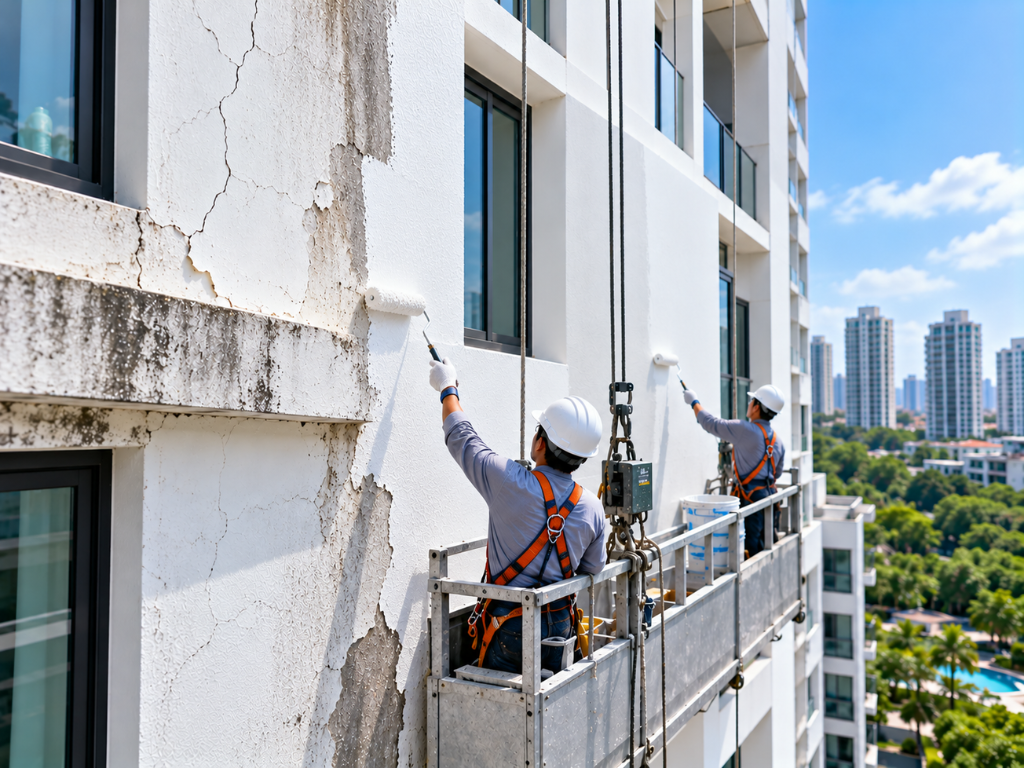
No statute sets a condo repainting cycle, and the evidence points to every 5 to 8 years. Proseal’s external wall repairs record tropical UV breaking down sealant and paint within 5 to 8 years. HDB’s new BTO blocks carry a 6-year warranty on external paintwork, per the Ministry of National Development in 2022.
Time your repaint to the Periodic Facade Inspection. Since 1 January 2022, BCA has required buildings taller than 13 m to have their facades inspected every 7 years once they pass 20 years old. A Competent Person must view every elevation and inspect at least 10% of each elevation’s surface at close range, according to BCA’s PFI Guidelines (Version 1.3, September 2026).
Paint doesn’t appear on the PFI defect list. The guidelines look for what can fall or fail: bulging or cracked plaster, spalling or cracked concrete, loose tiles, efflorescence and damaged sealant. All of those sit under the paint, so if you book the repaint straight after a PFI report, the inspector has effectively written your repair scope for you.
The 6 repairs to finish before the first coat
Repair each defect type before painting, because paint hides defects without stopping them. The table follows the order to work through a facade: safety first, then structure, then water, then finish.
| Repair | What to look for | Fix before paint | Source of the requirement |
| 1. Loose or dangling elements | Loose tiles, cladding, sunshades, aircon brackets | Remove immediately; cordon off and hoard the area | BCA PFI Guidelines, section 10.2 |
| 2. Spalling and hollow concrete | Cracks with rust stains, hollow sound on hammer-tapping | Break out, treat the rebar, reinstate with repair mortar | PFI defect list; Proseal concrete repair |
| 3. Cracked, bulging or debonded render | Hollow plaster, crazing wider than hairline | Hack and re-render, or fill with flexible filler | PFI defect list (plaster delamination) |
| 4. Failed sealant joints | Cracked silicone at windows, aircon pipes, panel joints | Cut out and replace | PFI lists damaged sealant; Proseal: UV breaks sealant down in 5 to 8 years |
| 5. Active external wall leaks | Stains inside units after rain that dry in 24 to 48 hours | Trace the entry point and seal it | Proseal external wall repair |
| 6. Efflorescence and damp patches | White salt deposits, damp render | Fix the water source, dry the wall, alkali-resistant sealer | PFI lists efflorescence |
Spalling carries the highest stakes. In February 2025, a piece of concrete fell about 20 m from a third-floor balcony at Foresque Residences in Bukit Panjang, and BCA issued a Notice to Maintain. The Straits Times reported in September 2026 that hammer-tapping by the MCST’s engineer found about 60% of Block 105’s balcony slab edges sounded hollow, across 88 balconies. The MCST alleges construction defects, which the developer and other parties deny. Whoever turns out to be liable, a hammer found the problem.
A repaint is the cheapest time to tap every balcony edge, because the access equipment already hangs on the facade. Proseal’s guide to spalling concrete repair covers the break-out and rebar treatment.
For leaks, Proseal locates the entry point first, then seals each facade leak point before the elastomeric coat goes on. On a younger estate, check whether the developer should fix a defect: Proseal’s explainer on developer defects versus wear sets out the evidence your MCST needs.
Rope access vs gondola for condo repainting
Use gondolas on long, uniform elevations where crews paint continuously, and rope access where the scope is scattered repairs, setbacks or balconies. The two methods carry different paperwork.
| Gondola (suspended scaffold) | Rope access | |
| How it hangs | Platform on outriggers or overhead supports on the roof | Two independently anchored ropes: one working, one safety |
| Design and checks | Outriggers designed by a Professional Engineer; PE inspects and issues a Certificate of Inspection for each worksite | Work to the IRATA International Code of Practice (ICOP) |
| Who sets it up | Only an Approved Scaffold Contractor; an Authorised Examiner certifies it | IRATA-certified technicians (Levels 1 to 3) who have completed the MOM-mandated Work-at-Height course |
| Fall protection | Tie-backs anchored independently of the suspension and safety ropes | A second, independently anchored safety rope |
| Roof constraints | Installation on certain parapet walls restricted unless a PE verifies their strength | Needs anchor points, not outrigger loads |
| Best for | Continuous painting of tall, flat elevations | Spot repairs, inspection, complex facades, work within 2 to 5 m of an anchor point |
The gondola requirements come from a joint MOM and BCA circular of 10 January 2025. It states plainly that “the AE shall not certify any suspended scaffold for which there is no PE design.” Tie-backs have to anchor independently of the suspension and safety ropes, and they can’t attach to roof installations such as solar panels.
A repair-led repaint changes the calculation. When the PFI report scatters defects across balconies and window bays, rope access reaches each point without re-rigging outriggers. Proseal works by rope access on facades to avoid scaffolding costs. For condos, its rope access FAQ notes that the MCST has to approve the work and verify the contractor’s insurance and rope access certifications.
When to repaint: the Northeast Monsoon dry phase
The best window for exterior painting in Singapore runs from late January to early March, the dry phase of the Northeast Monsoon. The Meteorological Service Singapore places that dry phase “usually from late January to early March,” after a wet phase from December to early January. During the wet phase, monsoon surges bring widespread continuous moderate to heavy rain.
The other seasons each cost you working days. The inter-monsoon periods, late March to May and October to November, bring afternoon and early-evening thunderstorms that turn severe at times. The Southwest Monsoon, June to September, brings occasional Sumatra squalls with gusts of 40 to 80 km/h between predawn and midday, which no crew wants while hanging off a facade.
Plan backwards from that window. Repairs need curing time before paint. Sika’s Singapore data sheet for Sikagard-550 W Elastic, for example, requires cement-based levelling mortars to cure at least 4 days before coating, and new concrete to be at least 28 days old. Award the tender by October so the repairs and curing finish as the dry phase opens.
From PFI report to final coat: the MCST sequence
Scope from evidence, fund the work at the general meeting, then repair before you paint. Follow that order and the sinking fund pays once.
- Start from the PFI report or a condition survey. Use its close-range findings, at least 10% of each elevation, to list defects by location.
- Scope the repairs by defect type. Use the six-repair table and price repairs separately from paint.
- Check the sinking fund. Table the budget at a general meeting, and vote a special levy if the fund falls short.
- Tender with documents. Ask for method statements, insurance, IRATA certificates for rope access, and PE design with Approved Scaffold Contractor details for gondolas. Proseal’s 12-point contractor checklist covers the registration checks.
- Repair, then let it cure and dry. Paint goes on only once the repairs meet the coating maker’s moisture and curing limits.
- Paint in the dry phase. Schedule the coats for late January to early March.
- Close out PFI items. The PFI Guidelines require the owner to submit photos and a certification once repairs are complete.
Proseal’s repainting and facade works for MCSTs cover repairs and paint under one contract. Its general works FAQ notes that it supplies the insurance certificates, work method statements and rope access certifications MCSTs ask for.
Budget the repairs, then the colour
Treat a condo repaint as a facade repair programme that ends in colour. Scope from the PFI report, tap the balcony edges, replace the sealant and seal the leaks before the first coat, and your sinking fund covers the job once. Paint over spalling, failed joints or live leaks, and you’ll pay to put the gondola or the ropes back up for the repairs you skipped.
Planning a repaint for your estate? Ask Proseal for a repair-and-repaint quote built from your latest facade inspection findings.
Frequently asked questions
Can the MCST raise a special levy for repainting?
Yes. BCA’s Strata Management Guide states that the management corporation can vote a special contribution or levy at a general meeting when funds fall short for major expenditure. Repainting is a named sinking fund expense, and BCA’s 2026 consultation on the Building (Strata Management) Act targets adequate sinking funds for ageing estates.
Is repainting part of the Periodic Facade Inspection?
No. Paint doesn’t appear on the defect list in BCA’s PFI Guidelines, Version 1.3 (September 2026). The inspection targets cracked or bulging plaster, spalling concrete, loose tiles, efflorescence and damaged sealant. Those findings give you the best repair scope for a repaint, since the Competent Person inspects at least 10% of each elevation at close range.
Who checks that a gondola is safe for condo painting?
A Professional Engineer designs the outriggers and issues a Certificate of Inspection for each worksite. An Authorised Examiner certifies the suspended scaffold, and only an Approved Scaffold Contractor may install, move or dismantle it. These requirements come from the joint MOM and BCA circular of 10 January 2025.
Can rope access be used to repaint a condo?
Yes. Rope access suits facade painting, leak repair and spalling repair on condos, using two independently anchored ropes under the IRATA code. Proseal’s rope access FAQ notes that the MCST has to approve the work and verify insurance and certifications. Technicians also complete the MOM-mandated Work-at-Height course under the 2013 regulations.

Sorry, the comment form is closed at this time.