





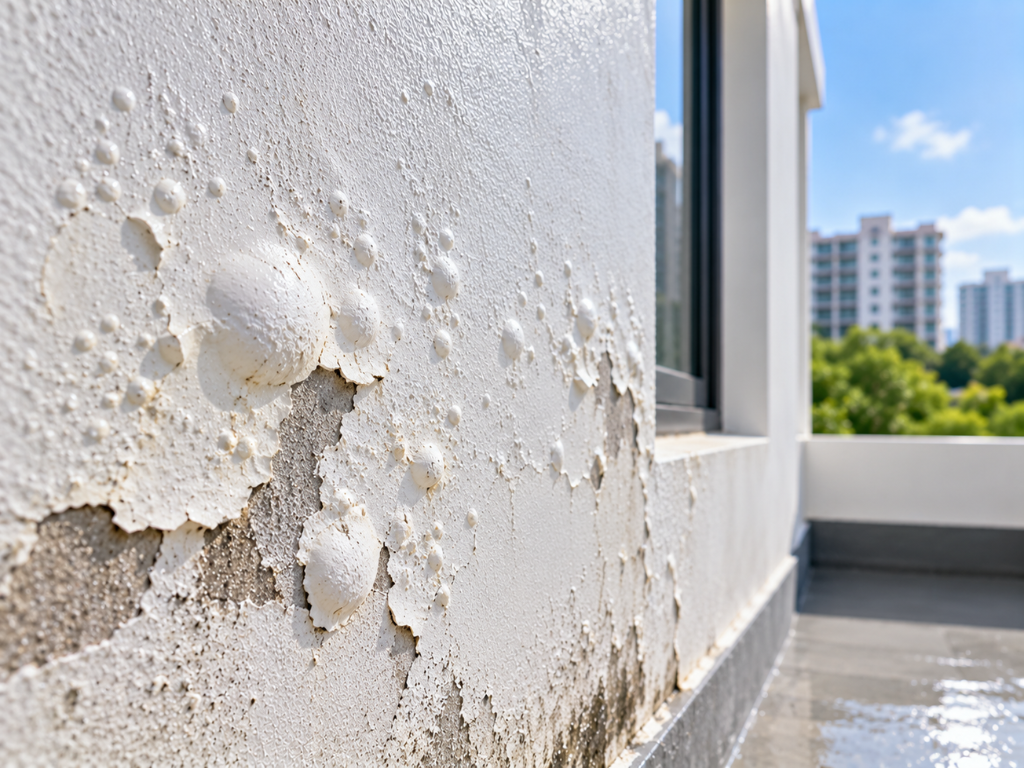
24 Oct Bubbling Paint on Wall? 5 Moisture Causes to Rule Out
Paint bubbles when water or vapour pushes out from behind the film, so a blister tells you the wall has a water source you need to stop before any repaint will hold. In Singapore homes that source is one of five: rain through the external wall, a concealed pipe, a leaking bathroom next door or above, ground moisture in low walls, or a wall that was still damp on painting day. HDB handled an average of 77 complex seepage cases a month in 2025, so tracing water leakage and seepage is routine work here.
Why paint bubbles: the moisture behind the film
Paint bubbles when water reaches the back of the film faster than the film can release it, and the pressure lifts the paint off the wall. Heat makes it worse. Singapore walls warm from a night-time minimum of about 23 to 25°C to a daytime maximum of about 31 to 33°C, and that warming drives trapped moisture outward as vapour.
Salts add a second force. Cement plaster holds soluble salts, and water moving through the wall carries them to the surface. Under a paint film, those salts pull in more water, a process called osmotic blistering. On bare or porous paint, the same salts dry out as efflorescence, the white powder you see on damp walls. Jotun’s Jotashield Primer data sheet describes its job as sealing the substrate against alkalis and moisture to minimise efflorescence and discolouration.
Pop one bubble with a clean blade before you do anything else. Water inside means an active source. White powder or crystals mean salts that came out over time, which points to a slower leak that has run for a while.
Each bubble is evidence of a water source. Repaint over it and you lose the evidence while the water keeps coming.
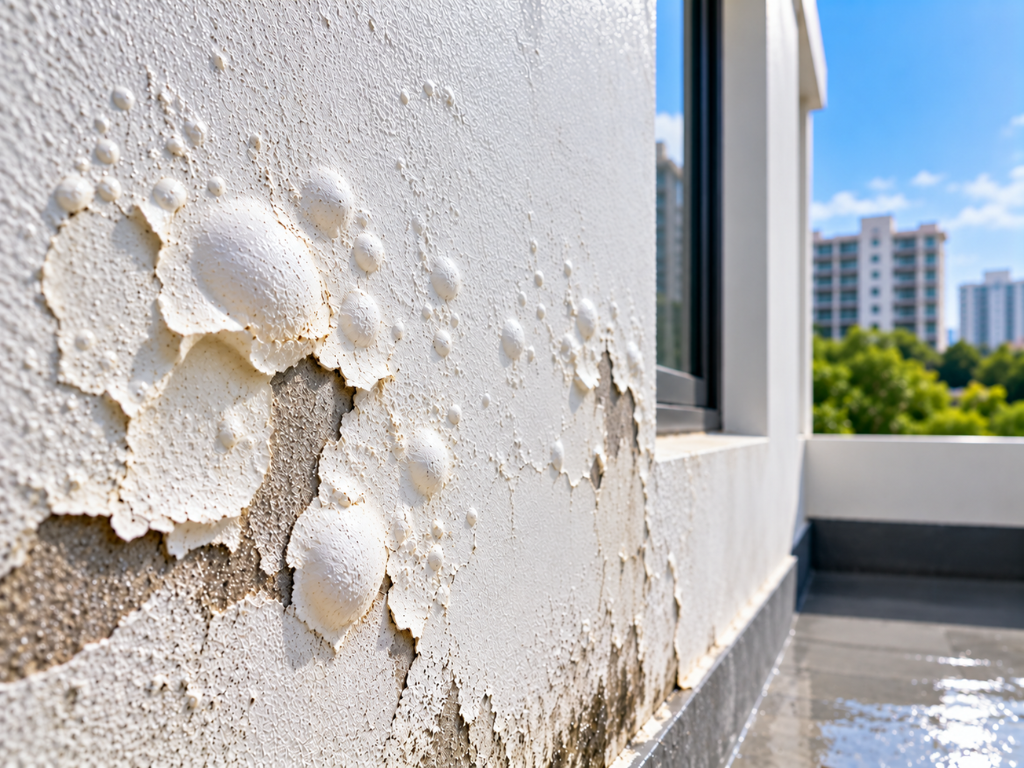
The 5 moisture causes and how to tell them apart
Each source leaves its own pattern: where the bubbles sit, and when they get worse. Match the pattern first, then run the one check that confirms it.
| Cause | Where bubbles appear | When they get worse | Quick check | Who usually fixes it |
| 1. Rain through the external wall | Outside-facing walls, near windows, aircon pipe entries, facade joints | After rain; dries within 24 to 48 hours | Log damp patches against rainy days | Town Council, MCST or owner, plus a waterproofing specialist |
| 2. Concealed pipe leak | Along pipe runs in kitchen and bathroom walls | All the time, whatever the weather | PUB 10-minute water meter test | Licensed plumber or leak detection specialist |
| 3. Bathroom next door or above | Walls backing onto a shower, ceilings below a toilet | After showers | Watch timing against shower use upstairs or next door | Both unit owners for inter-floor leaks |
| 4. Ground moisture (rising damp) | Low on ground-floor, basement and boundary walls | Steady; worse in wet months | Plastic sheet test | Landed owner or MCST |
| 5. Wall still damp when painted | Across a freshly painted wall, random pattern | Within weeks of the repaint | Moisture meter against the paint maker’s limit | The painter, after the wall dries |
Proseal’s guide to finding a leak in your house covers the wider checks for roofs, balconies and wet areas.
Cause 1: paint blistering after rain
Paint that blisters after rain and settles within a day or two points to rain getting in through the external wall. Proseal’s external wall repairs separate the two most common sources this way. A wall leak shows up only after rain and dries within 24 to 48 hours. A pipe leak stays wet whatever the weather does.
Look for the entry point higher than the bubble. Wind-driven rain gets in through hairline cracks in cement render, failed silicone at window perimeters and aircon piping, or expansion joints between facade panels. Inside, the stain runs diagonally downward from that point.
October and November make this cause more likely. The Meteorological Service Singapore describes this inter-monsoon period as the wetter of the two, with afternoon and early-evening thunderstorms that turn severe at times. In its September 2025 parliamentary answer, the Ministry of National Development noted that some Town Councils report more external wall seepage during monsoon periods.
Cause 2: a concealed pipe leak
A patch that stays damp in dry weather and keeps bubbling points to a concealed pipe. PUB’s guide to finding leaks gives you the test. Turn off every tap and water-using appliance, then watch the water meter for at least 10 minutes. If the dial moves, you have a leak.
PUB lists peeling paint on walls, floors or ceilings among the signs of a leak, alongside unusually high water bills and running water you can hear at night. Proseal’s concealed pipe work adds two more: chalky white efflorescence on the wall, and water pressure that drops for no clear reason.
You don’t have to hack the wall to find the pipe. Proseal’s concealed pipe leak detection uses acoustic and thermal tools, and detection takes 1 to 4 hours. PUB advises you to engage a licensed plumber for the repair itself.
Cause 3: a leaking bathroom next door or above
Bubbles on a wall backing onto a bathroom, or on a ceiling below one, that get worse after showers point to a failed wet-area membrane. HDB wet areas stack vertically, so a toilet waterproofing failure on an upper floor shows up in the unit below. Proseal puts the life of wet-area waterproofing in HDB flats and condos at 5 to 10 years.
The age of the flat matters. MND reported that HDB flats with ceiling leaks in 2025 averaged about 40 years old. For those inter-floor ceiling leaks, HDB co-pays 50% of the repair through its Goodwill Repair Assistance scheme, and the upper- and lower-floor owners split the remaining 50% equally.
Repainting the lower unit’s ceiling changes nothing while the bathroom above keeps leaking. Proseal’s guide to who pays, by property type sets out the HDB, condo and landed rules.
Cause 4: ground moisture in low walls
Bubbling that stays low on ground-floor, basement or boundary walls and never fully dries points to moisture from the ground. If your flat sits above ground level, cross this cause off. In a landed home, it stays on the list. Proseal’s landed-home work traces persistent boundary-wall damp to a neighbour’s higher ground level, poor waterproofing between adjoining walls, and soil moisture soaking into the wall.
The industry test needs nothing more than a plastic sheet. Sika’s Singapore data sheet for Sikalastic-595 rules out application over rising moisture, checked with a polyethylene sheet by the method in ASTM D4263. Tape a 457 by 457 mm plastic sheet tightly to the wall and leave it at least 24 hours. If the wall darkens under it or the sheet fogs on the inside, moisture is coming through from within the wall.
Ground moisture needs a barrier layer before any paint. Proseal treats it with pressure-injection waterproofing or an external membrane.
Cause 5: a wall that was still damp when painted
Bubbles that spread across a freshly painted wall within weeks, with no leak anywhere, mean the paint went onto a damp or contaminated surface. Every exterior paint system sets a moisture limit, and each one names the meter it was measured on. Nippon Paint’s Weatherbond requires below 4% on a Sovereign moisture master. Its WeatherBond Flex requires masonry below 16% on a Protimeter.
New plaster from a leak repair adds its own wait. The Nippon 500 Sealer data sheet asks for 28 days of curing or a Protimeter reading of 18% or lower, whichever comes first. You can’t swap readings between meters, so measure with the meter the data sheet names.
Air moisture counts too. Singapore’s relative humidity runs above 90% before sunrise on dry days, and Jotun requires the surface to sit at least 3°C above dew point. Sika’s Singapore data sheet for Sikagard-550 W warns that an undried primer causes bubbles and blisters, especially in warmer weather.
Can you repaint over bubbling paint?
No. Repaint only after you’ve fixed the source, the wall reads dry, and you’ve scraped every loose blister back to firm paint. Paint over a live blister and it lifts again along the same line.
- Fix the source. Match the cause in the table and repair it first.
- Scrape back to sound paint. Nippon’s WeatherBond Flex sheet tells the applicator to take off unstable old film with a chisel, scraper or grinder.
- Treat mould. Both Nippon data sheets specify an anti-fungus solution, left on for at least 2 hours on Weatherbond.
- Dry the wall. Hit the moisture limit for the paint system, measured on the named meter.
- Seal. Apply an alkali-resistant sealer to bare plaster and patched areas.
- Topcoat twice. Nippon’s Weatherbond overcoat interval is 2 hours.
When you can’t see the source, get a professional diagnosis before you buy any paint. Proseal’s water leakage diagnosis uses moisture meters, thermal imaging, acoustic detectors and pressure tests on supply lines.
Find the source, then book the painter
Every bubble on a Singapore wall traces back to rain, a pipe, a bathroom, the ground or the paint job, and the pattern of where and when it bubbles tells you which one. The PUB meter test costs you 10 minutes and the plastic sheet test costs you a day, so run both before you spend anything on paint. Find the source, fix it, dry the wall to the paint maker’s number, then paint.
Paint still bubbling and the source unclear? Book a leak diagnosis with Proseal before you book the painter.
Frequently asked questions
Can humidity alone make paint bubble?
Yes, on fresh paint. Singapore’s relative humidity passes 90% before sunrise on dry days, and paint applied below the dew-point margin traps condensation, which is why Jotun requires the surface at least 3°C above dew point. On paint that is months or years old, persistent bubbles point to a water source rather than the air.
Why is my paint bubbling with white powder?
That white powder is efflorescence: salts carried out of the plaster by moving water. Proseal’s concealed pipe work treats chalky white deposits as a sign of a leak that has run for a long time. Once you fix the source, brush the salts off and apply an alkali-resistant primer such as Jotun’s Jotashield Primer before repainting.
Who pays to fix bubbling paint caused by seepage in an HDB flat?
It depends where the water comes from. You pay for sources inside your unit, the Town Council handles the external facade and common property, and both owners share an inter-floor leak. HDB co-pays 50% of inter-floor ceiling leak repairs through Goodwill Repair Assistance, per MND in 2025.
How long after fixing a leak can I repaint?
Wait until the wall meets the paint maker’s moisture limit rather than counting days. Nippon’s 500 Sealer data sheet sets 28 days or 18% on a Protimeter for new plaster, whichever comes first. Measure again after any heavy rain, since October and November bring Singapore’s wetter inter-monsoon thunderstorms.

Sorry, the comment form is closed at this time.