





22 Aug 8 Red Flags When Hiring a Waterproofing Company
The red flags when hiring a waterproofing company in Singapore are mostly visible before any money moves. MOM’s WSH Report 2025 records that small-scale construction works, meaning addition and alteration works and renovations, accounted for over 60% of fatal and major injuries in the sector. This blog walks you through eight, ranked by severity, alongside waterproofing and leak repair services scope.
Proseal Contracts Pte Ltd is a BCA-registered waterproofing specialist and licensed building contractor founded in Singapore in 1999, working under workhead CR13, Waterproofing Installation.
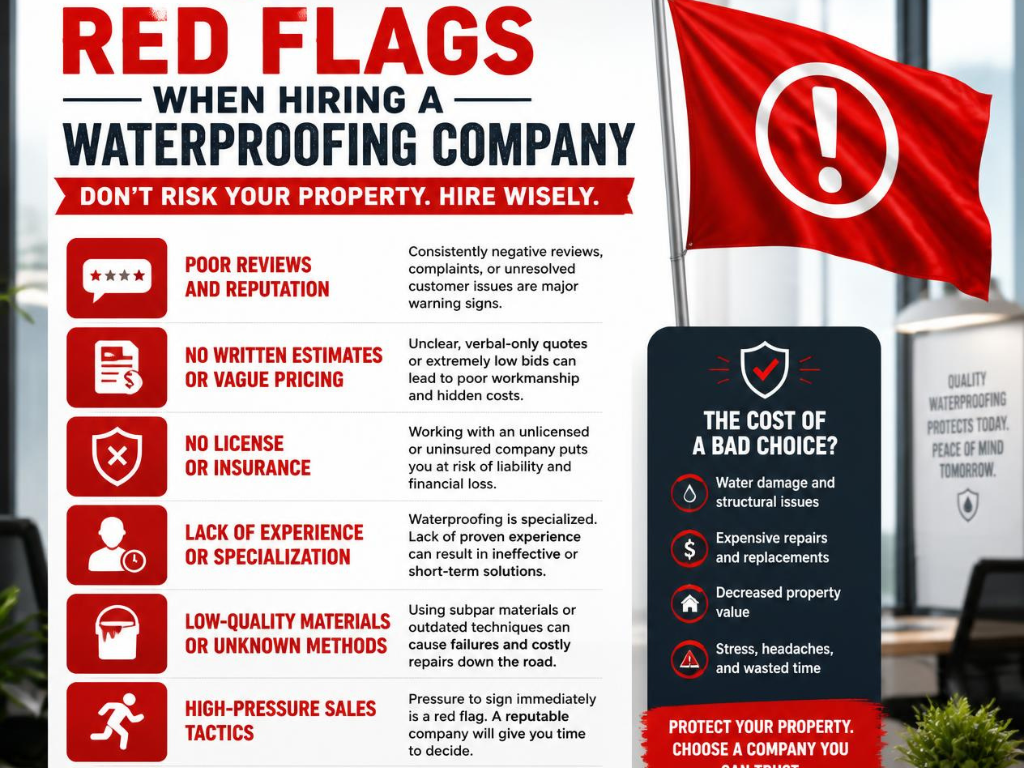
What are the eight red flags, and which ones are disqualifying?
Three of the eight end the conversation on their own. The other five are cumulative, and two of those together are enough to keep looking.
| # | Red flag | Weight |
| 1 | No BCA CR13 registration, and no explanation of who employs the crew | Disqualifying |
| 2 | A quote issued without a site inspection | Disqualifying |
| 3 | A price far below the other quotes, or cash-only terms | Cumulative |
| 4 | Vague scope with no membrane brand, thickness or surface preparation | Disqualifying |
| 5 | No written warranty, or a verbal one | Cumulative |
| 6 | No public liability or work injury compensation certificates | Cumulative |
| 7 | No physical address, no UEN on the paperwork | Cumulative |
| 8 | No portfolio you can verify | Cumulative |
Ranking them matters because a thin portfolio and a missing UEN are not the same problem. A two-year-old firm with a small portfolio can be excellent. A firm that will not put its UEN on a quotation has made a decision about being findable.
Red flag 1: no BCA CR13 registration
CR13, Waterproofing Installation, is BCA’s workhead for waterproofing firms, graded L1 to L6. A firm that cannot produce it, and cannot explain who employs the men coming to your home, is the clearest flag on this list.
The word “unlicensed” gets used loosely here and it muddies the advice. Singapore has no waterproofing licence, and BCA’s CRS Guidelines state that registration is not required to carry out construction work on private sector projects. So an unregistered firm quoting your bathroom is not breaking a licensing rule.
What changed is the workforce position. Since 1 June 2025, the CRS operates as a nation-wide registry and any firm wishing to hire construction S Pass or Work Permit holders must register with it first, whether or not it bids for public work. Almost every waterproofing crew in Singapore is staffed that way. An unregistered firm arriving with a crew is therefore either employing those men outside the rules or subcontracting the job to someone it has not named.
Both answers matter. The first means the men on your property have no employer standing behind them. The second means the firm you are paying is not the firm doing the work, and the warranty follows that gap.
Watch for the deflections. “We partner with licensed firms” means subcontracting; ask for the partner’s name and UEN. “CR13 is not needed for residential” is technically true about the work and silent about the workforce, which is the part that should worry you.

Red flag 2: a quote issued without a site inspection
A waterproofing price cannot be set from photographs. Substrate condition, existing membrane, moisture content, movement cracks, drainage falls and access all change the scope, and none of them are visible over WhatsApp.
Skipping the visit removes the four things that cost money to do properly: substrate preparation, a realistic membrane thickness, access provisions, and any existing damage that expands the scope. A contractor who has not seen those cannot have priced them.
The consequence arrives mid-job. Either the scope changes and the price climbs after you have committed, or the scope quietly shrinks to fit the number, and the shrinkage disappears under screed and tile where nobody will see it for two years.
Proper practice is a pre-quote site visit followed by a written scope that references what was observed: substrate type, existing system, measured area, noted defects. If a firm gives you a final figure over the phone, end the call. There is nothing to discuss yet.
Red flag 3: a price far below the others, or cash-only terms
A quote well below the rest of your set is a specification difference, not a discount. Somebody has priced a thinner membrane, fewer coats, no primer, less preparation, or no ponding test, and the saving is real until the system fails.
Compare specifications rather than totals. Ask the cheapest bidder for the dry film thickness in millimetres, the number of coats, and the surface preparation method, then put those answers beside the other quotes. In practice the gap explains itself within two questions, and you learn more from the answer’s precision than from the number.
Cash-only terms are a separate signal and a worse one. Cash means no receipt trail, no traceable payment, and nothing to produce if the matter ever reaches a dispute. A demand for full payment upfront is the second version of the same problem. Legitimate structure is a deposit, a progress payment when substrate preparation is complete, and the balance only after the ponding test passes, which keeps the final payment tied to evidence that the system works.
Understanding the residential and commercial scope a full job covers makes an underpriced quote easier to spot, because you can see what is missing from it.
Red flag 4: vague scope and no written contract
A scope that does not name the product is not a scope. “Standard waterproofing” and “as necessary” are placeholders that transfer the decision from the contract to the contractor, after your deposit has cleared.
A proper written scope states the membrane system by brand, the dry film thickness in millimetres, the number of coats, the surface preparation method, the primer where one is required, the protection or screed layer, the flood test protocol and duration, and the warranty terms. Every one of those is checkable on site. That is precisely why they get left out.
Thickness is the line worth reading twice. The difference between a 1.0 mm and a 1.5 mm applied system is invisible once tiled and material to how long it lasts, and it is the easiest place to recover margin on a keen price.
Four phrases deserve a direct challenge: “standard waterproofing”, “as necessary”, “typical scope” and “subject to site condition”. None of them are wrong as supplements. All of them are wrong as substitutes for a specification. Ask for each to be replaced with a stated method or quantity, and read what a proper scope covers before you request quotes so you can tell the difference.
Red flag 5: no written warranty, or a verbal one
A verbal warranty is a promise from a company that may not exist in three years. Get it in writing or treat the work as unwarranted.
A warranty document needs six things: a start date, a duration, the surfaces and failure modes it covers, a response time for rectification, what voids it, and the contractor’s UEN and signature. A page with a number of years and nothing else is a marketing claim.
Ask which warranty you are being given, because there are usually two. The manufacturer warrants the material, conditional in most cases on installation by a certified applicator such as Davco, Sika, Ardex or Mapei. The contractor warrants the workmanship. Almost every failure is a workmanship failure, so the second number is the one that protects you and the first is the one that gets quoted.
Where the work is subcontracted, the warranty usually runs to the main contractor rather than to you, which means you have no direct claim against the firm that actually applied the membrane. Ask for the specialist’s warranty certificate issued in your own name. A firm that will not do that has told you where it expects the claim to land.
Red flag 6: missing insurance certificates
Two policies matter, and the one people get wrong is work injury compensation. Public liability covers damage to your property and your neighbour’s. Work injury compensation covers the worker injured on site.
The obligation sits with the employer, not with you. MOM requires employers to buy work injury compensation insurance for all employees doing manual work regardless of salary, and for non-manual employees earning $2,600 or less a month, covering both local and foreign staff. A homeowner engaging a contractor is not that contractor’s employer, so the widely repeated claim that an injured worker can bill the homeowner directly under WICA misreads the Act.
Your actual exposure is simpler and still serious. An uninsured contractor is a contractor with nothing behind it when something goes wrong, whether that is an injured worker or a flooded unit downstairs. A firm skipping statutory insurance is showing you what it does with the costs it thinks nobody checks.
Two verification steps almost nobody takes. Since 1 January 2021 every work injury compensation policy must be issued by a MOM-designated insurer and comply with MOM’s compulsory terms, so confirm the insurer appears on that list. And MOM warns employers against under-declaring headcount, because under-declaration leaves workers uninsured. A genuine certificate can still exclude the men on your job, so ask whether they are inside the declared headcount.
Red flag 7: no physical address and no UEN
A firm that will not put its UEN on a quotation has decided to be hard to find later. That is the whole flag, and it costs nothing to check.
Every Singapore business has a Unique Entity Number, and ACRA’s BizFile lets you search it free to confirm the registered name, incorporation date, directors and current status. Check that the name and UEN on the quotation match the entity you find. Trading names and registered names often differ legitimately, but the two should reconcile when you ask.
A physical office address matters for the same reason. A WhatsApp number and a placeholder website can be discontinued in an afternoon. If the job goes wrong and you need to serve papers, an untraceable contractor means the claim is unenforceable, and the business reopens under a different name with your money. Proseal publishes its company registration and history for the same reason any established firm does.
Company age is the third check on the same screen. A firm incorporated a few months ago has no history of honouring a warranty, which matters when the warranty on offer runs seven years. Not disqualifying by itself, but it should change what else you demand.
Red flag 8: no portfolio you can verify
Any firm with two or three years of trading has completed work it can show you, with photographs, scope summaries and at least one client willing to confirm it. A blanket refusal citing confidentiality across every project is not a policy, it is an absence.
Three patterns are worth recognising. Stock photography reused from other sites, which a reverse image search settles in seconds. Reviews clustered inside a narrow window, forty in a fortnight after months of nothing. And testimonials with no name, no project and no date attached, which cost nothing to write.
What genuine evidence looks like is unglamorous: photographs from several angles including the preparation stage, dated projects with a stated scope, and reviews spread across twelve months or more. The preparation photographs are the ones to ask for, because they show the part of the job that gets skipped.
Ask two questions. Can I see two completed projects of similar scope to mine? And can you get owner consent for me to speak to one of them? A no to both is your answer. Proseal keeps documented past projects precisely so this question has an answer.
What should you do if you have already signed?
Stop further payments first, then create a paper trail before you raise a dispute. Every step after this works better if the request went out in writing.
Send a written request by email asking for three specific things: the CR13 registration details or the name and UEN of the subcontractor doing the work, the full written scope with membrane brand and thickness, and copies of both insurance certificates. A legitimate firm returns these within a day or two. A firm that stalls or refuses has answered a different question.
Check the registration yourself in parallel using BCA’s e-Directory and ACRA BizFile. If the entity is not what the quotation claims, review the contract’s termination terms and consider raising the matter with CASE, the Consumers Association of Singapore, which handles consumer complaints where a contract has soured.
Where work has already started and looks sub-specification, get an independent CR13 firm to inspect before anyone starts removing finishes. Damage escalates fast once tiles come up, and a second opinion recorded early is worth more than a stronger argument made later. The groundwork on picking a contractor properly applies just as much to the replacement as it did to the original.
Conclusion
Seven of these eight flags cost nothing to check and all of them are checkable before a deposit clears. The pattern underneath them is consistent: every flag is a firm making itself harder to hold to account later, whether by staying unregistered, leaving the specification vague, or keeping its name off the paperwork. Accountability is the thing you are actually buying.
Send your property type, the affected area and any existing quotations through the contact form or call 8688 8600. Proseal inspects before quoting, states the system and thickness in writing, and issues the warranty in your name.
FAQs About Red Flags When Hiring a Waterproofing Company
How do I check if a waterproofing company is BCA registered in Singapore?
Search the company name on BCA’s e-Directory and confirm workhead CR13, Waterproofing Installation, appears against the entity. Then check the UEN on ACRA BizFile to confirm the registered name, incorporation date and active status match the quotation. Both searches are free and take under five minutes.
Is it illegal to hire an unregistered waterproofing contractor in Singapore?
No. BCA’s CRS Guidelines state that registration is not required to perform construction work on private sector projects. Since 1 June 2025, though, a firm must be CRS-registered to hire construction S Pass or Work Permit holders, so an unregistered firm with its own crew raises a workforce question.
Why is my waterproofing quote so much cheaper than the others?
Because the specification differs, not the price. Ask the cheapest bidder for the membrane brand, the dry film thickness in millimetres, the number of coats and the surface preparation method, then compare those four answers across all your quotes. The gap usually explains itself in two questions.
Can I get my deposit back if the contractor turns out to be unregistered?
That depends on your contract terms rather than on registration status, since private-sector work does not require CRS registration. Put the request in writing, keep the paper trail, review the termination clause, and raise the matter with CASE if the contractor will not engage. Legal advice is worth taking before escalating further.
How do I know if my waterproofing contractor is subcontracting the work?
Ask which CR13 firm will apply the membrane and request its UEN in writing. Then check whether the crew that arrives matches the entity named. Manufacturer applicator certification from Davco, Sika, Ardex or Mapei attaches to the firm doing the application, so ask whose certificate covers your job.

Sorry, the comment form is closed at this time.